Training the next generation
Western Michigan University’s Tom Howe has spent 15 years connecting hydrogeology students with working drillers and real-world field experience.
Tom Howe’s unconventional path from a Michigan fruit farm to WMU helped shape an educator who has trained more than 500 students while strengthening ties between geoscience and the drilling trades.
Key Takeaways
- WMU honored Tom Howe for a career built around hands-on hydrogeology education and workforce development.
- His field-focused teaching helps future geologists understand drilling operations and collaborate more effectively with contractors.
- Howe’s legacy is the more than 500 students he has prepared for careers in geoscience and drilling.
When Tom Howe stepped up to the podium in Rood Hall on a Friday afternoon in early October to accept the 2026 Distinguished Alumni Award from Western Michigan University's Department of Geological and Environmental Sciences, the room was already full of his legacy. Packed into the lecture hall seats were colleagues, former classmates, family members, and dozens of students whose careers had been shaped by his hands-on, no-nonsense approach to discovering the subsurface.
His career reflection lecture was fittingly titled The Road He Didn't Plan. It was so much fun to follow Tom's winding, improbable path from a small-town fruit farm to leading one of the premier hydrogeology field programs in the country. Beyond students and academia, Tom means so much to the groundwater, environmental, and geotechnical industries. In an academic world that all too often keeps the mud, steel, and diesel of the drilling trades at arm's length, he has spent the past 15 years bridging the gap between the university lecture hall and the drill rig platform.
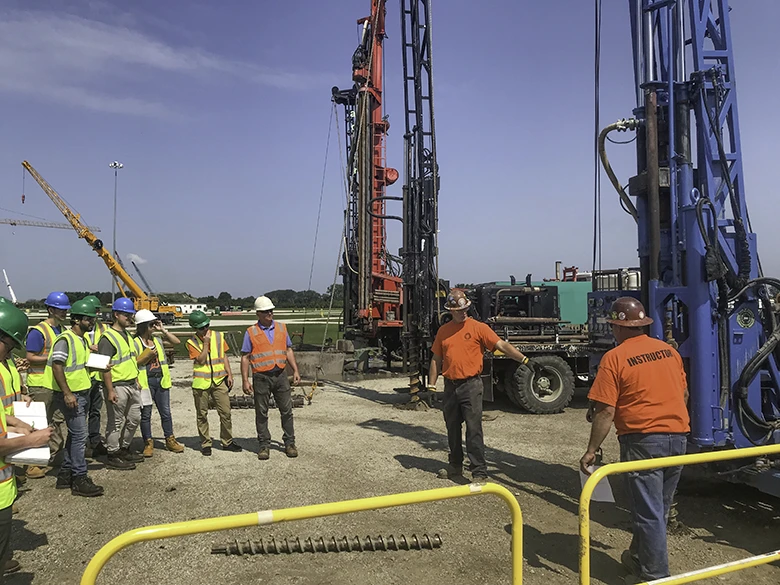
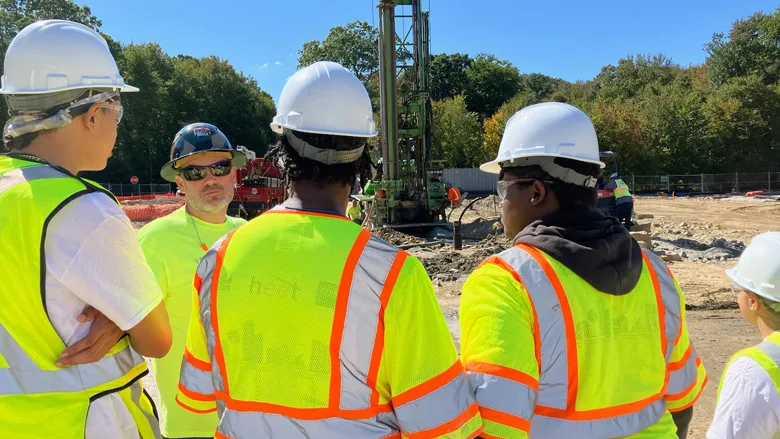
Tom Howe watches Dave Bowers, trainer at Local 150, talk about geotechnical drilling.
Photo: Brock Yordy
Howe, He Got from Farmhouse Laboratory to Water, Rocks, and Drilling
Howe didn't take a straight line into hydrogeology. Born in downtown Kalamazoo at Bronson Hospital on January 23, 1978—right in the middle of the legendary Midwest Blizzard of ’78—family lore holds that his parents had to bring him home on a snow machine because the roads were completely impassable. He grew up with his brother, Jeff, in an 1850s farmhouse in Mattawan, Michigan, on land their German-speaking Pennsylvania Dutch ancestors had homesteaded.
On that heritage fruit farm, surrounded by vineyards contracted to grow juice grapes for Welch's, Howe's childhood imagination ran wild. Long before he knew terms like hydraulic conductivity, vadose zone, or aquifer drawdown, the old farmhouse served as his first laboratory. He spent rainy days sitting on the porch, watching water run off the roof, erode miniature channels, pool into puddles, and slowly infiltrate the sandy Michigan soil. Out by the well house and barn, he and Jeff would run a garden hose down the hillside to watch braided rivers form in the dirt—or jam the hose directly into the ground at full throttle to watch subsurface pressure force borehole instability.
His first real taste of geology was a high school elective in Grand Canyon Geology taught by Dane Alexander, sparking an early affinity for rocks, rivers, and quarry trips in the school station wagon. Although great memories were made, a traditional four-year degree right out of high school wasn't in the cards. Accepted to Michigan State University to study horticulture, Howe felt like a small fish in a massive pond, scraping by on student loans and returned bottle deposits. Near the end of his first fall semester, before finals even started, a buddy knocked on his dorm door and announced they were taking a road trip to Mexico right that minute. Wearing only a pair of heavy Sorel winter boots and carrying virtually no money, Howe headed south. For two weeks, he slept in hammocks and on beaches, befriended film students in Guadalajara, watched scientists collect sea turtle eggs, and survived a terrifying near-drowning in an ocean rip current.
Soon after returning home to Michigan, tragedy struck when his mother passed away from cancer. Needing direction, Howe took a job restoring furniture and handling estate displays at a family friend's antique store, then spotted a Kalamazoo Gazette article about the Michigan Civilian Conservation Corps, an AmeriCorps program stationed in Baraga County in the western Upper Peninsula.
Trading southern Michigan for a work camp near the Keweenaw Peninsula, Howe learned the value of grit, physical trades, and crew leadership. Tapped to run the state park sign shop, he ripped, glued, and sandblasted heavy cedar boards before leading field crews across the state to pour concrete foundations and lay stonework. One memorable "side quest" sent his crew into the basement of the historic Calumet Armory, where they hauled more than 300 heavy wooden boxes of rock core to Marquette over two days without dropping a single box. Tom sneaked peeks at the banded iron formations inside, reinvigorating his passion for geology.
After completing two full AmeriCorps terms, returning to Kalamazoo, becoming a father, and spending five years building and installing commercial signs, his boss, Mark Ranch, sat him down for a five-year review and told him plainly: "You're way too smart to stay here." At 28, with his hard-earned AmeriCorps tuition grants about to hit their seven-year expiration date, Howe enrolled at Kalamazoo Valley Community College, powered through Calculus II, and transferred to WMU to study hydrogeology.
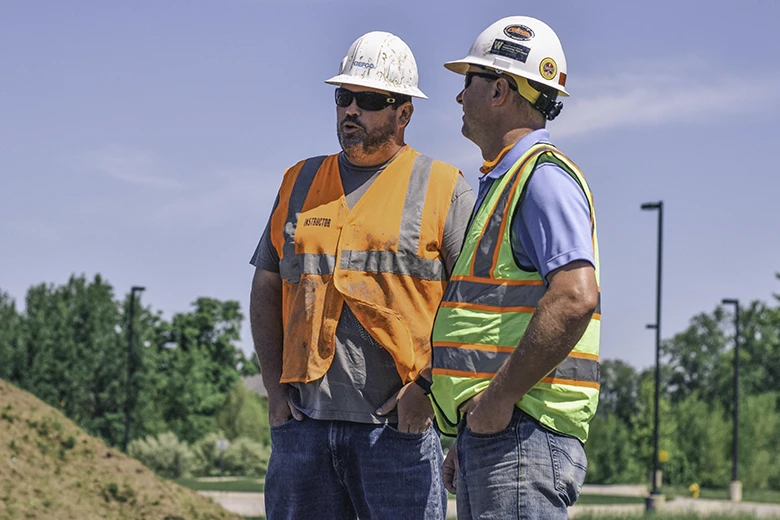
Brock Yordy and Tom Howe.
Photo: Brock Yordy
From the Field to the Front of the Classroom
Walking into college classrooms as a 28-year-old Gen-Xer surrounded by younger undergrads could have been intimidating, but Howe's background in the trades proved to be a massive advantage. He already understood time management, jobsite accountability, and how to build things with his hands. He loved every minute of the Hydro Field Camp, not knowing one day he would lead it.
After earning his degree, Howe stepped into environmental and geotechnical consulting at Soil and Materials Engineers (SME). Suddenly, everything from the field course was real. He was out in the elements installing monitoring wells, logging soil cores, pulling underground storage tanks, and working shoulder to shoulder with drilling crews. He thrived on the messy, unpredictable reality of drilling operations, pivoting around Michigan weather, troubleshooting downhole surprises, and taking meticulous field notes.
Tom likely would have stayed in consulting if WMU had not called him back home. With the department facing a wave of faculty retirements and the Hydrogeology Field Course director role opening up, Howe returned to his alma mater—not just to manage the gear and sort through retired professors' rock collections (including the legendary Dr. Christopher Schmidt's basement hoard), but to reshape how future geologists are trained.
Developing Problem Solvers on the Jobsite
Howe's philosophy as an educator mirrors his life philosophy: "Let's go do something and see what happens." He firmly believes students need experiential learning where they get their boots muddy and occasionally fail in the field, because vulnerability builds real-world problem-solving skills.
When he took over WMU's drilling and well construction course, he refused to keep the curriculum confined to whiteboard diagrams. Tom recounted how he took the class to the field: "So I started teaching this drilling and well class. I met people like Brock who introduced me to all these different drilling professionals. I just started cold-calling drilling contractors across the state. To his amazement, the drilling industry answered immediately; companies volunteered to mobilize rigs and crews from across Michigan just to show Howe's students how a borehole is created from start to finish.
That drive to connect academia with working drillers sparked our decade-long friendship. When Tom and I first met, we immediately geeked out over the phone about being Broncos and just missing each other by a semester—I graduated just before Tom started at WMU. Over the past 10 years, we've shared teaching and adventures. We have partnered on numerous drilling projects, hydrogeology field camps, and workforce outreach initiatives designed to bridge the communication divide between the geoscientists designing monitoring or production wells and the drillers installing product and extracting resources.
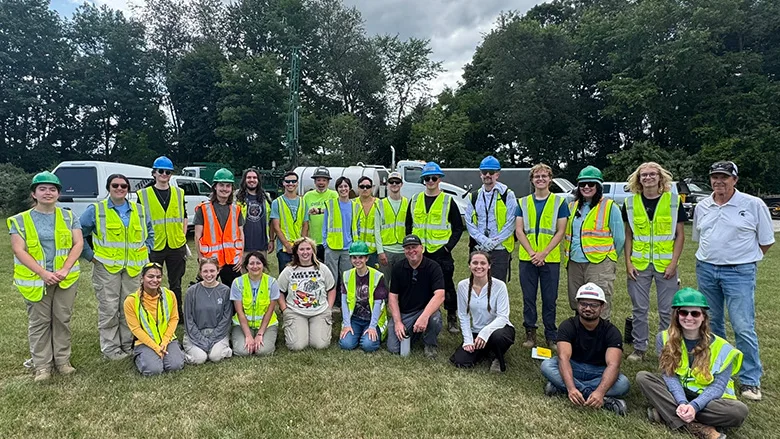
Our collaboration opened the door to adding one more TheDriller.com contributor to the mix: the infamous Dave Bowers and the International Union of Operating Engineers (IUOE) Local 150 world-class training facility in Wilmington, Illinois. For the past eight years, Howe has brought cohorts of students onto a site lined with five or six active rigs operating simultaneously, giving future project managers a visceral understanding of drilling fluids, borehole stability, rig safety, and downhole tooling.
Beyond the field course, Howe has become a vital voice across The Driller platform. Through contributed articles, field features, and appearances on The Driller Newscast and podcast, he has consistently championed the drilling trades, reminding young geologists that the smartest person on a jobsite is often the driller standing at the controls, and that mutual respect on site is the key to successful subsurface science.
Multiplying the Investment
Under Howe’s guidance, WMU’s summer field program doubled to two sessions a year and launched a specialized certificate program, drawing international cohorts from Scandinavia, Denmark, Japan, and Peru. Over the past 15 years, Howe has personally trained and mentored more than 500 students.
His influence stretches far beyond the classroom and jobsite. As advisor to the WMU Geology Club, he has led students on international expeditions to Ireland, Iceland, and Chile's Atacama Desert. In the department's museum, he installed a quarter-operated gumball machine filled with rocks, minerals, and fossils that went viral on campus and funds student club trips. Today, his former students lead environmental investigations, hold green cards in the U.S. geotechnical sector, manage national climate initiatives in Europe, and serve as head resource managers at U.S. National Parks. He even convinced his own son, Ian, to switch his major to geology, while his oldest daughter, Mary, holds two WMU degrees and works in the university's Alumni Advancement Office.
"I really don't just 'do' geology—I help people find their place in geology," Howe told the crowded lecture hall in Rood Hall, pointing to photos of his students and his blended family with his wife, Sarah. "Nobody builds anything in a silo. What am I most proud of? It's not getting an award or a title. It's the people. The detours along the way were the education."
For an industry constantly searching for the next generation of field-ready talent, Tom Howe is far more than WMU's 2026 Distinguished Alumnus. He is living proof that when you take a farm kid who loves watching water run down a dirt hill, teach him the value of the trades, and put him alongside a drill rig, he won't just carve out his own career; he'll bring 500 new professionals into the field right behind him.
Looking for a reprint of this article?
From high-res PDFs to custom plaques, order your copy today!

Brock Yordy, Director of Industry Engagement for The Driller, is a third-generation driller and globally recognized subject matter expert who has written for The Driller since 2013. Driven by a passion for industry education and digital media, he anchors The Driller Newscast and hosts weekly podcasts for the trade. His technical authority is backed by decades of extreme fieldwork worldwide for organizations like Halliburton, SUEZ, and the U.S. Government. Dedicated to ensuring clean water for all and advancing equitable geothermal heating and cooling, Brock actively collaborates with states nationwide through The Developed Well Group and the Geothermal Drillers Association to shape policy, safety, and workforce training.
email: brock@thedriller.com | office: (269) 348-5156