
Baker Water Systems provides trusted water well solutions, pitless units, pumps, filtration, and accessories built for dependable performance, long-term value, and the professionals who keep water flowing.


Built to Spec: Custom Booster Stations for Real-World Water Systems
Water systems rarely operate under ideal conditions. Demand fluctuates, supply varies, infrastructure ages, and operating environments introduce constraints that standard equipment was never designed to handle. Yet many systems are still built around predefined configurations that assume uniformity across applications. The result is predictable, underperformance, inefficiency, and long term reliability challenges.
A different approach is required. One that begins not with a product, but with the system itself.
Since 1873, Monitor, a division of Baker Water Systems, has taken that approach. With a legacy rooted in groundwater innovation, including pioneering the pitless booster design, the focus has remained consistent, engineering solutions that respond directly to real world conditions. Today, that same philosophy extends into above ground pump stations through custom skid mounted packaged booster systems designed around specific system design parameters.
Engineering Begins with the Application
Every water system has its own operating profile. Flow rates, pressure requirements, intake variability, infrastructure layout, and environmental factors all influence performance. Treating these variables as fixed inputs into a standard design often leads to inefficiencies that compound over time.
Custom engineered booster stations shift that paradigm. Instead of forcing the system to adapt to the equipment, the equipment is designed to match the system. Each packaged booster is built to order, configured around the precise hydraulic and operational requirements of the application. This ensures that performance is not only achieved at commissioning but sustained across varying operating conditions.
The ability to engineer around system design parameters allows for flexibility across a wide range of applications, from municipal water distribution to industrial processes and complex infrastructure systems. It is not about offering multiple standard options. It is about delivering a solution that is inherently aligned with how the system is expected to perform.
Configurable Pumping Systems for Performance and Redundancy
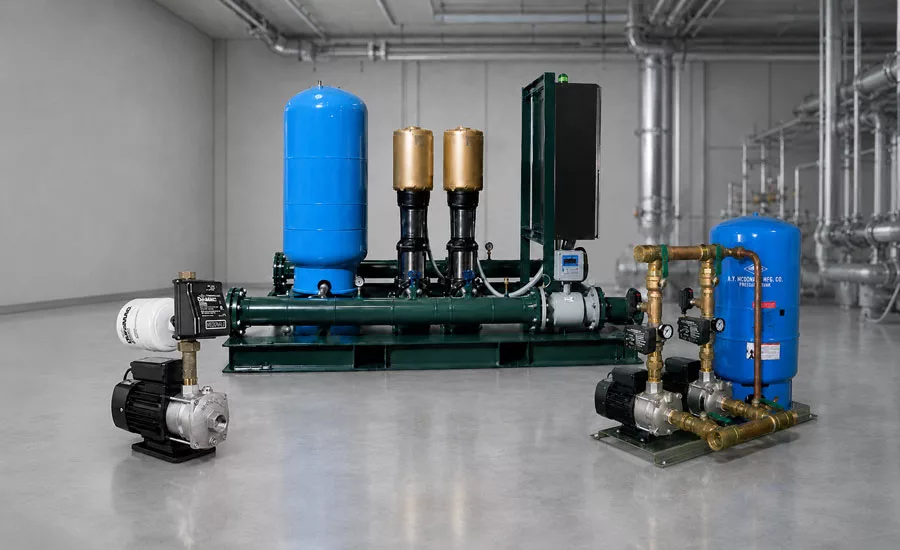
At the core of any booster station is the pumping configuration. Monitor’s packaged booster systems offer a wide range of pump selections, including horizontal and vertical centrifugal pumps, configured as simplex, duplex, triplex, or quadplex systems depending on the application.
This level of configurability enables precise control over capacity, redundancy, and system responsiveness. For applications where uptime is critical, multi pump configurations provide built in redundancy and load balancing. For systems with variable demand, configurations can be optimized to ensure efficient operation across a broad flow range.
Additional components such as hydropneumatic pressure tanks and flow meters can be integrated based on system requirements, ensuring that the booster station operates as a cohesive unit rather than a collection of independent components.
Precision in Design and Fabrication
Engineering a booster station to match system design parameters requires more than selecting the right components. It demands precision in design and fabrication.
Using advanced parametric modeling tools and CAD platforms, engineering teams develop detailed piping configurations tailored to each application. These designs are supported by 2D and 3D CAD files and comprehensive specifications, providing clarity and alignment across all project stakeholders.
Fabrication follows the same standard of precision. Booster skids are constructed from heavy duty structural steel, designed to withstand the demands of the operating environment. Protective coatings such as fusion bonded epoxy powder provide long term corrosion resistance, ensuring durability over the life of the system.
Fluid piping is manufactured using corrosion resistant materials, including stainless steel or epoxy coated steel. Quality assurance processes, such as holiday spark testing, are used to identify any discontinuities in protective coatings, eliminating potential points of failure before the system is deployed.
All wetted components are built using materials that meet NSF and ANSI standards for safe drinking water, reinforcing the system’s suitability for critical water applications.
Quality Assurance Built into Every System
Reliability in water systems is non-negotiable. To ensure consistent performance, rigorous quality assurance measures are embedded throughout the manufacturing process.
Certified welders, qualified to ASME boiler and pressure vessel standards, execute all structural and piping welds. Each weld is inspected by a certified welding inspector, providing an additional layer of verification and quality assurance.
Hydrostatic pressure testing is conducted on all systems to validate structural integrity and water tightness under specified operating pressures. This ensures that each booster station performs as intended before it reaches the field.
The result is not just a product that meets specifications, but a system that has been validated against real world performance criteria.
Integrated Controls for Intelligent Operation
Modern water systems require more than mechanical reliability. They demand intelligent control and real time adaptability.
Custom control panels, built to UL standards, integrate variable frequency drives to optimize pump performance across varying demand conditions. By adjusting pump speed in response to system inputs, these controls improve efficiency, reduce energy consumption, and minimize mechanical stress on system components.
Advanced control logic, developed using programmable logic controllers, enables continuous monitoring and adjustment based on intake and discharge pressure data. This allows the system to respond dynamically to fluctuations in supply, maintain consistent output, and prevent issues such as low pressure cut offs or excessive cycling.
SCADA compatibility extends this capability further, enabling remote monitoring and control across distributed systems. Operators gain real time visibility into key performance metrics, including pressure, flow rate, amperage, and pump speed, through customizable human machine interfaces.
This level of integration transforms the booster station from a passive component into an active part of the system’s operational strategy.
Designed for Real World Conditions
Water systems do not operate in controlled environments. They face variability in supply, changes in demand, and the constraints of existing infrastructure.
Custom engineered booster stations are designed with this reality in mind. By aligning system design parameters with engineering execution, these systems are able to maintain performance even under inconsistent or challenging conditions.
From handling variable intake pressures to delivering consistent output across fluctuating demand profiles, the focus remains on ensuring that the system performs as expected, not just in theory, but in practice.
End to End Support and Commissioning
Engineering a system is only part of the process. Ensuring that it operates as intended requires proper installation, commissioning, and support.
As part of a complete package, trained factory representatives are available to commission each booster station on site. This ensures that the system is configured correctly, integrated seamlessly with existing infrastructure, and optimized for performance from day one.
This hands-on approach reflects a broader commitment to accountability. It is not enough to deliver a system. The goal is to ensure that it delivers results.
A Legacy of Engineering Excellence
With over 150 years of experience, Monitor has built a reputation for quality, innovation, and engineering expertise. From pioneering groundwater solutions to advancing modern booster system design, the focus has remained on solving real world challenges through practical, engineered solutions.
Custom engineered booster stations represent the continuation of that legacy. They reflect a shift away from standardization toward precision, where every system is designed to meet the specific demands of its application.
In an environment where performance, reliability, and efficiency are critical, this approach is not just beneficial. It is essential.
As water systems continue to evolve, the need for adaptable, high-performance infrastructure will only increase. Standard solutions will continue to fall short in addressing the complexity of modern applications.
Custom engineered booster stations offer a path forward. By aligning engineering with system design parameters, they provide a foundation for reliable, efficient, and scalable performance.
The question is no longer whether customization is required. It is how precisely a system can be engineered to meet the demands placed on it.
That is where true performance begins.
Looking for a reprint of this article?
From high-res PDFs to custom plaques, order your copy today!