Geothermal
The Geothermal Renaissance: Scaling the Subsurface at GRC 2026
The "Geothermal Decade" is no longer a forward-looking prediction; it is an active drilling and construction site.
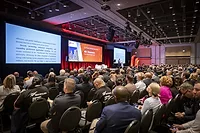
The world's energy capital understands the subsurface. It understands what it takes to move from theoretical ideas to real, steel-in-the-ground infrastructure. That was the resounding message as the 2026 Geothermal Rising Conference (GRC) kicked off in Houston, Texas. For those of us who have spent our lives on drilling projects, the shift in the room was palpable. Geothermal professionals are no longer asking where thermal energy belongs in the energy mix; we are now pushing the limits of how fast we can scale it.
If the geothermal industry were to queue up a soundtrack for this moment, it would undoubtedly feature The Killers. Much like Mr. Brightside, the sector is finally coming out of its cage and doing just fine, stepping fully into the baseload power spotlight. And as we look at the rigs turning and the capital flowing, the collective community can proudly reflect on All These Things That We've Done to make this modern renaissance a reality.
The opening plenary didn't rely on the standard presentation bullet points to prove its point. Instead, it showcased explosive momentum, highlighting a unified industry ready to step out of the shadows and scale up. The "Geothermal Decade" is no longer a forward-looking prediction; it is an active drilling and construction site.
Collective Learning
Robin Zuza, Director of Global Exploration for Ormat, set the tone early, emphasizing that this era of geothermal is less about proving potential and entirely about repeatable delivery at scale. "The future of geothermal will not be built by one perfect well," Zuza noted. "It will be built by what we learn from each of them and how quickly we can make the next one better."
Poem for Geothermal Progress
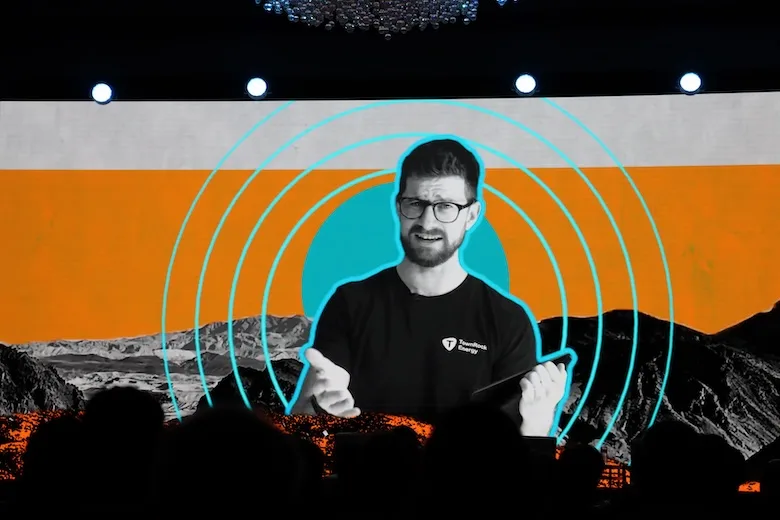
This collective learning curve came to life in a unique spoken-word presentation by David Townsend, with true Edinburgh Fringe Festival flair replacing the traditional state-of-the-industry slide deck. Our Geothermal Poet Laureate, accompanied by a live orchestra, used spoken word to paint an impressive picture of active deployments and technical leaps across the globe:
"A building standing warm inside the snow. Darcy Solutions, 15 states, 70 projects on the go, 130 wells, a resource in the ground. Heat sold as a service. The smallest footprint to be found. In McKinney, Texas, Egg Geo caught the heat thrown away and warmed 4 million gallons of a surf lagoon all day. Draws the districts. Model, plan, design, deliver. COMSOL runs the physics twice before a single bit can shiver. And baseload is the state of play. We build for this, full stop. 90% capacity, 50 years, no drop."
David goes on to showcase the entire industry, with these lines being some of my favorites: "Calpine bringing another 25 megawatts online at the Geysers; Fervo Energy drilling 19,400 feet deep in just 21 days; and companies like Sage Geosystems, Quaise, and Eavor pushing the extreme boundaries of pressure, heat, and closed-loop systems."
A Texas-Sized Demand for Baseload Power
In Texas, the urgency for dispatchable power is acute. Barry Smitherman, Chairman of the Texas Geothermal Energy Alliance, drew a direct line from the state's historical oil boom at Spindletop to the modern geothermal renaissance. The big push comes from the Electric Reliability Council of Texas (ERCOT), which anticipates a staggering doubling of electricity demand within the next five years. The next industrial revolution and the broad deployment of data centers largely drive this. Barry said, "When the sun starts to set, and the wind hasn't picked up, geothermal can fill the gap," recalling extreme weather events that have impacted Texas's electric grid. He goes on to promote applying the oil and gas industry's techniques to harvest thermal energy resources. To accelerate this, the Texas Geothermal Energy Alliance is asking the state legislature for $400 million in seed capital this upcoming session to develop Texas's deep resources further.
Proving the Resource: The Drill Bit Must Meet the Rock
Momentum requires capital, but capital requires certainty. Lauren Boyd from the Department of Energy's applied research programs addressed the critical bottleneck of resource exploration and the federal government's role in compressing the learning curve.
The geothermal sector is currently drilling around 100 wells a year, which is a significant leap from the past, with EGS (Enhanced Geothermal Systems) wells doubling from 24 to 60 over the last year alone. However, to achieve true commercial scale, that number needs to reach into the thousands. Boyd highlighted the DOE's ongoing efforts to reduce early-stage resource risk through research at FORGE and advocating for funding of exploration drilling.
The DOE focused on the industry to evaluate these projects in the field; Boyd's focus on drilling was a refreshing shift from the lab to the rig platform. While digital mapping software tools are incredible for feasibility, they are not replacements for exploration and test holes that give us regional geological expertise. At some point, the model must meet the subsurface. You must turn to the right, put a bit in the ground, and physically prove the flow, temperature, and pressure. Only continuous, real-world data can de-risk projects for the private market.
Community First: Building Resources and Infrastructure
As the industry scales, how we build matters as much as what we build. Alissa Sanchez and Aroha Campbell, representing the Indigenous People's Seat of the Geothermal Rising Board of Directors, delivered a powerful mandate on partnership. Developing sustainable thermal energy resources and infrastructure requires Indigenous communities to be involved at the project's genesis, not merely consulted after the engineering plans are finalized.
"We need to be the drivers of the bus," Campbell emphasized, drawing on her 35 years of experience with geothermal development in New Zealand. True success in building out this critical infrastructure relies on what the working group calls the "1,000 Cups of Tea" approach: engaging in deep, ongoing conversations with landowners and tribal nations to align the value of the reservoir with the long-term prosperity and cultural values of the community.
The Finance Stack: Funding the Renaissance
The final piece of the scaling puzzle is money. Torsten Kolind of Underground Ventures led a candid panel on the evolving geothermal finance stack, featuring Liz Harnmeijer (EIG), Elizabeth Wolfe (DOE Office of Energy Dominance), and Jonathan Sisto (RBC Capital Markets).
The consensus was that the financial sector is fully tuned into geothermal, driven largely by aggressive off-take agreements from hyper-scalers. However, capital markets are still finding their footing in funding the crucial mid-stage development, the "valley of death" between a successful confirmatory well and full commercial field development.
Harnmeijer pointed out that while there is excitement, geothermal financial markets remain fragile. There is a desperate need for standardization in quantifying reserves and creating predictable borrowing bases so lenders can comfortably deploy project finance without needing bespoke engineering teams for every deal. Sisto offered a pointed piece of advice to developers seeking capital: avoid the "bragawatts." Investors are looking for predictable, executable milestones, not theoretical maximums across millions of acres. Developers must show the data, prove the decline curve, and demonstrate that a project can reliably hit its power purchase agreement targets.
As GRC 2026 moves forward, the industry is doing more than celebrate technological milestones; we are actively building the institutional, financial, and community frameworks required for massive deployment. With Pilar Montoya officially stepping in today as the new Executive Director of Geothermal Rising, the organization is uniquely positioned to guide this united front. Driving the geothermal decade requires a deliberate balance of every professional involved in scaling our thermal energy resources and infrastructure. The tools are advancing, the test holes are complete, and the models are proven. The rigs are turning, and the market is calling. To channel The Killers: "We've got soul, but we're not soldiers. We are a unified force of drillers, engineers, geologists, developers, investors, and innovators; together, it's time to build the future of baseload energy.
Want More Geothermal Insights?
Explore the inaugural Ground2Grid Thermal Energy Summit, launching in 2027, and connect with the ideas shaping the future of geothermal energy. Learn more.
Looking for a reprint of this article?
From high-res PDFs to custom plaques, order your copy today!

Brock Yordy, Director of Industry Engagement for The Driller, is a third-generation driller and globally recognized subject matter expert who has written for The Driller since 2013. Driven by a passion for industry education and digital media, he anchors The Driller Newscast and hosts weekly podcasts for the trade. His technical authority is backed by decades of extreme fieldwork worldwide for organizations like Halliburton, SUEZ, and the U.S. Government. Dedicated to ensuring clean water for all and advancing equitable geothermal heating and cooling, Brock actively collaborates with states nationwide through The Developed Well Group and the Geothermal Drillers Association to shape policy, safety, and workforce training.
email: brock@thedriller.com | office: (269) 348-5156