Overheard at Drill Expo 2026
The Real Cost of Doing Business: Leadership, Scaling, and the Professional Driller
Drilling leaders say sustainable growth depends on disciplined scaling, stronger accountability, workforce development and a culture that values people as much as production.
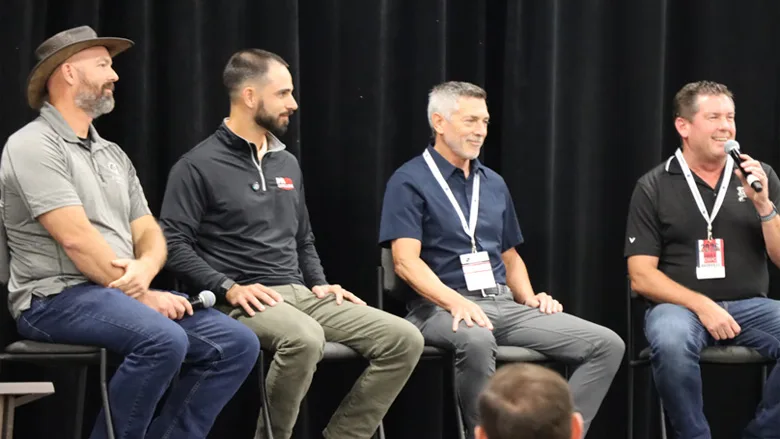
(from left) Greg Smith of Pontil Drilling Services, Luke Mishu of M&W Drilling, Pete Byer of Summit Drilling and Sam Connelly of Connelly and Associates take part in a panel discussion.
Key Takeaways
- Sustainable drilling growth now depends on leadership, structure and operational discipline—not simply more rigs, crews or footage.
- Downtime, burnout and weak communication can cost contractors more than visible expenses while undermining retention and performance.
- Contractors should scale deliberately, normalize learning from mistakes and invest in professional development to build stronger drilling teams.
The environmental drilling industry is undergoing an operational shift. For decades, success was measured by daily footage, fleet size, and relentless drive to the next job. Today, long-term viability requires navigating complex supply chains, economic cycles, and a generational workforce transition demanding a new leadership approach.
During a panel discussion at Drill Expo 2026 moderated by Will Keyes, four industry leaders unpacked these challenges. Pete Byer of Summit Drilling, Luke Mishu of M&W Drilling, Sam Connelly of Connelly and Associates, and Greg Smith of Pontil Drilling Services offered a transparent look at the burdens of business ownership. Their insights delved into scaling psychology, Extreme Ownership on the rig platform, and the meaning of culture.
Here are the critical takeaways from a panel that redefined sustainable drilling enterprises.
The Hidden Costs: Beyond the P&L
When owners enter the space, financial anxiety focuses on obvious items: equipment, fuel, and tooling. However, panelists emphasized that the most dangerous costs never appear on a profit and loss statement.
M&W Drilling highlighted the difference between visible expenses and operational drag.
"It's easy to stare down the P&L and say, materials are killing us... but I actually think the bigger costs are all the days that you're down because equipment isn't running properly or someone calls in sick or there's a safety issue. All these missed days add up... And I think that dwarfs anything you can quantify on the P&L." — Luke Mishu
Beyond financial metrics, the psychological toll of ownership is an unrecorded expense. Leadership means carrying the weight of the company's survival, often at the expense of family.
"The flip side of running a drilling company: the real cost is the sacrifice you make personally. Who's getting that catastrophic call on Saturday during your kid's soccer game? Who's having to go in on the weekend to make sure the big proposals are done? Who is constantly having their attention pulled from their family?" — Luke Mishu
Summit Drilling echoed this sentiment, warning against the illusion of smooth operations. Growth is never guaranteed, and leaders must anticipate unknown variables.
"There is no autopilot in life. And just because you're running smooth today does not mean it's going to stay at that level... It's constantly changing, and you need to prepare for that. You have an incident that occurs and you go, didn't see that coming. Now all of sudden insurance is first in line." — Pete Byer
The Addiction of Demand and Smart Scaling
In a booming market, the temptation to scale is overwhelming. Drilling companies equate adding iron with revenue growth. Yet, panelists warned against "scaling just to scale." Growth without a foundational structure guarantees collapse.
Connelly & Associates shared a candid reflection on his early career, describing the dangerous mindset of capturing every available project without evaluating capacity.
"One of the biggest challenges... was trying to alleviate demand and trying to only say yes, never saying no to anyone. And so never really being proactive to what the economic cycles were. And what that leads you to is it's almost like an addiction. You just keep going and going until your bandwidth is completely shot." — Sam Connelly
To scale intelligently, leaders must recognize when their operational framework is maxed out. Pontil Drilling spoke about the need to pause growth to overhaul internal structures.
"A couple years ago we reached a maximum level of growth that I knew we would structurally need to change the company to really get to that next level. So, we went on a path of getting better at communication, getting better at training, upskilling everyone... so that in that next round of growth I wanted to be able to actually have control of it." — Greg Smith
Summit Drilling added that geographical expansion multiplies overhead in ways rarely anticipated. Adding regional offices doesn't just increase revenue; it exponentially increases demands on the owner's finite time.
Eradicating the Blame Game on the Rig Platform
One critical segment centered on workforce development and how management handles operational errors. When a driller gets stuck at 300 feet, the default reaction has historically been anger. The panel argued for a radical shift toward the morning's keynote speaker, Rob Jones, teaching on Extreme Ownership and post-job accountability.
M&W Drilling championed pushing employees into uncomfortable situations to accelerate development, paired with a culture embracing mistakes as learning opportunities.
"If you're going to push this exposure idea of putting people in situations where they're going to make some mistakes... you have to be comfortable with, 'hey, it's all good, learn from it, but don't make that same mistake again.' You have to disseminate the mistakes. There has to be a culture of not being afraid to share mistakes." — Luke Mishu
Drill crews must know leadership supports their decision-making process. Summit Drilling emphasized that sheltering employees from risk creates a stagnant workforce.
"If you're not going to take any risks, you're not going to be in uncomfortable situations... they're not going to be a better employee or a better driller for it if they feel like they can't make that mistake out there. And as a business owner, you have to plan for that." — Pete Byer
Connelly & Associates summarized the need to manage forward, comparing drilling development to coaching a team.
"If somebody commits a mistake, they can hold on to that for a couple weeks. If the manager's beating on them about that same mistake, you might as well just fire them because you're done. You're not making them any better. You're not going to grow. That mindset and that leadership example is just really important." — Sam Connelly
Culture: The True Meaning of an Open-Door Policy
Retention is arguably the greatest hurdle facing the drilling sector. While competitive compensation is required to keep employees engaged, it is rarely the sole reason a top-tier driller stays.
Pontil Drilling noted financial compensation must be strong enough to remove money as an immediate pain point, allowing culture to take center stage.
"Compensation always has to be top game. If you're not there, you're not going to retain the people you need to... [But] you really try to need to cultivate a positive person that wants to overcome challenges because that's the job. The entire job is just challenge." — Greg Smith
Building that culture requires intentionality. Connelly & Associates delivered an impactful story dissecting what an "open-door policy" demands. Sam described moments when he was buried in work, and an employee would peek in. Previously, his distracted answers signaled he didn't have time. He realized this destroyed morale.
"The time you spent on the phone with that person, turning your shoulders and your body to him when you walk in the door and listening to him. In his mind, he's getting a few moments with the boss... That controls his compensation, controls his days, controls what rig he runs... why wouldn't I want to entertain him for 5 to 10 minutes, spend that time with him and share some true value?" — Sam Connelly
M&W Drilling reinforced this, noting that for field crews who spend weeks away from the shop, a manager's undivided time is the ultimate currency of respect.
The Evolution of the Professional Driller
The panel closed expressing deep optimism for the future. The days of the "ragtag" driller are fading, replaced by skilled technicians serving as technical advisors.
"I think what was once thought of as a ragtag, grab a rig and a truck and go drill, is now being perceived more as a very professional group that really understands what they're doing... the number of times that I hear about drillers solving problems for clients or basically walking clients through a job... it makes you proud." — Luke Mishu
Greg Smith, with Pontil Drilling Services, added that industry digitization, allowing crews to record, transcribe, and share complex site conditions via smart technology, is giving a powerful voice to workers who might not naturally excel at administrative communication.
Ultimately, industry champion Will Keyes and panelists drove home a singular truth: The success of a modern drilling company isn't determined by the depth of its boreholes, but by the depth of its leadership. By taking Extreme Ownership of operational failures, investing in rigorous crew training, and consciously making time to value the people doing the heavy lifting, contractors build legacies that outlast any cycle.
Looking for a reprint of this article?
From high-res PDFs to custom plaques, order your copy today!

Brock Yordy, Director of Industry Engagement for The Driller, is a third-generation driller and globally recognized subject matter expert who has written for The Driller since 2013. Driven by a passion for industry education and digital media, he anchors The Driller Newscast and hosts weekly podcasts for the trade. His technical authority is backed by decades of extreme fieldwork worldwide for organizations like Halliburton, SUEZ, and the U.S. Government. Dedicated to ensuring clean water for all and advancing equitable geothermal heating and cooling, Brock actively collaborates with states nationwide through The Developed Well Group and the Geothermal Drillers Association to shape policy, safety, and workforce training.
email: brock@thedriller.com | office: (269) 348-5156