Uncharted Waters Chapter 1
The Regulatory Blind Spot and Hydrological Reality
As industrial water demand grows, drillers and groundwater professionals can help communities understand and defend interconnected water resources.
Key Takeaways
- Deep and shallow groundwater systems can be interconnected, making industrial pumping and dewatering relevant to nearby wells and surface waters.
- Water well professionals can bring field data and subsurface expertise to local planning, impact studies and groundwater protection efforts.
1. A Jar of Murky Water and the Federal Hands-Off Policy
The deep division in how the United States protects its drinking water came into sharp public focus this year when, during a congressional hearing, Representative Alexandria Ocasio-Cortez held up jars of dark, turbid water collected from private domestic wells in Morgan County, Georgia. Residents living in the shadow of a rapidly expanding data center reported sudden, severe drops in water pressure and water quality so poor it destroyed their household appliances, according to CBS News.
“These families now have to ship water to their house in order to cook and bathe themselves,” Ocasio-Cortez stated, pressing EPA Assistant Administrator for Water Jessica Kramer on what the federal government was doing to investigate.

Democratic Congresswoman Alexandria Ocasio-Cortez holds up jars of dirty water allegedly taken from the taps of Morgan County residents during a hearing in Washington D.C. on May 20.
Photo: CBS Atlanta
Defending the decision to leave water regulations entirely as a state-by-state patchwork, Zeldin stated:
"Ten times out of 10, I'm not going to sit inside of an agency building in Washington, D.C. and say that we know that local community in Georgia or Florida or Arizona or elsewhere, better than everyone there locally."
While Zeldin and federal proponents of the rapid artificial intelligence scaling argue that tech companies will voluntarily solve these issues through "closed-loop" cooling systems, this federal abdication exposes the exact systemic gap that private water wells are completely excluded from the protections of the federal Safe Drinking Water Act (SDWA). While municipal tap water is heavily monitored, tested, and protected under both the SDWA and the Clean Water Act, the federal government has zero regulatory authority over the safety of private wells.
That is a huge message to the water well drilling industry and their nearly 50 million customers, or roughly 1/5 of the United States population, who rely on private wells. These statements have made it clear: when it comes to the safety of private water wells, those families are entirely on their own.
2. The Science of Interconnection: Dismantling the "Isolated Impact" Myth
To defend industrial expansion and to create division, developers and their allies rely on the myth of "isolated impact." The claim is that a data center draws from a deep, cased bedrock aquifer and cannot affect the shallow water table or surface streams that domestic wells and local agriculture rely on. Remember, just last year, Texas citrus farmers sued New Mexico for water consumption upstream of the Rio Grande, and Texas won via a Supreme Court decision.
In a landmark study published in Nature Water, lead author Chen Yang and the University of Arizona's Laura Condon, alongside Reed Maxwell of Princeton University, overturned long-standing assumptions about how groundwater interacts with surface streams across the contiguous United States. Their research revealed two staggering realities:
- Deep-Shallow Coupling: Deep groundwater contributes more than half of the total baseflow in 56% of the subbasins analyzed nationwide, proving that deep aquifers directly sustain surface waterways rather than operating as isolated reservoirs.
- Long-Distance Interconnection: Subsurface flow paths extend far beyond localized topographic divides, with groundwater routinely crossing watershed boundaries and traveling hundreds of kilometers over decades to millennia before discharging into surface streams.
When a data center, heavy industrial site, or commercial development executes deep excavations, alters surface recharge, or pumps millions of gallons from deep formations, it does not act in an isolated vacuum. Under the fundamental laws of hydrogeology and fluid mechanics, drawing down a confined or semi-confined deep aquifer inevitably induces a downward hydraulic gradient, pulling water directly from the unconfined shallow water table above it. Findings from Yang, Condon, and Maxwell show that disrupting a single layer in this interconnected column propagates hydraulic shocks throughout the entire watershed.
To claim that deep commercial or industrial extraction wells have "zero connection" to shallow residential drinking wells and local stream baseflow is not just an operational oversight; it is a scientific falsehood.
3. The Ghost of Vella Pit: When Dewatering Met Local Resistance
In Ann Arbor Charter Township, Washtenaw County, Michigan, a textbook example of this hydrological coupling played out on the ground. Sometime in late 2022, residents in the rural communities surrounding the Vella Pit, a historic sand and gravel quarry purchased and expanded by Mid-Michigan Materials, began noticing their private water wells failing over the course of a year; by the time residents could alert the state of Michigan, several residential wells had gone completely dry.
The culprit? The mine's operators shifted from traditional dredging (which leaves the aquifer intact) to "dewatering", actively pumping millions of gallons of groundwater out of the gravel pit each day to access dry aggregate. The mine was discharging up to 2 million gallons of water daily, with applications filed to more than double that to 4.8 million gallons a day. Even with overwhelming physical proof, including dry wells, drops in static water levels of up to almost 40 feet, and adjacent wetlands flooding, it took the local community and township board nearly a year of organizing, grassroots campaigning, and finally a multi-party lawsuit to secure a temporary restraining order from Washtenaw County Judge Timothy Connors in October 2023 to temporarily stop the dewatering. But that battle, and the lawsuit that followed, took place when the US had a different understanding of and defense of groundwater.
In the past, the communities could point to a giant physical hole in the ground filled with muddy water and make a direct, visible connection between the mine's pumps and their dry wells. It was an intuitive, mechanical cause-and-effect that a local judge and county planning board could comprehend.
Today, in the race to be the high-tech superpower or the automated manufacturing hub of the new world, the threat is heavily sanitized by the promise of progress. Developers shield themselves behind tech jargon, private-to-public water translations, and massive regional legal exemptions, rendering the modern defense of groundwater nearly impossible for the average rural community. Thriving communities with an active voting population of 15,000 or more are not the target. It's the adjacent communities pushing to grow, stabilize local infrastructure, and agree to compromise to provide steady jobs while the system is built. The true question is what happens when the box is complete and automated while consuming utilities and water at unprecedented rates.
4. Ground Truth: Building a United Front for Local Subsurface Defense
Defending our shared groundwater cannot wait for federal intervention; enforcement has already focused on state and local rules. If the regulatory framework leaves private well owners and rural townships to fend for themselves, the best defense is forged at the grassroots level through an active, technical coalition uniting local governments, watershed protection NGOs, community advocates, and state water well associations. When these projects come to your backyard, there is money from the developments to be put in escrow, so that your community can hire your own professionals to do the impact study of very serious consequences. It is up to you to organize the all-star: team that will impact your success.
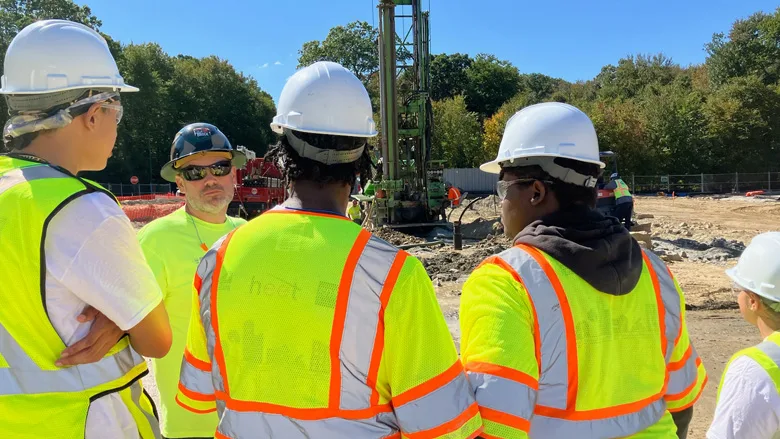
Water well drillers and groundwater professionals have empirical subsurface data, static water levels, geologic borehole logs, and stratigraphy mapping that planning commissions and zoning boards lack. When developers arrive with promises of tax base expansion, local leaders must partner directly with water well associations to scrutinize the full lifecycle burden of these hyperscale facilities before rubber-stamping permits.
Auditing the Total Infrastructure Footprint
Communities must demand absolute transparency across every public utility metric:
- True Consumptive Water Balance: Boards must require third-party hydrological modeling calculating peak drawdown, aquifer recovery rates, and cumulative cone-of-depression impacts on adjacent residential wells.
- Wastewater & Sewer Capacity: Evaporative cooling blowdown water is laden with concentrated minerals, biocides, and corrosion inhibitors. Municipal treatment plants must evaluate whether accepting high-salinity industrial discharge will compromise local sewer infrastructure and downstream surface water quality.
- Grid and Traffic Strains: Beyond immense electrical demands, the logistics footprint, continuous heavy construction traffic, hazardous chemical deliveries for cooling treatments, and auxiliary diesel generator staging demand dedicated municipal impact assessments and enforceable developer-funded mitigation bonds.
Mandating Real Thermal Alternatives
High-tech expansion does not require sacrificing local aquifers. The standard industrial reliance on open evaporative cooling towers, which vaporize millions of gallons of potable groundwater daily into the atmosphere, is an engineering shortcut that minimizes capital expenditures at the expense of regional resource security.
Sustainable, non-consumptive alternatives exist and must be mandated in local zoning overlays: Direct Geo-Exchange & Thermal Energy Systems, which use closed-loop subsurface thermal exchange to reject heat without consuming or evaporating a single drop of groundwater, preserving the integrity of regional aquifers should quickly become a non-negotiable.
When water well contractors, municipal planners, and grassroots environmental advocates sit at the same table, the dynamic shifts. Developers can no longer hide behind corporate ambiguity or isolate landowners one dry well at a time. Protecting the subsurface requires treating groundwater as the irreplaceable community lifeline it has always been, demanding rigorous hydrological accounting before the first foundation is poured.
Looking for a reprint of this article?
From high-res PDFs to custom plaques, order your copy today!

Brock Yordy, Director of Industry Engagement for The Driller, is a third-generation driller and globally recognized subject matter expert who has written for The Driller since 2013. Driven by a passion for industry education and digital media, he anchors The Driller Newscast and hosts weekly podcasts for the trade. His technical authority is backed by decades of extreme fieldwork worldwide for organizations like Halliburton, SUEZ, and the U.S. Government. Dedicated to ensuring clean water for all and advancing equitable geothermal heating and cooling, Brock actively collaborates with states nationwide through The Developed Well Group and the Geothermal Drillers Association to shape policy, safety, and workforce training.
email: brock@thedriller.com | office: (269) 348-5156