Honoring our Veterans
Turning to the Right Under Fire: Honoring the Veterans Who Build Our Subsurface Infrastructure
From Florence, Arizona, to remote drilling operations in the Middle East and Africa, the National Guard and RED HORSE prove why veterans are the backbone of the drilling industry.
Every November, between the Marine Corps birthday on November 10 and Veterans Day on November 11, many of us in construction and subsurface drilling look around our shops, supply yards, and rig platforms and recognize a familiar posture. You see it in the lead driller who stays calm when losses occur at 600 feet. You see it in the mechanic working late in freezing rain to rebuild a mud pump, so the crew doesn't lose a shift. You see it in the contractor who takes full accountability when a project goes sideways.
American veterans are the backbone of heavy construction and drilling. Making up more than 6 percent of the U.S. construction workforce, over half a million strong, transitioning service members bring qualities you cannot screen out of 100 online interviews: situational awareness, mechanical grit, and an unshakeable sense of mission.
Working alongside military drilling units has been one of the highest privileges of my career. While every branch produces men and women built for the trades, a select fellowship has worn both uniforms at once, serving on the rig stateside and abroad. Today, we salute all veterans in construction and drilling, with a special callout to the soldiers of the 243rd and 802nd National Guard water well drilling units and the airmen of the 819th, 820th, 823rd, and combined 555th RED HORSE water well drilling teams.
Citizen-Soldiers Turning Bits to the Right: The 243rd and 802nd National Guard
Being a National Guard water well driller demands rare toughness. One month, you work your civilian job back home; the next, you mobilize a rotary rig into unforgiving geology overseas with zero supply house down the road if you twist off or burn up a bit.
Working with the 243rd, whose Maryland National Guard Engineer Support Platoon out of Cumberland gave me a camouflage hard hat I still take immense pride in, and the 802nd National Guard water well drillers is a masterclass in crew cohesion. Whether cutting teeth on winter training holes in snowy central Indiana or deploying into the drought-impacted extreme heat of theaters abroad, Guard detachments understand the mission-critical stakes of groundwater.
In civilian drilling, a dry hole or a poorly producing well is an expensive headache. For the soldiers of the 243rd and 802nd, potable water is force protection, humanitarian relief, and regional stability rolled into one borehole. When these crews rig up, mix mud, and set screen, they deliver life-sustaining infrastructure where clean water changes everything.
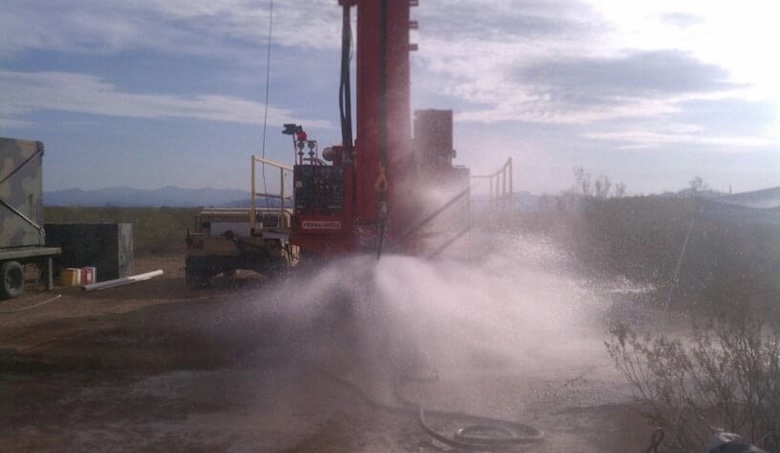
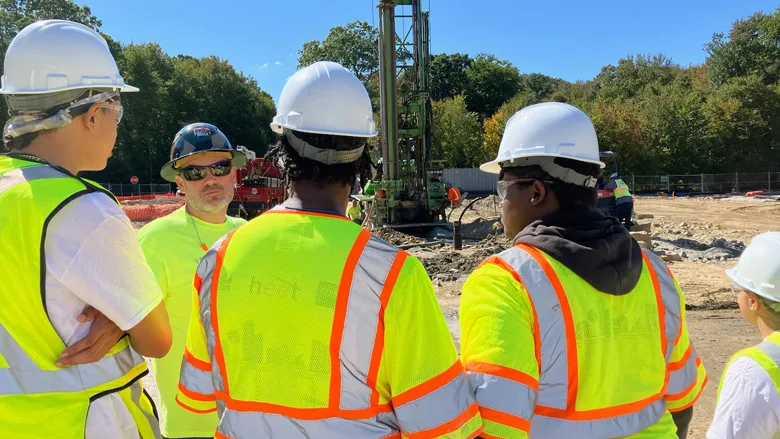
Successful training mission in Florence, AZ, to develop a fire-suppression water well.
Image: Brock Yordy
Airborne and Downhole: The 819th, 820th, and 823rd RED HORSE Squadrons
If recruiters told every young professional seeking a career in water wells that they could load drilling equipment into a C-130, drop into remote corners of the globe, and drill deep-water wells, our industry wouldn't have a workforce shortage. That is the reality of the U.S. Air Force's RED HORSE—Rapid Engineer Deployable Heavy Operational Repair Squadron Engineers.
Self-sufficient and built for expeditionary construction, the water well drillers of the 819th RED HORSE (Malmstrom AFB, Montana), 820th RED HORSE (Nellis AFB, Nevada), and 823rd RED HORSE (Hurlburt Field, Florida) represent the pinnacle of tactical subsurface engineering.
It has been a pleasure watching airmen step onto a training site and watching disciplined professionals fall in love with the craft. Give them 50-pound bags of bentonite timed through a hopper, a Marsh funnel, and a Fann fluid testing kit, and by day two, they trade fatigues for mud-covered overalls with Christmas-morning energy. Rotating seamlessly between the controls, solids control, rig tending, and fluid testing, every airman learns to turn the bit to the right with surgical precision.
These RED HORSE units continually train to pull off the improbable in high-stakes theaters by planning for every situation, from bringing rigs online under pressure in the Middle East to completing deep-water wells for tactical locations in Africa. These airmen develop insertion plans for humanitarian missions across the globe. They execute through problematic formations, so clinics, schools, and forward airfields have reliable water.
Proving the Fundamentals in Florence, Arizona
If anyone doubts what happens when military discipline meets true drilling fundamentals, I want to take you back to one of my fondest training missions in the sunbaked ground of Florence, Arizona. Out in the lower Sonoran Desert, where blistering heat and live-fire ranges make reliable water a matter of survival and range safety, a commercial drilling company had previously mobilized, punched a 1,000-foot hole, come up empty, and demobilized, calling it a dry hole.
In production drilling, when the clock is ticking, that happens too often. Drill to a targeted production zone, blowing past a low-yielding zone without enough time to evaluate cuttings, and a formation can appear bone-dry.
Then came a joint training mission on that exact location, bringing Army and Air Force drillers shoulder-to-shoulder on site: the 802nd National Guard alongside the 820th RED HORSE. With no branch egos and a plan to methodically evaluate the subsurface, those soldiers and airmen executed tactical drilling fundamentals: clean cutting action, disciplined cuttings removal, monitored fluid properties, and accurate sample logging.
Where a commercial crew had written off the geology as barren, the combined 802nd and 820th team pulled water from the desert and completed a working fire suppression well. They didn't have magic geology; they had patience, science, and crew accountability.
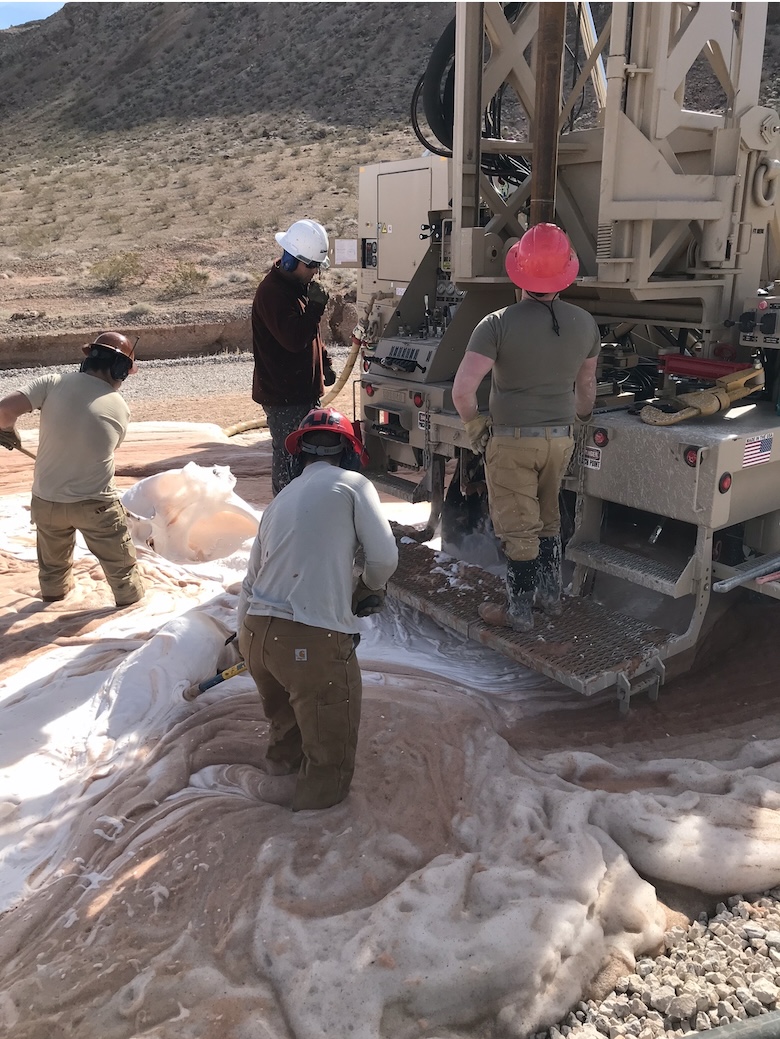
820 RED HORSE trains with drilling foam.
Image: Brock Yordy
American Rig Manufacturers Drilling Overseas
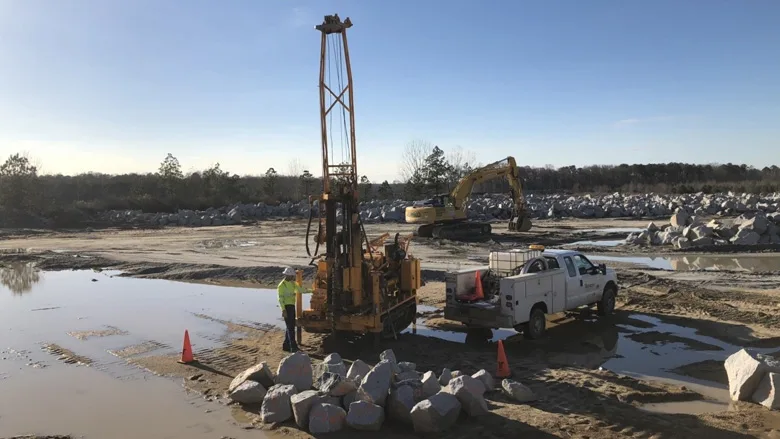
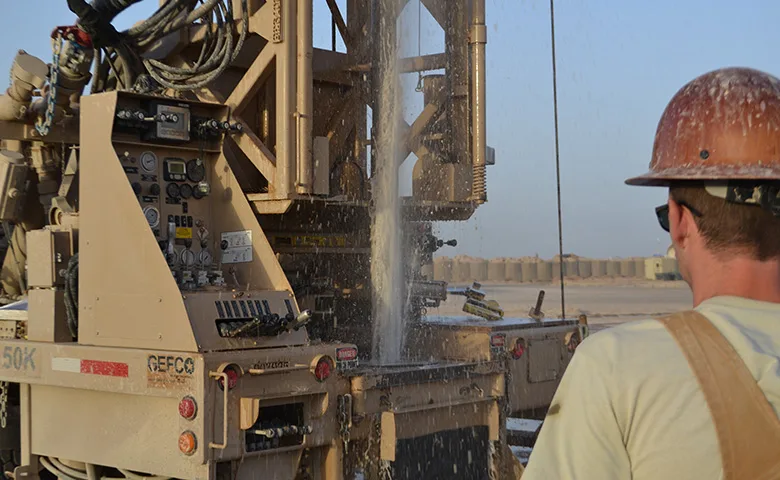
Behind every military borehole is a logistics story civilians rarely see. You cannot load a county-road water well rig onto a transport plane, drop it into a combat zone or sub-Saharan desert, and expect it to survive. Taking groundwater capability to the Middle East and Africa required purpose-built American iron, most notably the Versa-Drill V-2000 and the GEFCO trailer-mounted 50K.
When the Army National Guard needed rapid-deployment rigs, Laibe Corporation's Versa-Drill answered with military-spec V-2000 packages. Built to handle global subsurface conditions, those V-2000s met brutal specs not only for drilling but also for air and land transport across developing countries. These V-2000 fleets carried Guard and Army drillers across rocky Afghan riverbeds and remote African villages, thousands of miles from factory support.
To meet compact deployment demands, the RED HORSE squadrons chose a trailer-mounted GEFCO 50K, a rig package with double-line hoist capacity, the classic lattice mast, and a table built for heavy casing strings. These rigs keep turning right through unforgiving formations for strategic missions anywhere a loadmaster can design a safe landing.
From the Tactical Rig Platform to the Civilian Workforce
What makes veterans from the 243rd, 802nd, 819th, 820th, and 823rd, alongside every Marine, soldier, sailor, and airman in the trades, so vital to water well, geotechnical, environmental, and geothermal drilling?
It comes down to embracing the science and fundamentals of drilling along with the military discipline of planning to never fail. You don't have to explain to a veteran why pre-shift inspections matter, why PPE isn't optional, or why concise jobsite communication keeps fingers and lives intact. When the military deploys a drilling mission, everyone learns every station, and post-job after-action reviews (AARs) are not about blame; they are about drilling the next hole safer and faster to provide a mission-critical resource.
As America confronts aging water infrastructure, scales the adoption of thermal energy, and extracts critical minerals, hiring a transitioning service member isn't charity; it is the smartest safety and operational investment a contractor can make.
To all my peers and friends at the National Guard, the U.S. Air Force RED HORSE, and every veteran running heavy iron on site every day: thank you for holding the line overseas and thank you for building critical infrastructure at home. We are proud to share the jobsite with you. Keep turning to the right.
Looking for a reprint of this article?
From high-res PDFs to custom plaques, order your copy today!

Brock Yordy, Director of Industry Engagement for The Driller, is a third-generation driller and globally recognized subject matter expert who has written for The Driller since 2013. Driven by a passion for industry education and digital media, he anchors The Driller Newscast and hosts weekly podcasts for the trade. His technical authority is backed by decades of extreme fieldwork worldwide for organizations like Halliburton, SUEZ, and the U.S. Government. Dedicated to ensuring clean water for all and advancing equitable geothermal heating and cooling, Brock actively collaborates with states nationwide through The Developed Well Group and the Geothermal Drillers Association to shape policy, safety, and workforce training.
email: brock@thedriller.com | office: (269) 348-5156