Leadership
Extreme Ownership from the Front Lines to the Rig Platform
What Rob Jones Teaches Us About Leadership
Key Takeaways
- Marine veteran Rob Jones connected military leadership principles directly to safer, stronger drilling operations.
- Clear communication, emotional control, trust and ownership can prevent mistakes, downtime and crew conflict.
- Drilling companies can strengthen leadership and recruiting by empowering crews and proactively connecting with veteran organizations.
From environmental monitoring to foundation boring, Veterans have long found a natural home in the drilling industry. Many who started as a temporary first job after returning home have gone on to supervise multi-rig spreads and build thriving drilling enterprises.
Military service and drilling share a unique cultural DNA: arduous conditions, heavy machinery, unpredictable environments, and absolute reliance on the person standing next to you. Yet, while mechanical aptitude earns a spot on a crew, hard skills don't separate average contractors from exceptional ones. What truly determines success on the ground is leadership, specifically, communication, emotional control, and mutual trust.
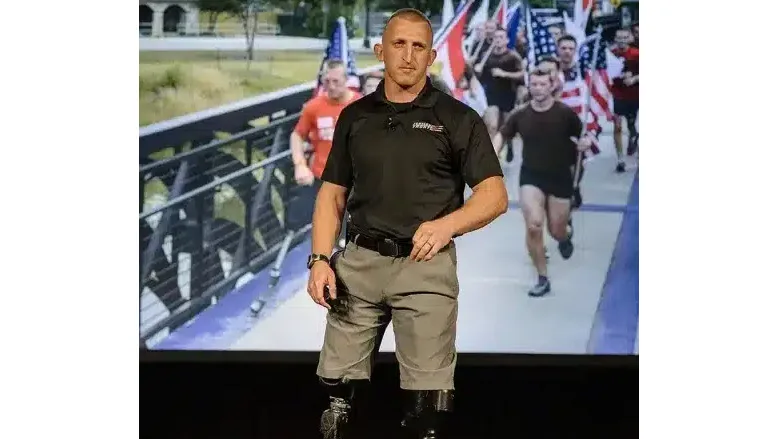
When combat-wounded Marine veteran Rob Jones addressed the National Drilling Association (NDA), he laid bare the profound connection between battlefield survival and workplace performance. Jones, who lost both legs to an improvised explosive device (IED) in Afghanistan in 2010, didn't pitch determination or grit as the primary differentiator between failure and success. He pointed straight at leadership.
For an industry constantly grappling with workforce recruitment and site safety, Jones's message delivered a blueprint for developing better leaders and highlighted why veterans remain one of our greatest assets.
The Soft Skills Bridge: Why Technical Problems Are Leadership Problems
A common misconception in heavy trades is that leadership belongs exclusively to the front office or the lead driller. Jones dismantled that notion. A leader is simply any human being who interacts with another human being. Because every challenge on a drilling project involves people, whether coordinating with general contractors or directing a green hand, every technical problem ultimately demands a leadership solution.
Consider the military principle of Cover and Move, which translates directly to teamwork. When Jones swept a minefield with a metal detector, he could not carry a rifle; he was exposed and counted on his fellow Marines covering his flanks.
On a drilling project, crews easily slip into organizational silos: drillers blame support drivers, and field hands blame estimators. Silos destroy operations. The tool that bridges those gaps is relationships. Veterans understand this intrinsically. In the military, rank gets compliance, but relationships earn commitment. When a driller builds genuine relationships with helpers and superintendents, people step up on their busiest days to solve problems before they turn into costly downtime.
The Georgian Army Lesson: The Danger of Overcomplicating the Mission
One of the most memorable moments of Jones's presentation centered on a hard-learned lesson from Afghanistan, where he was tasked with training Georgian army soldiers to find IEDs using metal detectors. Eager to prove his credibility, Corporal Jones drafted an extensive curriculum. The immediate hurdle: they spoke no English.
During the presentation, Jones pulled me on stage to act as the interpreter. He launched into the exact speech he gave back then, rattling off technical jargon about pressure plates and explosive chemical compounds. When asked to summarize, I answered quickly and honestly: "It goes boom."
That exercise illustrated a trap drillers and company owners fall into daily. When delivering morning tailgate briefings, leaders often pack directions with unnecessary technical jargon and ego-driven detail to prove their expertise. The result is blank stares and zero comprehension.
When Jones recognized his failure, he simplified the lesson to its bare operational core: pressure plate, battery, big jug of explosives. Instantly, the concept was executable.
On a drill rig, complex briefs confuse. When assigning tasks, leaders must communicate in simple, clear, and concise terms. True expertise isn't demonstrated by making simple work sound complicated; it is proven by making complex work simple enough for anyone to execute safely.
Detachment Under Pressure: Prioritize and Execute
When Jones stepped on that IED, the blast introduced instant chaos. His squad leader, Shane, faced an overwhelming crisis: secure the perimeter, call medevacs, communicate with higher headquarters, and administer trauma care to a wounded brother in a live minefield.
Every emotional instinct screamed at those Marines to sprint forward and pull Jones out. But emotional reactions in high-stakes environments are disastrous. Rushing in would have triggered secondary buried charges.
Instead, Shane had to detach.
Jones emphasized that detachment is a physical and mental discipline: take a step back from chaos, relax, look around, and make a call. Shane prioritized the most critical objective: security. Once the ambush threat was handled, he called a combat engineer to clear a safe path to Jones methodically.
In drilling, Mother Nature's cooperation is optional. Fragile sands cave in, drill strings get stuck, and hydraulic hoses fail. In high-stress moments, an untrained operator reacts emotionally, forcing rig controls and turning a setback into a failure. Leaders must practice detachment. Stepping back, assessing the full scope of hazards, and executing one solution at a time keeps crews safe and iron intact.
Decentralized Command and Extreme Ownership
The Marines who stabilized Jones didn't take step-by-step orders from a distant battalion commander. They were junior Marines trained to make decisions because they understood the overarching why behind their mission.
When drilling business owners give crew members the context behind a project, explaining why a specific grout is vital to groundwater protection or why decontamination matters after a Superfund project, they empower workers to act decisively when challenges arise.
Field Questions: Navigating Ego and Veteran Recruitment
During the open discussion, drillers brought forward practical questions about translating these battlefield principles to the rig platform. When asked about the biggest internal barrier to adopting Extreme Ownership, Jones pointed directly to the human ego. Admitting a mistake often feels like a loss of identity, especially for individuals who pride themselves on their specific technical expertise. However, Jones challenged the audience to adopt a higher-level identity: becoming a leader who takes responsibility for shortcomings and improves future operations rather than reflexively defending their pride.
This ego-driven friction is often at the core of dealing with difficult coworkers. Jones emphasized that when interpersonal conflicts arise, the first step is checking your own ego and recognizing that everyone on the site is working toward the same mission. Crew members do not need to be best friends, but they must cultivate strong working relationships based on mutual respect to ensure the team succeeds.
The conversation also tackled actively bringing more veterans into the drilling workforce. Jones noted that heavy trades are a natural fit for transitioning service members accustomed to hard work and highly interdependent team environments. For companies looking to recruit this talent pool, he advised being highly proactive. Drilling businesses should reach out to veteran-focused nonprofits like Hire Heroes, connect with local VA offices to provide company resources, and clearly communicate the shared operational values their company offers.
Ultimately, Jones left the NDA membership with a clear mandate: whether sweeping a path through a hazardous environment or managing a complex drilling operation, true leadership requires stepping up, setting ego aside, taking full ownership of the outcome, and ensuring the entire team can execute the mission safely.
Looking for a reprint of this article?
From high-res PDFs to custom plaques, order your copy today!

Brock Yordy, Director of Industry Engagement for The Driller, is a third-generation driller and globally recognized subject matter expert who has written for The Driller since 2013. Driven by a passion for industry education and digital media, he anchors The Driller Newscast and hosts weekly podcasts for the trade. His technical authority is backed by decades of extreme fieldwork worldwide for organizations like Halliburton, SUEZ, and the U.S. Government. Dedicated to ensuring clean water for all and advancing equitable geothermal heating and cooling, Brock actively collaborates with states nationwide through The Developed Well Group and the Geothermal Drillers Association to shape policy, safety, and workforce training.
email: brock@thedriller.com | office: (269) 348-5156