Geothermal News
Yale Completes 263-Borehole Geothermal Field Beneath Science Hill
Crews drilled 263 boreholes to depths of 850 feet as part of a district geothermal system that will heat and cool the university's research buildings.
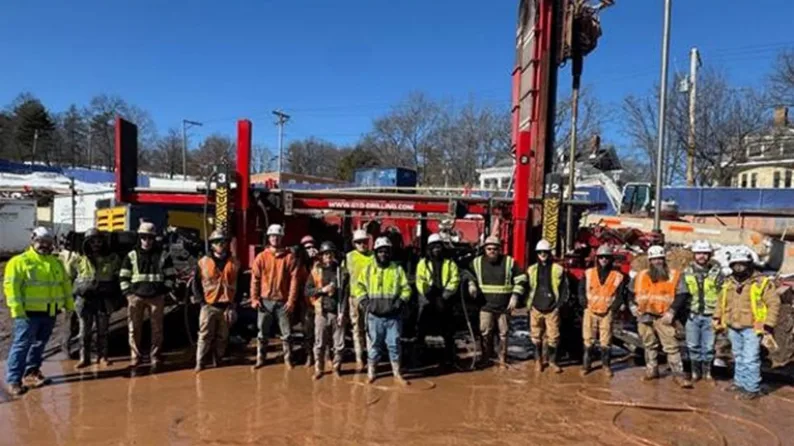
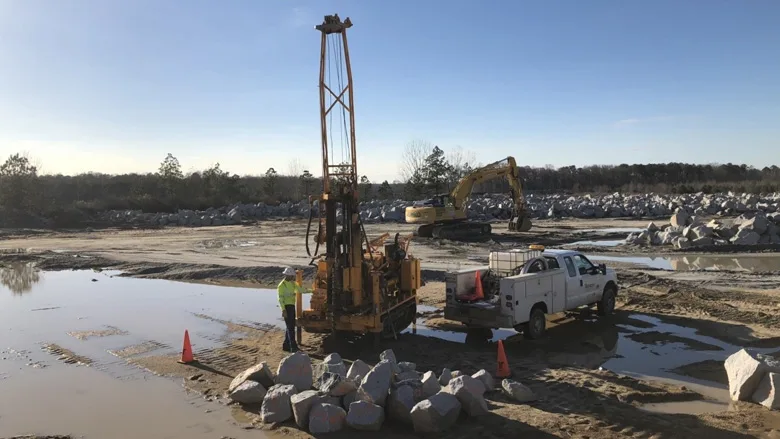
After nearly two years of drilling, Yale University has completed a major geothermal borefield beneath its Science Hill campus, including 263 boreholes reaching 850 feet underground.
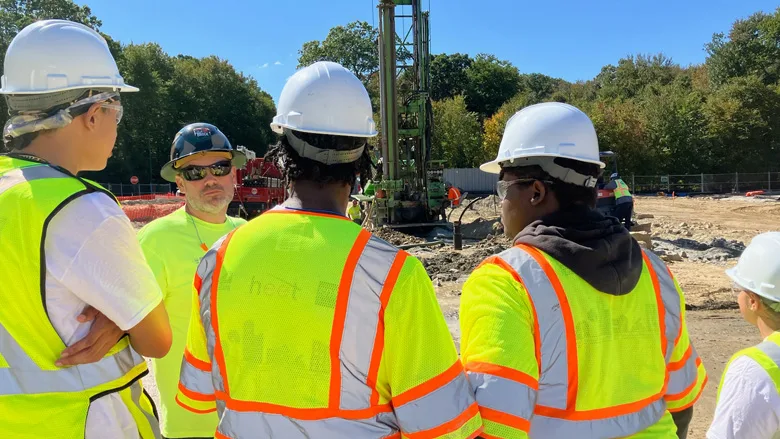
Crews drilled the boreholes between August 2024 and March 2026 as part of Yale’s Upper Science Hill Development, a roughly 600,000-square-foot campus project that includes a new Physical Sciences and Engineering Building, Advanced Instrumentation Development Center and supporting infrastructure.
The borefield will eventually connect to a new Thermal Utilities Plant and help provide heating and cooling to the new building and five existing research laboratories.
For drillers, though, one of the more interesting parts of the project may be how crews managed to fit such a large borefield into a relatively small and complicated jobsite.
Unlike a conventional geothermal installation, where boreholes can be drilled vertically and spaced roughly 20 to 25 feet apart, the Science Hill site had limited available land and existing underground infrastructure to work around.
The solution was to drill at angles ranging from 5 to 20 degrees. That allowed crews to keep the boreholes relatively close together at the surface while spreading them farther apart underground, essentially creating a fan-shaped borefield beneath the campus.
According to Yale, the approach reduced the surface footprint of the borefield by about 44%.
Once drilled, crews installed closed-loop piping and sealed the boreholes with thermally conductive grout. Altogether, Yale says the underground piping would stretch more than 88 miles if laid end to end.
The project also offered some familiar lessons for contractors working on large geothermal jobs.
Test bores conducted early in the project helped crews gather thermal information and better understand construction conditions before moving ahead with the full borefield. Managing drilling spoils also became a significant part of the operation. With hundreds of deep holes being drilled on a constrained campus, crews used settling tanks and centrifuges to handle the water and rock debris coming out of the boreholes.
Then there was the weather.
During freezing conditions, crews erected heated tents to prevent water used during drilling operations from freezing. Production also improved as drillers became more familiar with the site's bedrock. Yale says crews initially needed three to four days to complete a borehole but eventually cut that time to about two days.
The completed borefield is part of a larger change in how Yale plans to heat and cool its campus.
For more than a century, the university has relied on a district steam system that burns fossil fuels at a central plant and distributes high-temperature steam to buildings. Yale is gradually moving toward a low-temperature hot water system supplied in part by centralized heat pumps and geothermal exchange.
At Science Hill, four 600-ton heat pumps planned for the new Thermal Utilities Plant will exchange heat with the borefield. During the winter, the system will draw heat from the ground for campus buildings. During warmer months, the process will reverse and send excess heat back underground.
Yale estimates that the combination of the new system and building energy conservation measures will reduce total energy use across Science Hill by about 20%. The university also projects it will avoid approximately 27,000 metric tons of carbon dioxide equivalent emissions.
The borefield itself is now complete, but the overall project still has a way to go. Construction is moving ahead on the Thermal Utilities Plant, with portions of the geothermal system expected to begin operating in 2028.
For an industry increasingly looking at larger district-scale geothermal systems, the Science Hill project also provides a useful case study in what happens when hundreds of deep geothermal bores have to fit into a site that was never designed with a borefield in mind.
In this case, that meant drilling deeper, drilling at an angle and learning how to work faster as crews became familiar with what was beneath their feet.
Looking for a reprint of this article?
From high-res PDFs to custom plaques, order your copy today!

John Oldani is an editor, journalist, and reporter with over a decade of experience producing clear, engaging, and well-researched content. He holds a Bachelor of Arts in Journalism from Oakland University, with a focus on financial reporting, editing, and long-form writing. Over the past year, John has specialized in covering the drilling industry, reporting on key developments, policy shifts, and impactful stories shaping the field.
email: johnnyoldaniwords@gmail.com | office: (248) 838-8535