search
cart
facebook twitter linkedin youtube
  • Sign In
  • Create Account
  • Sign Out
  • My Account
  • NEWS
    • Water
    • Geothermal
    • Construction
    • Environmental
    • Mining
    • All Industry News
  • CLASSIFIEDS
  • EQUIPMENT
    • Rigs & Heavy Equipment
    • Consumables
    • Pumps
    • Featured Products
  • SAFETY
  • VIDEOS
    • Newscast
    • Drill Talks
    • Ask Brock
    • Emerging Drillers
  • PODCASTS
    • The Newscast
    • The DRILLERcast
  • EDUCATION
    • Drilling Business Insights
    • Reference Desk
    • Sponsored Insights
  • SOURCEBOOK
  • EVENTS
    • Ground2Grid
    • Conferences & Demo Days
  • ABOUT
    • Contact
    • Advertise
  • SIGN UP
Drilling Industry News

Water news

The World Cup has ended but how much water did it actually use? A whole lot.

Over 2.7 million gallons were used just to maintain the field on a game day, even before regular maintenance of all 16 venues over the 39 days of the tournament.

By Kerith Gabriel
World Cup match at Met Life
Anywhere from 26,000 gallons of water or more was sprayed onto the field during a World Cup game day. Courtesy / Kerith Gabriel
July 22, 2026

The monthlong spectacle that was the FIFA World Cup has left North America, but it left an indelible mark on just how much water it consumed to do everything from food in concessions to water to fill bathroom sinks and commodes in stadiums across Canada, Mexico, and the United States. 

We won’t tap into that, but instead take a look at what it took for field maintenance over the 39 days of the tournament. For starters nearly all of the 16 venues required an install of FIFA-specific Bermuda grass which turf management experts said was more equipped to handle the amount of games that would be played on it, specifically during extremely hot days of tournament’s duration from June 11, until the final in New Jersey

Irrigation was no small feat, as according to the Economic Times, a typical soccer field can consume 26,000 gallons of water per day, and freshly laid sod like the ones placed in cities like New Jersey, Philadelphia, Seattle, Atlanta and more consume even more. 

If you look at that as irrigation consumption on a game day alone, there were 104 matches of the World Cup with each match using 26,000 gallons. Over 2.7 million gallons were used just to maintain the field on a game day, even before you got into regular maintenance of all 16 venues over the 39 days of the tournament.
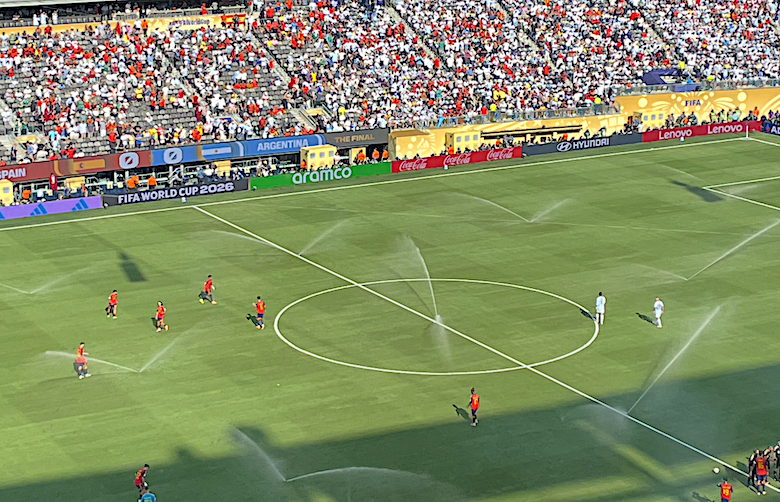
World Cup final in NYCOver 2 million gallons of water were used on game days by the time the World Cup final in New Jersey came to a conclusion. Courtesy / Kerith Gabriel

In order to ensure the pitches would be pristine for the tournament at every venue, FIFA’s turf management experts consulted turf management labs at Michigan State University and the University of Tennessee to evaluate the challenges that 16 stadiums in three different countries, each with different grass varieties for different climates would bring. 

A big part of that was just how much water it would take to stay ahead of the game. During a call with media members in advance of the World Cup, FIFA’s chief turf management expert, Alex Ferguson, discussed what that might look like and how the strategy for each field took a concerted effort, not just working with professors at both universities, but the field management teams across all 16 venues. 

“If you think about it, we had to go into mostly NFL buildings, which host America’s biggest sport, but were never really built for international soccer,” Ferguson told reporters in advance of the tournament. “We’ve had to create what we’ve called the ‘shallow pitch profile,’ which we’ve researched and tested across a number of stadiums during [last summer’s FIFA] Club World Cup. It wasn’t a one cap fits all … but much of the research that’s been done at both universities prepared us for how each venue would perform.” 


In short, a “shallow pitch profile” is a fancy technical term for how turf that’s brought in works on top of the existing field that’s been roughed up to allow for the grass that’s installed to lay in quickly. There’s a belief too, that the install would need more than the projected 26,000 gallons initially to withstand the rigors of multiple matches in a short span — but then need to be watered at certain times in order to maintain over the life of the tournament. 

This was particularly the case for the eight venues during the tournament that were turf fields, which were transformed into natural grass for the games. 

While most of the country experienced some sort of heat wave over the course of the World Cup, FIFA’s turf scientists were particularly vigilant about monitoring pitch performance and irrigation in hot, dry climates like the eight games played at SoFi Stadium in Los Angeles and the record nine games in Dallas that included a World Cup semifinal game between France and eventual winners Spain. 

“There was a good deal to consider in this research, said Dr. John Sorochan, turf management expert and professor at the University of Tennessee. “We’ve got five indoor stadiums. We’ve got eight total pitches that are synthetic that have to be converted to natural grass, and the ability to provide evidence-based science and data to come up with a system that’s going to help provide consistency and uniformity across all the surfaces is key.”

KEYWORDS: water conservation water industry water management

Share This Story

Looking for a reprint of this article?
From high-res PDFs to custom plaques, order your copy today!

Kg headshot

Kerith Gabriel is the digital strategy editor for The Driller.

Gabriel brings more than a decade of experience across digital, social and interactive storytelling to The Driller, covering social justice issues across a variety of topics. He has worked and created content for several consumer-centric publications, most notably the Philadelphia Inquirer, in addition to brand and B2B agency work. In his role with The Driller, Gabriel oversees strategic placement of content cross-platform and works with a vibrant community of contributors to produce captivating content and bring fresh perspectives to The Driller’s current and emerging readership.

Email: kgabriel@bnpmedia.com | Office: (248) 786-1241

Recommended Content

JOIN TODAY
to unlock your recommendations.

Already have an account? Sign In

  • geotechnical drilling rig

    6 Onsite Phrases Environmental Drillers Hate

    Here are six phrases that highlight common frustrations...
    Environmental Monitoring
    By: Jeff Garby
  • Pipe Stuck? Common Causes and Solutions for Drillers

    If you have drilled for any length of time, sooner or...
    World According to Wayne
  • deep water well

    Selecting and Sizing Submersible Pump Cable

    This article helps pump installers and servicers decide...
    Opinions
    By: Bob Pelikan
You must login or register in order to post a comment.

Report Abusive Comment

Manage My Account
  • Newsletters
  • Online Registration
  • Subscription Customer Service
  • Manage My Preferences

More Videos

Sponsored Content

Sponsored Content is a special paid section where industry companies provide high quality, objective, non-commercial content around topics of interest to the The Driller audience. All Sponsored Content is supplied by the advertising company and any opinions expressed in this article are those of the author and not necessarily reflect the views of The Driller or its parent company, BNP Media. Interested in participating in our Sponsored Content section? Contact your local rep!

close
  • skid-packaged booster stations
    Sponsored byBaker Water Systems

    Built to Spec: Custom Booster Stations for Real-World Water Systems

  • 3135GT drilling rig
    Sponsored byGeoprobe

    Driller Feedback Drives Innovation in Geotechnical & Environmental Drilling

  • CUE100 external variable‑frequency drive (VFD)
    Sponsored byGrundfos

    Unlocking Simplicity and Reliability in Critical Water Systems

Popular Stories

High-Tech Gold Rush: A Crisis for Rural Aquifers

High-Tech Gold Rush: A Crisis for Rural Aquifers

The Vandalia State House is the oldest surviving state house in Illinois.

Thanks to collaborative grant funding, Vandalia Ill. preps to go geothermal

Abandoned oil wells

Illinois has the money to plug orphan wells. So why are so many still sitting idle?

The DRILLER logo CLASSIFIEDS

COMPRESSORS

EAST WEST MACHINERY & DRILLING IS BUYING AND SELLING AIR COMPRESSORS, AIR BOOSTERS, AIR ENDS & PARTS
Company: East West Machinery

DRILL RIGS

LOOKING FOR LATE MODEL TOPHEADS & DRILLTECH D25'S
Company: Spikes’s Rig Sales

DRILL RIG PARTS

MEETING DRILLERS NEEDS AROUND THE WORLD
Company: East West Machinery

ELEVATORS

SEMCO INC. PIPE ELEVATORS
Company: Semco Inc.

GROUTERS

GROUTING EQUIPMENT - GROUT PUMPS & GROUT HOSE REELS
Company: Geo-Loop Inc.

PUMP HOISTS

SEMCO INC. - BASIC PUMP HOISTS
Company: Semco Inc.

WELL PACKERS

LANSAS PRODUCTS - INFLATABLE WELL PACKERS
Company: Vanderlans Lansas Products

WELL SCREENS

WELL SCREENS & SLOTTED PIPE
Company: Alloy Screen Works

Events

June 15, 2027

Ground2Grid Thermal Energy Summit

Ground2Grid logoGround2Grid is a new, national event hosted by The Driller where the full lifecycle of Thermal Energy Resources comes together. From the subsurface to the final system connection, this summit brings builders, policymakers, engineers, and investors into one collaborative space to accelerate the future of carbon-neutral heating and cooling.
View All Submit An Event

Products

Water Quality Engineering: Physical / Chemical Treatment Processes

By carefully explaining both the underlying theory and the underlying mathematics, this text enables readers to fully grasp the fundamentals of physical and chemical treatment processes for water and wastewater.

See More Products

The Driller EGO award - Tell Us Who's Making An Impact in the Field

Related Articles

  • climate change

    ‘False Hope’ is in The Air: The Heat Streak Has Ended, but Climate Change Remains the Same

    See More
  • The Driller Newscast episode 48: How Much Water Do We Use in the U.S.?

    How Much Water Do We Use in the U.S.?

    See More
  • Gerard-Sylvain

    What’s it like to be in the business of drilling? We ask an unlikely face in a growing industry.

    See More

Related Products

See More Products
  • In Too Deep: BP and the Drilling Race That Took it Down

  • 1119819962.jpg

    Stantec's Water Treatment: Principles and Design, Updated, 3rd Edition

  • 9780128201930.jpg

    DRILLING ENGINEERING

See More Products
×

Dig deeper into the drilling and water supply industry!

Build your knowledge with The Driller, covering the people, equipment and technologies across drilling markets.

SIGN UP NOW
  • RESOURCES
    • Advertise
    • Contact Us
    • Directories
    • Store
    • Want More
    • Classifieds
  • SIGN UP TODAY
    • Create Account
    • Newsletters
    • Customer Service
    • Manage Preferences
  • SERVICES
    • Marketing Services
    • Reprints
    • Market Research
    • List Rental
    • Survey/Respondent Access
  • STAY CONNECTED
    • LinkedIn
    • Facebook
    • YouTube
    • X (Twitter)
  • PRIVACY
    • PRIVACY POLICY
    • TERMS & CONDITIONS
    • DO NOT SELL MY PERSONAL INFORMATION
    • PRIVACY REQUEST
    • ACCESSIBILITY

Copyright ©2026. All Rights Reserved BNP Media, Inc. and BNP Media II, LLC.

Design, CMS, Hosting & Web Development :: ePublishing