And the Winner of The Driller’s E.G.O. Award is…Jim Beath!
The Driller announced Jim as the winner in New Orleans at Groundwater Week
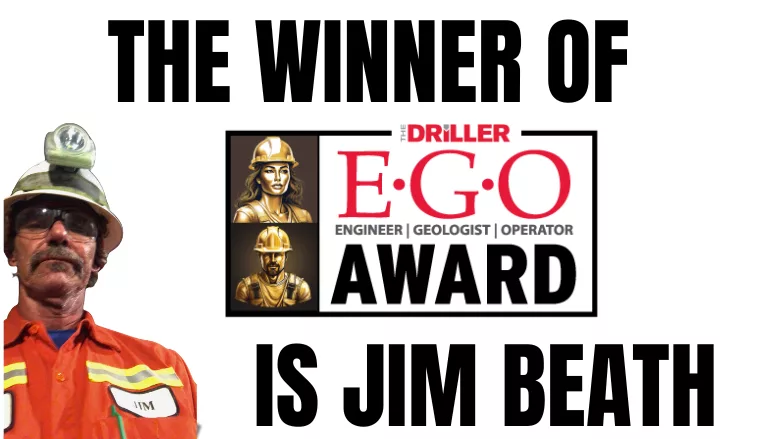
Image courtesy of Jim Beath, overlay created by the Driller staff
“I met Jim Beath at the 2025 South Atlantic Jubilee. He and I sat down to geek out about drilling. An hour had passed without our noticing, as we shared knowledge and lessons learned from drilling projects in the southeast to those in the western US. In Jim's 41 years of drilling, he discussed building his first rig, expanding a small water well business in Florida, and becoming licensed in six states.
He concluded by examining how much The Driller magazine, now a digital platform, had impacted his career. I instantly challenged him to write for The Driller. Jim not only accepted the challenge but also developed a new voice by telling the unabridged version of how he became a driller. As of December 2025, Jim has submitted seven articles, and he's just getting started. Jim Beath fully embodies the ethos of The Driller EGO award by stepping off the rig platform and picking up a laptop to share over 40 years of knowledge, experience, and heart.” - Brock Yordy.
Here is Jim’s submission:
Why I'm Certified By Jim Beath
I remember my stepdad, Driller Mike, saying to me, “Get your 6g welding certification, son. The more paper you get, the more valuable you'll be." I was about eighteen years old then, and I got it. Back in the day, I made a lot of money welding casing and landed a number of high-paying drilling jobs because I had it. I've let it expire now because my new friend Arthur Ritus will only let me weld for about five to ten minutes before my hands cramp up. I also went and got my chauffeur's license as soon as I turned eighteen. That's what you got back then if you wanted to drive a truck, bus, taxi, or limo.
So I've had my CDL since before they were invented. When I was twenty-one years old, I became the youngest person in the Saint Johns Water Management District with a Florida State Water Well Contractors License. I still have that license as well as Texas Master Drillers License, North Carolina Level A drillers license, South Carolina Environmental Drillers license, Kentucky Drillers License for driven wells, reverse circulation, mud rotary, auger rig, sonic drilling, and direct push, NGWA voluntary Drillers certification, and on December 2 I'm scheduled to take the exam for a Nevada well drillers license.
Having a little "paper", a lot of skill, and a lot of strength made me valuable when I was younger. Nowadays, I've used up all of my strength, and employers are satisfied to have drillers who are strong and hard workers, even if they lack a lot of skill. Rigs are easier to operate, and young drillers can usually be directed over the phone on how to solve a problem if they are unable to figure it out on their own. In my opinion, that's a good thing because I no longer run rigs unless I have to. I can't stand at the console all day, and what would happen if, no, not if, when the swivel starts to leak and rains mud on me for hours before I get it down low enough to grease and tighten it? I'd probably curse a lot while getting rained on by mud and then feel good after I stopped the leak. There used to be a spot for me in the drilling industry as a superintendent, but office management can now handle that task by phone with some assistance from the driller. I can't work for small drilling companies anymore; they don't need the likes of me. I work for a corporation that bought out several small drilling companies. They work in multiple states, and I like it because I don't have to drill anymore, and I don't have the responsibility that comes with being a superintendent, either.
All states have well-drilling regulations in place to protect the health of the people who live there and visit. Regulations such as sanitary setbacks, delineation zones, size of the annulus, grouting regulations, and rules for how to decontaminate a well. In most states, the geology is different and the environment is different too, so from state to state, and sometimes from county to county, the rules vary. They also protect the agricultural groundwater supply with casing depth stipulations, well spacing rules, water quality, and regulations on the amount of acre-feet of water you can pump from a well in a year.
Some states require a licensed driller to be present during any drilling activity. These states usually require drilling permits and well completion reports. Besides generating money for the state through permitting and licensing, having a licensed driller on site ensures that the regulations protecting public health and the groundwater supply are being followed, as that driller is personally accountable for following those rules. The permits and reports help states establish a well database to monitor water quality and water levels. These databases are also helpful to drillers because they can log on to a website and view the depths of the wells in the area where they will be drilling, as well as the formations to expect, which helps them make an informed decision about the type of drilling equipment to bring.
Permitting and licensing also help drilling contractors by eliminating low-balling unqualified competition, bringing well prices up because they can add on an administrative fee for the permits and reporting, and letting the customer know that the driller is professional, safe, and qualified to do a great job. Having a drilling license brings a sense of pride and professionalism to the individual and the industry. To me, having one or not having one is the difference between being a well driller or a drill rig operator. I mostly work with rig operators, some of whom have up to five or so years of experience, and I believe the right way to grout a well is to insert a hose into the annulus at ground level and start pumping. They really think they're doing it right because they were trained by another rig operator and not a licensed driller. Texas has an apprentice license that requires a rig operator to work under the supervision of a licensed driller for two years before they qualify to take the driller's exam and work independently. That’ll learn’em how to properly grout and well.
Every year, I attend conferences for continued education to maintain my license. This keeps me informed about regulations, up to date with new products and technologies, allows me to reconnect with old friends in the drilling world, and meet new ones. More than a few times, doors of opportunity have opened for me at well-drilling trade shows where I've gone for continued education, and I always leave with a bag or two of swag from the sponsors. My favorite swag this year is a bright yellow shirt that says THE DRILLER. It makes the rig operators chuckle when I wear it, as I bring them bottles of water to drink and fill the water totes. They don't think of me as a driller anymore, but I've got forty-two years of experience and six drilling licenses in my wallet that say I am. My paychecks also represent fairly what a good driller should earn, and a rig operator can't honestly say any of that. Being licensed has helped me retain my value in the industry, allowed me to teach and mentor younger drillers, and is the main reason that I still have a job in the well drilling industry today.
As a licensed driller, I am an E-engineer. Because I can make the right decision when it comes to selecting the correct type of casing, choosing the appropriate grout, determining where to install centralizers on the casing, and determining the optimal amount of grout at the proper weight to pump in a single shot, thereby avoiding damage to the casing or formation. I am a G-geologist. Because I can identify water-bearing formations that should be cased and sealed in the borehole before proceeding with the well, to avoid mixing water qualities, I can examine the cuttings and recommend the appropriate slot size screen and type of filter pack to use, and write an accurate report of the well's lithology. I am an O-operator because, with two good assistants, I can build a comfortable seat at the brake handle or console, and the swivel doesn't leak, or the wind is blowing in the right direction if it does. Hammer, drill, jet, drive, or vibe, I’ll safely make a hole as big and as deep as it needs to be, and I'll usually get it drilled ahead of schedule and under budget.
Looking for a reprint of this article?
From high-res PDFs to custom plaques, order your copy today!