Drill Crew Evaluation
Management Development: 6x4 Goals for Leaders
Advance drill leaders from 5x3 crew cards to 6x4 KPIs.
Key Takeaways
- Ground 5x3 Reviews in Safety and Individual Legacy: Replace performative employee goals and unobtainable management targets with two core priorities—enforcing "Safety as a condition of employment" with full stop-work authority, and asking employees where they want to grow over the next one to five years.
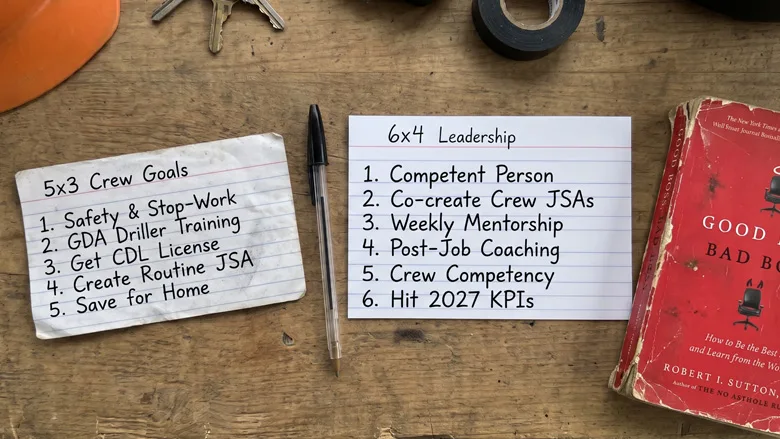
- Move Promoted Leaders from 5x3 to 6x4: Help capable field personnel transition from working in the business to working on the business by adding a 4x6 notecard featuring 12 annual milestones (six company objectives and six leadership goals, including year-end KPIs) reviewed in closed-door, one-hour quarterly meetings.
- Develop Competent Persons, Mentors, and Industry Networks: Require managers to qualify as OSHA-designated competent persons who co-create SOPs and JSAs with their crews, protect dedicated mentorship time, hit project completion KPIs across scheduling and risk mitigation, and grow through peer collaboration, drilling associations, and shared leadership reading.
In my 2023 feature article, “The Simple ‘5x3 Goals’ System for Drill Crew Evaluation,” I outlined the value of new hires and existing employees creating goals to be completed within a year. The 5x3 Goal System is a straightforward employee review program that builds opportunity, accountability, and shared expectations between the employee and employer.
The 5x3 system utilizes an analog 3x5 notecard—there is no need to involve the cloud. The process starts by asking the employee to write down five goals to achieve in a year. Next, the management team writes down five company goals on the back of the card. The goals on both sides are broken down into one goal for the end of the first month, two for the sixth month, and two for the end of the year. The final step involves the “3” aspect of 5x3, where the employee and management establish dates for those three review meetings.
Since publishing that piece, I have had many great discussions about the successes, failures, and improvements needed in the 5x3 system. As the drilling industry enters the second quarter of the 21st century and prepares for 2027, it is time to go beyond the “simple system” to advance. As an industry, we have endless workforce development resources, yet we still struggle to create effective company development resources.
5x3 Employee Goal System 101
The initial challenge with the 5x3 system was creating quality goals for both employees and the company. Owners who embrace the 5x3 system tie the company's mission, vision, and culture into those goals. Yet the biggest bottleneck often lies with employees creating goals based on what they think looks productive rather than the path they actually need to succeed. On the company side, a similar blocker developed when managers created unobtainable goals for their teams just to impress ownership.
Over years of reflection with my team, I have learned that it is essential to develop core milestones that allow employees to focus on their growth while embedding company super objectives. The number one super objective is “Safety as a condition of employment.” If you are hurt, you cannot work. If you hurt others, you will not work. Work will always stop when an employee commits an unsafe act or fails to recognize a hazardous condition. Plain and simple, we do not work unless it is safe.
Next, and a very close second to safety, is "What do you want to do next?" I want team members to constantly seek to improve their skills, knowledge, and abilities. I ask my team to consider where they want to be professionally and personally in the next year and the next five years. If we want our team to care about the business's legacy, we must care about their individual legacy. The first step in demonstrating genuine care and investment in our employees is meeting on the agreed-upon review dates for the one-month, six-month, and year-end evaluations.
Working In or On the Business
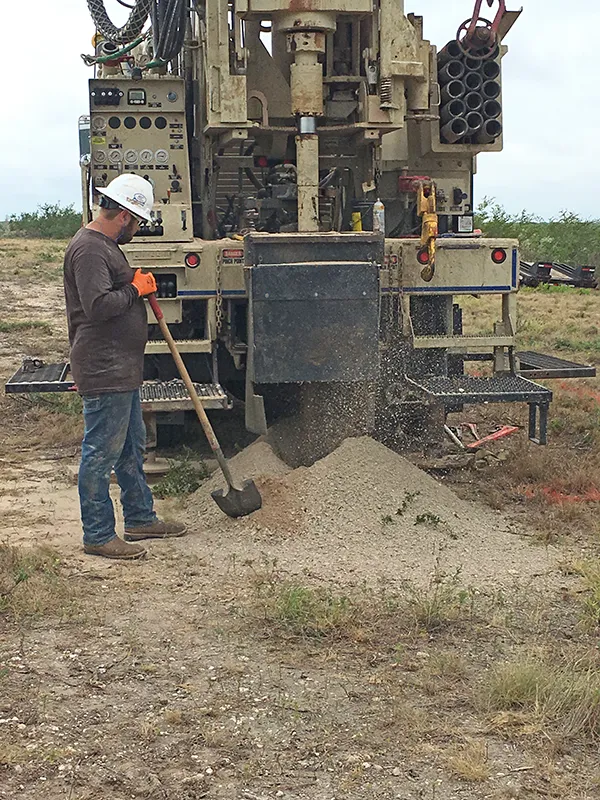
New Driller stepping up on the platform while the lead driller watches from a distance.
Photo: Brock Yordy
Taking the 5x3 system from simple to advanced requires shifting focus from employee development to company development. My colleague, The Driller contributing writer Robert Meyer, co-founder of the Geothermal Driller's Association, says it best: "Are you working in the business or on the business?" Individuals tasked with leading our companies must transition away from day-to-day operations and focus on building the business for the future.
Sadly, many of our people who performed admirably while working in the business were not ready to work on the business once promoted. The 5x3 system helped align expectations with the five company super objectives, yet the employee's five personal milestones were never intended to focus on running the business—they were designed to build individual competency within their role. The solution is to advance leaders from a 5x3 to a 6x4.
The 6x4 system establishes 12 total milestones to be achieved in one year—six company objectives and six leadership goals. The review process occurs once a quarter for at least one hour. Each quarterly review should be a closed-door, one-on-one meeting to allow for candid, uninhibited discussion of responsibilities and progress. Like the original system, the 4x6 notecard dedicates one side to company objectives and the other to the manager's and their team's core goals. However, the 6x4 system adds one extra company objective and one extra core goal, both serving as year-end key performance indicators (KPIs). Ideally, a manager continues carrying their 3x5 card for individual growth while working in the company and starts a 4x6 card dedicated to working on the business.
6x4 Company Development Objectives
The six company objectives chosen for a manager can still be rooted in the original five super objectives that reflect the company's mission, vision, and culture. Maintaining those roots is essential, but leadership requires higher responsibilities and expectations. I build objectives that require managers to develop their teams for the business's future.
Their first super objective is to study and become the company's designated competent person for every project they step onto. OSHA defines a competent person as someone capable of identifying existing and predictable hazards in the surroundings or working conditions that are unsanitary, hazardous, or dangerous to employees, and who has authorization to take prompt corrective measures to eliminate them. Consider what it means for safety, risk mitigation, and accountability when your leaders operate as company-designated competent persons. I expect them to create standard operating procedures (SOPs) and job safety analyses (JSAs) alongside their teams to substantiate their role as a competent person on-site.
The next objective is to build and protect dedicated time for mentorship and knowledge sharing—both within their crew and across the entire company. Finally, their year-end KPI should focus on project completion accountability across scheduling, change orders and procurement, risk mitigation, and quality.
6x4 Manager Development Goals
Managers should also be encouraged to set goals centered on collaborating with other leaders. If your company has multiple managers, peer collaboration is easy to structure in-house. If you run a smaller or growing shop, push your emerging leaders to get involved with local business groups or state and national drilling associations. Managers who invest in developing themselves, their crews, and their industry network build far greater leadership capacity back home. I am also a big advocate for building a shared book or audiobook list for leadership teams. Robert Sutton's Good Boss, Bad Boss, Patrick Lencioni's The Five Dysfunctions of a Team, and Malcolm Gladwell's Talking to Strangers are all great starters.
Company development starts with choosing a system that fits your operation. The key is to keep it simple and balanced enough to adopt company wide. As owners and general managers of drilling companies, we must balance the time we spend working in the business with the time required to grow by working on the business. Think about the training, hours, and experience it took for you to move from helper to standing on the platform as the driller. Now think about what it takes to step off that platform so the next capable driller can take the controls. You cannot effectively work on the business while standing next to the rig; it's time to trust your system and advance your company.
Looking for a reprint of this article?
From high-res PDFs to custom plaques, order your copy today!

Brock Yordy, Director of Industry Engagement for The Driller, is a third-generation driller and globally recognized subject matter expert who has written for The Driller since 2013. Driven by a passion for industry education and digital media, he anchors The Driller Newscast and hosts weekly podcasts for the trade. His technical authority is backed by decades of extreme fieldwork worldwide for organizations like Halliburton, SUEZ, and the U.S. Government. Dedicated to ensuring clean water for all and advancing equitable geothermal heating and cooling, Brock actively collaborates with states nationwide through The Developed Well Group and the Geothermal Drillers Association to shape policy, safety, and workforce training.
email: brock@thedriller.com | office: (269) 348-5156