The TEN Playbook: Load, Risk, and ROI
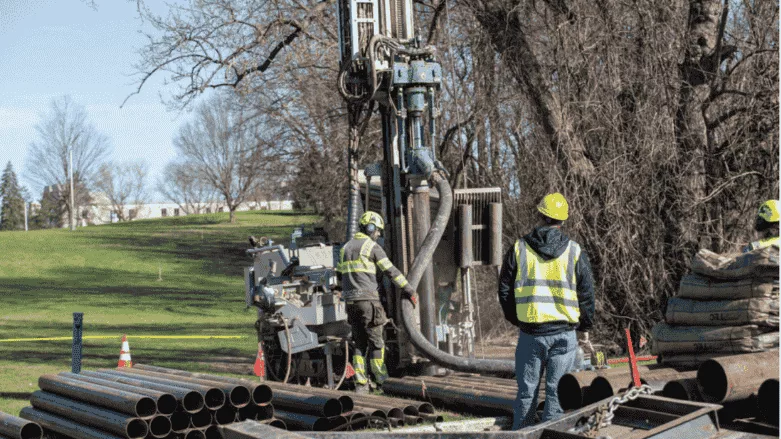
Image Courtesy of Framingham Geothermal
You’ve seen the meeting before. Everyone’s excited about Thermal Energy Networks (TENs). The sustainability goals sound great. Then someone flips to the drilling and civil CapEx page.
Silence.
The conversation shifts from decarbonization to cost per foot. Drilling becomes a “necessary evil” instead of what it actually is: foundational infrastructure.
As we head toward NY-GEO 2026 in Brooklyn, the industry needs a gut check. If we keep defending drilling costs instead of reframing the value of the network, we’ll stay stuck in margin-crushing negotiations. We’re not punching holes for isolated HVAC systems anymore — we’re building the next century’s utility backbone.
To scale TENs, especially in dense urban markets, we have to move the conversation beyond upfront CapEx and focus on three pillars: load diversity, capital risk diversity, and developer ROI.
Load Diversity: The Force Multiplier
In a traditional design, engineers size geothermal borefields to meet a building’s absolute peak load. That often means oversized systems and sticker shock.
But a well-designed TEN isn’t just a heat source — it’s a shared thermal platform.
Picture a Brooklyn block: residential high-rise on one corner, data center or office building next door. The residential tower peaks in winter mornings and evenings. The commercial building is rejecting heat year-round. Connected through an ambient loop, they trade energy.
Instead of drilling two maximized borefields, the shared network reduces total load on the ground. The borefield no longer has to handle every building’s peak simultaneously.
That’s the key message developers need to hear: smart network design shrinks the CapEx before the rig mobilizes. Fewer boreholes per square foot — but higher-value, stabilized load. That’s what makes projects feasible instead of defaulting back to gas.
Capital Risk: Stop Asking One Developer to Carry It
Even with load diversity, district-scale TENs are heavy lifts. If a single private developer has to finance the entire loop and borefield, the market caps itself.
This is where the utility model changes everything.
Utilities already finance long-life infrastructure over 40 to 80 years. Borefields and ambient loops have similar longevity. When utilities own and rate-base the thermal network, CapEx gets amortized across decades and distributed across ratepayers. The sticker shock disappears for individual building owners.
Outside utility pilots, projects need phasing and creative ownership models.
Start with an anchor building — hospital, municipal facility, campus — using grants or tax incentives to offset initial drilling. Then expand phase by phase as neighboring properties connect. Third-party Energy-as-a-Service models can also own the loop, paying drilling invoices upfront while developers purchase thermal energy under long-term agreements.
Diversify who holds the capital risk, and you unlock the pipeline.
ROI: The Math That Actually Moves Money
Private capital moves when ROI is clear.
Yes, drilling costs more upfront than rooftop boilers and chillers. But TENs shift the financial equation from CapEx to long-term OpEx, compliance, and asset value.
In markets like New York, carbon regulations such as Local Law 97 introduce recurring financial penalties for high-emission buildings. Avoiding those fines is no longer a “green bonus.” It’s a line item in the pro forma.
Buildings connected to clean thermal networks also see higher asset valuation and tenant demand. ESG-driven tenants want low-carbon space. Stable indoor environments and predictable operating costs improve retention and lease pricing.
There’s also a revenue angle. In a TEN, waste heat isn’t a liability. It’s an asset. A commercial building injecting heat into the loop can effectively function as a thermal micro-utility, offsetting costs or generating credits. When drilling transforms a building from pure consumer to energy participant, the ROI calculation flips.
The Education Gap
The biggest barrier isn’t engineering — it’s understanding.
Mega-developers and utilities have teams modeling these systems. Mid-market developers and municipalities often don’t. They see the CapEx and stop there.
Drillers shouldn’t be the first ones explaining load diversity or phased financing in a project meeting. That requires a coalition — engineers, architects, utilities, regulators — aligning early in design.
Decision-makers need clear language around:
-
Regulatory compliance and avoided penalties
-
Protection from volatile gas and power prices
-
50- to 100-year system longevity
When leaders understand they’re investing in generational infrastructure — not a 15-year rooftop unit — the math changes.
Changing the Conversation
As the geothermal community gathers in Brooklyn, the opportunity is real. Policy momentum is building. Urban markets need scalable decarbonization. The technology works.
But drilling cannot remain a commodity line item to be squeezed.
We need to position rigs and crews as builders of long-life, revenue-generating infrastructure. Costs will optimize over time. Technology will improve. But waiting for cheaper drilling isn’t the strategy.
Proving the financial model — and educating the people who control capital — is.
The future of TENs won’t be unlocked by cheaper boreholes alone. It will be unlocked when we stop selling holes in the ground and start selling the network.
Looking for a reprint of this article?
From high-res PDFs to custom plaques, order your copy today!



.webp?height=200&t=1784662993&width=200 "Geothermal Students with Trainer Brock Yordy")