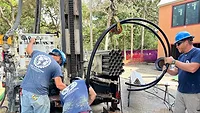
The Driller's Progress: 5,000 Years of Fueling Civilization
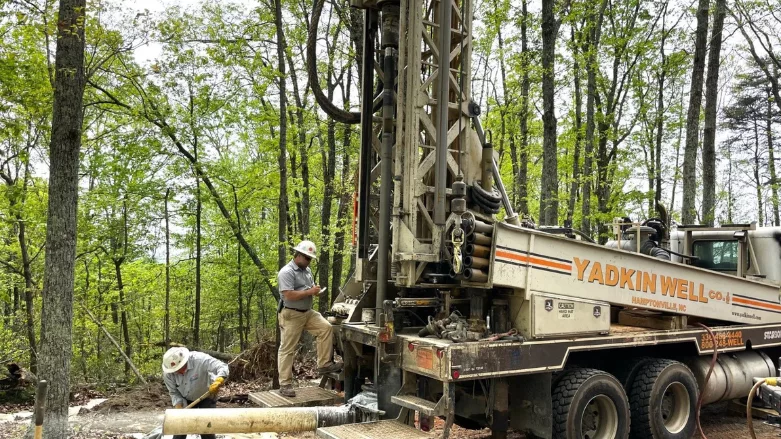
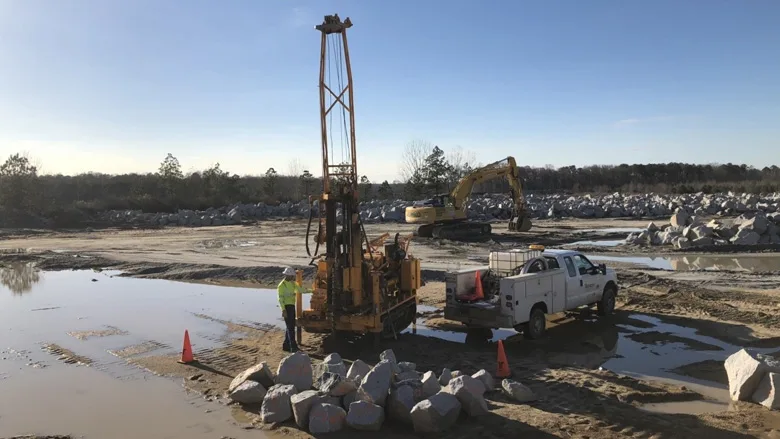
Image courtesy of Yadkin Well Co.
Drillers have been progressing civilization for more than 5000 years.
It all started with civilization's ability to stabilize water and mineral resources, enabling the construction of population centers, allowing humanity to come together to develop a better tomorrow. The most significant focus over the past 5,000 years has been on water for life. Over time, the need for water has taken many forms, ranging from hydration and sanitation to agricultural sustenance. The stability fueled by water developed a flourishing civilization and started humans' thirst for knowledge.
The earliest discovery of the influence of drilling on humanity was not for water, but for engineering, and can be found in Egypt, dating back to around 3000 BCE. A group of archaeologists found granite and quartz cores created by Egyptian builders. The cores sparked a debate on drilling methods and what type of bits were utilized. The earliest evidence of water well drilling and its influence on humankind dates to the first millennium BC, introducing two significant innovations in the utilization of water wells for large populations. In Persia, Qanats were underground aqueduct systems designed to harness aquifers and transfer water throughout the Middle East without impacts to evaporation, natural disasters, or war. At the same time, the earliest written record and evidence of large supply wells date back to China in 1000 BC. The Chinese have developed water well life cycle programs to protect and maintain the production and capacity of their wells. The Chinese developed the spring pole drilling method, which, 2,500 years later, evolved into cable tool drilling in early Appalachia. However, before the early American water wells, advancements in drilling played a crucial role in the discovery of precious metals, shaping the Renaissance period. Even Leonardo da Vinci found the opportunity to develop a rotary drill utilizing auger flights in search of a better understanding of what is in the ground to explore the unknown.
The advancements in drilling technology led to the discovery of more mineral and energy resources, which in turn initiated the Industrial Revolution. This revolution had a profound impact on drilling by mechanizing drills and drilling support equipment. The drilling industry and industrial progress, supported by advancements in technology, contributed to a significant increase in the global population, from 1 billion people in 1803 to 2 billion in 1928 and 3 billion in 1960. After that, the snowball effect continued to grow by a billion people every 12 years, reaching a very resource-hungry 8.1 billion today.
The latest estimates from the United Nations indicate that the global population will reach approximately 10.4 billion by 2100. The planet started the 21st century with 6.144 billion people and will end 100 years later with over 4 billion more souls. To better understand our global water and resource demands from today to the next century, let's focus on the United States' current consumption of water and energy. As of the end of 2025, the USGS estimates that the United States consumes 274 billion gallons of water per day. Only 35.4 billion gallons a day are for public use. Thermoelectric generation withdrawals over 82 billion gallons a day and continues to increase demand due to peak load for US power demands. The US Energy Information Administration breaks down power consumption, with nearly 70% of the 10.25 million megawatt-hours produced being used by residential homes and commercial buildings. Most of those power requirements are for heating and cooling. The significance of these numbers is that the United States population is 342.8 million people, which is less than 5% of the global population. The US ranks as the second-highest greenhouse gas emitter, behind only China.
The future of sustainability in the US and the globe will be to harness thermal resources through drilling. For many drillers in the US, geothermal boreholes for ground-source heat pumps have been a way to diversify their business and ensure growth as the number of private single-family home water wells has decreased over the past 20 years. Yet, within the timeline of 2005 to 2015, the demand for heat pumps has also fluctuated in response to changes in the market price of gas and policy shifts. In July 2025, the industry experienced another detour with the passing of the Big Bill, which eliminated home energy tax credits for residential heat pumps.
However, with further interpretation, the Big Bill opened significant opportunities for ground source loops to be leased as a service, thereby decreasing the upfront cost to owners and increasing the potential for more projects. The Department of Energy's Geothermal Lift Off Report estimated that 80 million buildings would be converted to geothermal heating and cooling by 2050. To meet that goal, the heat loop industry would require a minimum of 50,000 more drill rigs dedicated to drilling and installing loops year-round for the next 24 years. What happens with every system installed for the widespread adoption of geothermal heating and cooling? The US could decrease its annual electricity demand by 15% according to NREL's report "New Analysis Highlights Geothermal Heat Pumps as Key Opportunity in Switch to Clean Energy." (NREL, January 26, 2024.) Drilling and installing loops not only decreases power demands but also creates a domino effect, where less electricity is required, resulting in reduced water usage and more water becoming available for agriculture and the public.
Beyond heating and cooling, deep geothermal power generation will increase the US power production while decreasing carbon emissions created by coal and gas power generation. Deep Hole Geothermal will be drilled using 21st-century developed 1,500 and 2,500-horsepower oil and gas rigs with optimized drilling programs to combat high temperatures and pressures during drilling and development. Hot Rock Geothermal will push the limits of current drilling capabilities and drive innovation to meet the required depth and temperature, exceeding 572 degrees Fahrenheit (300 degrees Celsius). Just as the Industrial Revolution influenced drilling capabilities, the Hot Rock Geothermal Revolution is rapidly innovating downhole tooling, diagnostics, evaluation, monitoring, and efficiencies that will quickly trickle down to the industrial drilling industry, including the installation of water wells and geothermal loops.
From the Spring Pole drilling in 1000 BCE China to the US rack and pinion rigs with real-time monitoring in 2025, drilling has propelled humankind into the 21st century, and drillers will continue to be critical to providing resources and saving the planet to sustain the momentum of 10.4 billion humans. The next challenge and opportunity for drillers is providing water, geothermal energy, and rare minerals to meet civilization's growing thirst for knowledge.
Cloud Data, Streaming Internet, and Artificial Intelligence have needs that require water and energy at increasing demand, which cannot be met without drilling more wells and boreholes throughout the country.
Looking for a reprint of this article?
From high-res PDFs to custom plaques, order your copy today!

Brock Yordy, Director of Industry Engagement for The Driller, is a third-generation driller and globally recognized subject matter expert who has written for The Driller since 2013. Driven by a passion for industry education and digital media, he anchors The Driller Newscast and hosts weekly podcasts for the trade. His technical authority is backed by decades of extreme fieldwork worldwide for organizations like Halliburton, SUEZ, and the U.S. Government. Dedicated to ensuring clean water for all and advancing equitable geothermal heating and cooling, Brock actively collaborates with states nationwide through The Developed Well Group and the Geothermal Drillers Association to shape policy, safety, and workforce training.
email: brock@thedriller.com | office: (269) 348-5156