Unlocking Geothermal Power Everywhere
Part 1: The Long Road
.webp?t=1762957903)
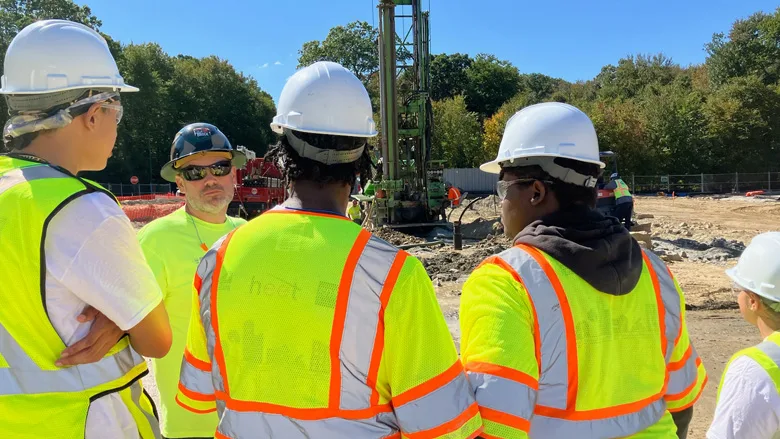
During an on-site drilling day, Brock explains fluid fundamentals to students.
In late August, Ormat Technologies and Sage Geosystems announced a strategic commercial agreement under which Ormat will pilot Sage's advanced Pressure Geothermal technology at an existing power plant.
Once the pilot is completed, Ormat will have the right to develop, build, own, and operate pressure-based energy storage using Sage's technology. As the energy world buzzed with news of a groundbreaking alliance,
The Driller's in-house geothermal expert, Brock Yordy, sat down with Sage Geosystems' Chief Technical Officer, Robert "Lance" Cook, to drill beyond the press release. They discuss the long road of acceptance for geothermal from the early 2000s to today and how Sage Geosystems' path from pilot project to commercial-scale deployment with Ormat is a "dream come true."
Brock: Thank you for taking the time to meet with the Driller. We see how busy Sage is changing the geothermal industry through hard work and innovation. I'll jump in with our first question.
Q: To get to widespread adoption of geothermal, we must overcome many things that come from our drilling roots, which are also what will get us there. How can we attract the top drilling professionals to help harness the most reliable energy?
Lance: Yeah, I think drillers may be working 10 years from now more for geothermal than they are for oil and gas.
Brock: I agree. If you consider the Department of Energy's Liftoff report for geothermal, along with our 2030 and 2050 goals, we will need thousands more drill rigs and drillers, not to mention the support staff and equipment, to achieve these goals.
Lance: Yeah, when you lay out the work to get to 2050, you're not going to have the ups and downs that oil prices drive the oil field towards, right? So it's going to be at a much steadier pace. You're going to be able to field a drilling rig and keep the crews together, working for the same company, for a decade-plus. It's going to change things quite a bit.
Brock: That's a beautiful point you just made. I want to continue exploring this line of thought. For the last century, we have gone where the resources are located and utilized them. Often not in the most convenient location. The passion within Sage Geosystems to take lessons learned from the Oil and gas industry to advance geothermal is not only inspiring but necessary for us to harness geothermal everywhere.
Q: The concept of harnessing thermal resources from dry rock technology opens the door to geothermal everywhere, how did that become Sage’s mission?
Lance: You know, it started when I was at Shell. I was VP of R&D, and we had a geothermal section until about 2007. The driver behind that was that we thought oil and gas were slowly disappearing. Shell was the founder of the concept of peak oil —what are we going to do once all the oil's gone? There were a lot of renewable initiatives. The interesting thing is, back then, renewables didn't mean carbon-free; it meant renewable, right, so sugarcane, et cetera, et cetera, that's why we've got Europe burning wood chips and calling it green, right, it's not really green, it's producing a whole lot of CO2, but it was renewable. That's what the goals were in the 90s and the 2000s, rather than carbon-free. We put in a lot of effort in the geothermal area. The idea was geothermal anywhere, right? The idea was that the center of the earth is the center of the earth, no matter where you are on the earth, and that if you drill deep enough, no matter where you are in the crust, you could reach a depth hot enough to generate electricity.
Q: What happened in 2007 that shifted away from Geothermal?
Lance: Around 2007, we recognized that George Mitchell was for real. Up until then, we thought he was a nutcase. There's no way you're going to get oil out of shale, right? But he did it. And it was around 2007 that it finally really dawned on me, I think, that the majors like shale realized that the shale oil revolution was dramatically postponing peak oil. So, we ended up needing all the capital and all the staff, so we shut down the geothermal effort and moved them all over to our unconventional resources.
Brock: It's ironic because the oil and gas downturn in 2008 was scary for a young man working at Halliburton, and I was thankful for the Ball State Geothermal project, which was starting its first 1,800 holes for geothermal exchange to replace its coal-fired power plant. Let's talk about harnessing energy anywhere. The Department of Energy has two classifications for geothermal energy: High Temp, above 150°C (302°F), and Low Temp, below 150°C.
Q: What is the ideal temperature for harnessing this resource anywhere? What is the optimal temperature to make it feasible?
Lance: This is my take, and if you want to go through spreadsheets, I probably don't have the spreadsheets to nail it down exactly. I believe we want to be cheaper than combined-cycle gas plants, so I'm using a combined-cycle gas plant cost of $6 per MCF. Okay, that doesn't work for you in West Texas, but in most of the world, natural gas is trading above $6 per MCF. It's $10 to $12 in Europe. So, if you're going to, say, get below combined-cycle gas in terms of cost per kilowatt-hour (LCOE), when they're paying $6.00 an MCF for fuel, I believe we really need to get to about 250 °C (482 °F). 250°C static, with 220 °C at the wellhead. So that's sort of my vision. Now, 150 °C to 200 °C, it's good, that's what most people are doing, but it's going to be sort of expensive at that depth. But as soon as you go from 200°C to 250°C, you double your well's output. You double your output because of Carnot's efficiency; you double the electricity you can get. At 300°C, it's 10 times the amount. So, a good part of the Western U.S., Nevada, Utah, et cetera, you can get down to 250°C fairly easily, with a 2,000-horsepower, 1.2-million-pound rig.
Brock: That's excellent. Last year, I participated in Project Interspace's Geode Project, along with dozens of drilling industry professionals, where we discussed drilling and tooling capabilities regarding drilling to total depth at higher temperatures. Our technology is currently limited by availability for extreme conditions.
Q: Are you seeing limitations as well, and how do we work past these factors?
Lance: Yes, but if you look at what we do in Haynesville, we use a lot of mud chillers, strategic circulation, and if you look at what Fervo just did on their Sugarloaf test well, they were able to use conventional rotary steerable systems, MWD, down to 270 °C. I think they've got a pretty good summary of that on their website. So, using the same oil-field technology used in Haynesville, with downhole temps of 270 °C, we can keep it much cooler inside the hole with mud chillers, heat sinks, and the rest.
Brock: I would have thought deep gas drilling would need technology for higher temperatures.
Lance: We were working heavily in 2007 on ultra-deep gas. Because it met all the tax incentives for unconventional, and that's what we were really kind of considering as unconventional gas. We were making a lot of effort to get these really deep wells in there. A lot of that technology we abandoned in 2000 —we not only abandoned geothermal, but also ultra-deep gas. We didn't believe that was the case until about 2007. So, there was a lot of effort put into drilling deep in that time frame. Ultra deep, ultra hot was what we called it.
Q: Can you explain to the Driller’s broad audience, from water well drillers to policymakers in D.C., the process of Sage's Hot Dry Rock and how it optimizes power generation?
Lance: Real quick, let me describe what Hot Dry Rock is and the fundamentals of geothermal energy anywhere. You don't need an aquifer; you bring your own water, heat it, bring it to the surface, harvest the heat from it, then send it back down the well again. That's the fundamental premise. Now, EGS is really defined by Fenton Hill, and what Forge is doing, and what Fervo's doing.
Lance: It's basically a two-well process where you pump fluid from one well to another, and the problem with that, we saw studying the process, is that one, you've got to connect the wells. You've got to create fractures that go from one well to the other, and you need to do it over just as an easy number of somewhere around a thousand feet apart. They've got to be parallel; you've got to drill them nice and parallel, then place them a thousand feet apart, and connect them with a fracture. Connecting them is one part of the problem. The other problem is conductivity. You want all those fractures not to eat up all the power you're trying to generate with your pumps, pumping water through the fracture network. So that’s problem two. Then the third is the horizontal well, where you've got 50 zones open, let's say. You want that water evenly distributed throughout those zones. Sage’s approach solved two of those problems that are easy to fix.
Q: How do you fix them?
Lance: One is to get rid of one well. You do one well, and we create a fracture; by definition, the fracture is connected to both your injector and producer. Because your well is both an injector and a producer, we use the huff-and-puff process: we inject water, let it heat up, and then flow it back. The second thing we do to maximize conductivity is to operate those fractures above fracture opening pressure, so that the fracture walls don't touch —basically, you've got two hot plates held open —and then inject above fracture opening pressure. Then you flow it back above the fracture opening pressure. Once the fracture closes, you start the cycle over again. Think about a pumped hydro situation: you pump water up a hill, then let it flow down a hill. This is the exact opposite; now you're fighting hydrostatic pressure, but it's two to three miles deep in the Earth. But you've got the lithostatic load because we're using water to jack open the rock, so you've got all this rock sitting on top of you, wanting to close those fractures. It's pretty neat to watch this thing because the power you can feel comes back at the wellhead as these things discharge. So those are two easy problems to solve.
Q: What about the third problem?
Lance: The third issue we still have not perfected is conformance. How do you ensure that all the zones you have open are receiving equal amounts of fluid? We're working on some solutions right now. We just recently filed the patents, and now we've got to do the field trials to prove we can put that one to bed as well.
This is part one of a two-part interview with Robert Lance Cook, Chief Technology Officer of Sage Geosystems. Lance's experience and willingness to share knowledge made it essential to maintain the integrity of the interview. However, some of the comments made were paraphrased to reduce the article's size. Look for part 2 to be released week of November 17th.
Looking for a reprint of this article?
From high-res PDFs to custom plaques, order your copy today!

Brock Yordy, Director of Industry Engagement for The Driller, is a third-generation driller and globally recognized subject matter expert who has written for The Driller since 2013. Driven by a passion for industry education and digital media, he anchors The Driller Newscast and hosts weekly podcasts for the trade. His technical authority is backed by decades of extreme fieldwork worldwide for organizations like Halliburton, SUEZ, and the U.S. Government. Dedicated to ensuring clean water for all and advancing equitable geothermal heating and cooling, Brock actively collaborates with states nationwide through The Developed Well Group and the Geothermal Drillers Association to shape policy, safety, and workforce training.
email: brock@thedriller.com | office: (269) 348-5156