Passing the Torch
Dave Bowers’ Dedication to Sharing Knowledge and Building Drillers
Inside Dave Bowers' Local 150 driller training method.
Key Takeaways
- Retire "Sink-or-Swim" and the "Watch Johnny" Method: Expanding contractors cannot rely on trial-by-fire habits or assume their fastest operator is equipped to teach; structured apprenticeships prevent "cowboy" shortcuts and downhole mistakes like entraining solids into "self-made mud".
- Pair Short Classroom Blocks with Immediate Rig Proficiencies: At IUOE Local 150, Dave Bowers combines two-hour morning theory sessions with full-day field reinforcement, proficiency checks, crew rotations every few months, and borehole risk reviews.
- Earn Gen Z Buy-In and Cross-Train Across Markets: Young drillers want to understand the "why" and see clear career value for their labor, and companies running apprenticeships owe crews cross-training across water well, geothermal, geotechnical, and construction sectors to stay recession-proof.
As the drilling industry gathers around the table this November, there is plenty to be thankful for: full rig schedules, booming commercial geothermal demand, and a long infrastructure runway. However, our greatest asset in 2026 isn't a top-head drive or a specialized hammer; it is the veteran drillers who stepped off the rig platform to become full-time trainers.
When The Driller sat down with Dave Bowers in 2024, contractors faced rising equipment costs and an urgent need to build structured training pipelines. Over the last two years, an unprecedented surge in commercial borefields and thermal energy networks has reshaped the market.
Having spent the last 17 years navigating this industry alongside Dave as friends, colleagues, and co-trainers, I know his real bottleneck has never been steel. It has always been men and women with iron will and a passion for discovering the unknown.
Dave has become the tip of the spear in changing how we pass knowledge to the next generation. To staff the millions of feet of drilling required for modern infrastructure and thermal energy networks, he realized early on that the industry had to fundamentally change how it teaches. His work building the structured apprenticeship program at the International Union of Operating Engineers Local 150 is a masterclass in workforce development, and a direct reflection of his own journey into the trade.
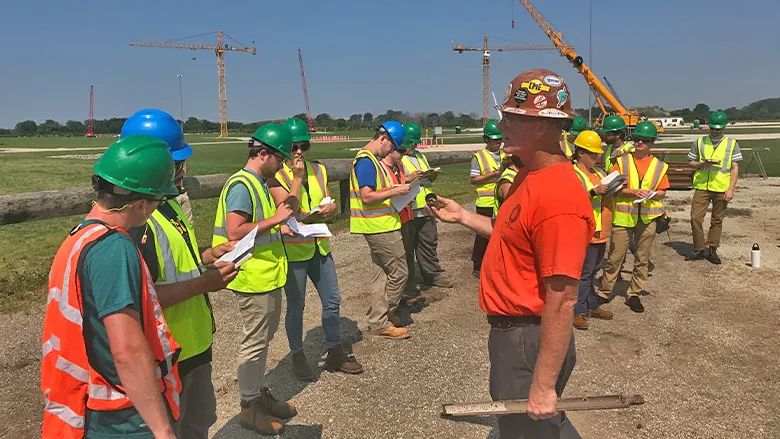
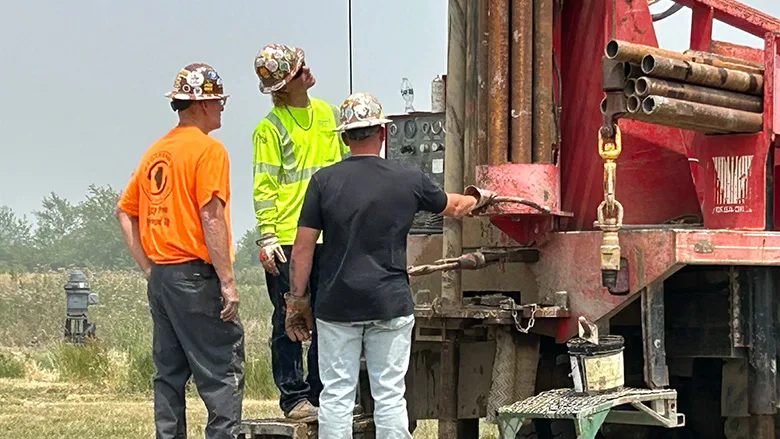
Dave Bowers teaching young engineers and scientists how to work with drillers sucessfully
Photo: Brock Yordy
The Reluctant Driller: From "Sink-or-Swim" to Mentorship
Stepping from a drill rig into a classroom is one of the hardest transitions in the trade, and Dave knows the pitfalls of unstructured training because he lived them. After he was laid off as a cabinet maker, his transition to a drilling operator became a sudden trial by fire when the lead driller had to leave the jobsite for a family emergency, pointed at Dave, and told him he was the driller now.
What they want is value for their work.
"I had people help me here and there, but I wound up teaching myself and then later had to find out, 'Hey, was I doing any of this right?'" Dave reflected on a 2025 episode of Drillercast, which we co-host. "And some of it was right, and some of it was completely the wrong process."
While sink-or-swim moments forged many legacy operators, Dave's leadership perspective solidified years later under Dominic Sazi at Rock and Soil. Sazi approached crew development with profound respect, proving what happens when experienced operators invest in their people.
Still, when Dave made the leap to formalized drilling education, trading the yellow logbook for a classroom whiteboard brought immediate culture shock.
"Before I taught my first class, I was like, 'Why did I take this? I don't even like people,'" Dave admitted with a laugh. "That was more of the driller field mentality that I've had to learn to get around. I'm now able to slow down and talk about the steps necessary: 'Here's what you should do, here's why I think you should do it, here's your other options.'"
Over 17 years of collaborating, I've watched him turn that initial reluctance into unwavering dedication in front of pre-apprentice classes. Dave firmly believes retiring the trial-by-fire mentality is the only way to safely scale a 21st-century workforce.
"So much of it has been self-taught, and people have gotten away with doing things that weren't technically sound," Dave explained. "Then you don't look for 'What caused the downhole issue?' So, you struggle with fixing those problems."
Ending the "Watch Johnny" Method and "Self-Making Mud"
With Local 150 placing a steady pipeline of first-year apprentices into the field annually, Dave's mission is building operators who make sound decisions. He notes that the biggest mistake expanding companies make is assuming their highest-producing operator is automatically qualified to train the next generation.
"A lot of companies are faced right now with figuring out, 'Well, how do I develop these new people?'" Dave said. "And it really shouldn't be that we set them on the back of a rig and they do what Johnny does. He may or may not be technically sound. He may or may not explain things properly. Just because Johnny's your fastest or best driller doesn't mean he's going to be good at teaching the next driller."
Left solely to a single operator's habits, apprentices inherit "cowboy" shortcuts, and crews struggle with downhole fundamentals when formations shift.
Dave's passion for mentorship shines brightest when helping crews untangle these exact messes. He recently took a troubleshooting call from a crew struggling on a slow test hole in a hard, friable formation. Running straight water with a small roller cone, they were entraining fine cuttings into the water, increasing mud weight and slowing penetration rates.
"I had to explain to him what's happening when you're 'self-making mud'... you're actually shearing those solids up, and that's creating self-made mud," Dave recalled. "You want those solids to be removed at the surface; every time it goes back down, the mud weight increases. Plus, that roller bit has the wrong cutting action for that material compared to a drag bit."
Dave walked the crew through switching to a drag bit and mixing bentonite with a clay inhibitor and surfactant. Yet the crew pushed back with the classic refrain: "Well, we don't have that," and "We don't do it that way."
"You've got to be willing to take the knowledge from somebody. It's called indirect learning," Dave noted. "I don't need to put my hand on a piece that we just welded to know it's hot."
Less Chalk, More Mud: The Bowers Method
Above all else, Dave champions getting apprentices out of the classroom and onto the rig. Once Local 150 apprentices earn baseline competency in operating procedures and safety, he pairs short morning theory blocks with hours in the field.
"While I have them, I want to teach them the best process to be successful for a couple of hours in the morning and then go reinforce it for the rest of that day," Dave said. "There has to be a knowledge check to show not just do they know what the knowledge is, but can they apply the knowledge? And that's why we do proficiencies to ensure they can not only describe it but also perform it."
To break entrenched habits, Dave advocates rotating helpers across different crews every few months to see multiple approaches. Because drilling is fluid and reactive, he also teaches young drillers to question whether a habit is truly the latest best practice, framing every borehole through a field risk review.
"There is no one answer in drilling, so you have to be able to give whomever you're trying to develop a large enough scope that they can make the best answer," Dave said. "We can't control that we could get stuck or have a job go slowly; those are all risks that are always going to be there. We need to be reasonably sure that we give them the tools to mitigate that risk as much as possible."
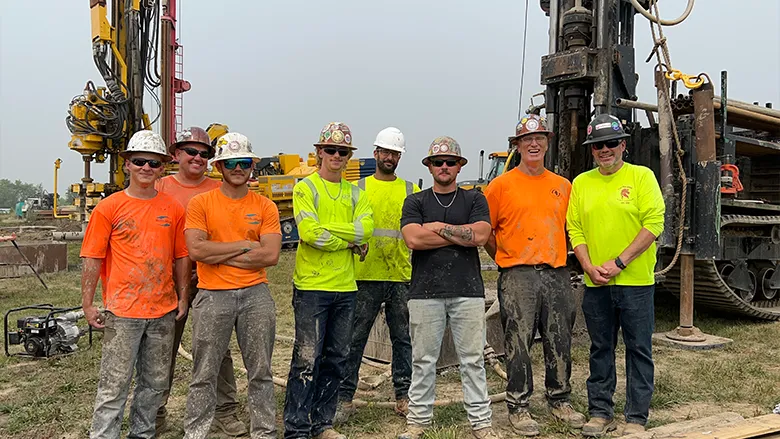
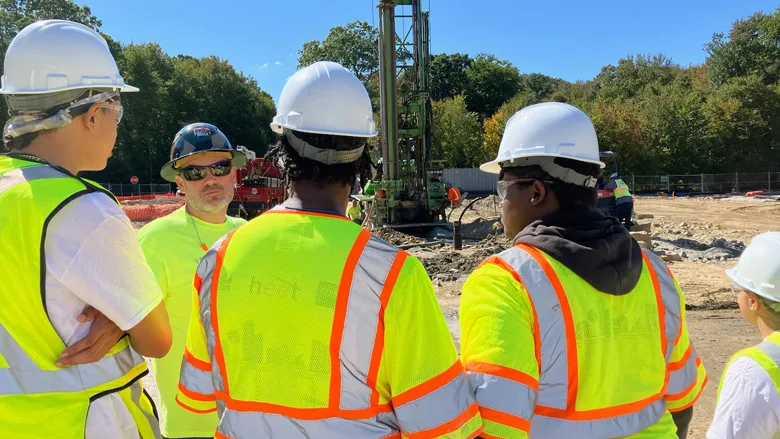
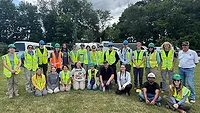
Dave Bowers and Brock Yordy with apprentices in the field training
Photo: Brock Yordy
Engaging Gen Z and Keeping the Promise
Watching Gen Z become the core of the field workforce has only fueled Dave's passion for defending young drillers against outdated jobsite tropes.
"Too often I hear, 'These kids don't wanna work'; that's not true. What they want is value for their work," Dave stated emphatically. "These kids have been raised to ask the question, 'Why?' They want some buy-in that, 'Hey, I'll give you my labor as long as I understand what's coming back to me.'"
Accountability, however, cuts both ways. As contractors hire for the next project surge, Dave warns companies must cross-train drillers to pivot between water well, geothermal, geotechnical, and construction markets when cycles ebb and flow.
"As soon as you say you're running an apprenticeship, you're making a promise to somebody to get them a career," Dave emphasized. "We owe it to them to be flexible enough that we do the best we can to recession-proof our companies."
After 17 years of traveling to rigs, classrooms, and trade shows with Dave, I am profoundly thankful for his dedication to leaving this trade better than he found it. Dave doesn't do it for the glory; he does it for the legacy.
"This industry has given not only myself, but a lot of people that I've had contact with, a livelihood, and that's really what we're after," Dave concluded. "We're gonna help the world in some way or another, but the best way to help somebody is to let them make a living wage, make a career, feed their family, and have the best life possible, albeit within 30 feet of the back of a drill rig, getting muddy."

Want More Geothermal Insights?
Explore the inaugural Ground2Grid Thermal Energy Summit, launching in 2027, and connect with the ideas shaping the future of geothermal energy. Learn more.
Looking for a reprint of this article?
From high-res PDFs to custom plaques, order your copy today!

Brock Yordy, Director of Industry Engagement for The Driller, is a third-generation driller and globally recognized subject matter expert who has written for The Driller since 2013. Driven by a passion for industry education and digital media, he anchors The Driller Newscast and hosts weekly podcasts for the trade. His technical authority is backed by decades of extreme fieldwork worldwide for organizations like Halliburton, SUEZ, and the U.S. Government. Dedicated to ensuring clean water for all and advancing equitable geothermal heating and cooling, Brock actively collaborates with states nationwide through The Developed Well Group and the Geothermal Drillers Association to shape policy, safety, and workforce training.
email: brock@thedriller.com | office: (269) 348-5156