Honoring our Veterans
Sword, and Pen: Driller contributor J.J. Smith recalls how the USMC made him into the journalist he is today, nearly 50 years later.
The base newspaper—The Henderson Hall News—published Smith's first bylined story. Today, he's still covering government affairs as it pertains to the drilling industry
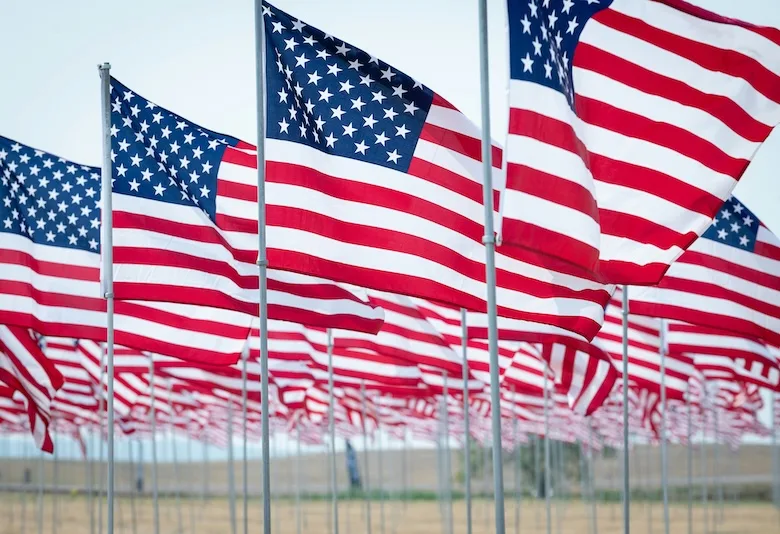
On this Veterans Day, I believe its time to look back at my military service, the mission it served, and how it impacted my life. I enlisted as one of Uncle Sam’s Misunderstood Children (U.S. Marine Corps) while still in high school; my enlistment was more out of a desire to leave my hometown of Buffalo, N.Y. and see some of the world than to serve my county and the first place I got to see was “Paradise Island” (a.k.a. Parris Island) deep in the bowels of a South Carolina swamp.
Parris Island wasn’t such a bad place as long as you don’t mind hundreds of sand fleas swarming around your crotch while you do sit ups, or being on the receiving end of an enraged psycho—called a “drill instructor”—who has made it his mission (every action in the military is a “mission”) to scream all of your shortcomings at you. Such kind sirs were easily identified by their ornate headgear — designated as a “campaign cover”— and who would place some recruits on his “list” (and I don’t mean his Christmas card list), which was a schedule that marked the recruits for extra humiliation (like Jello, at Parris Island there was always room for humiliation).
However, like all good things, recruit training reaches the end of the normal 12-weeks, and the recruits graduate out into the Corps (that is unless you injure your right leg fallowing of the aptly named “slide for life” and have to spend a few weeks in medical platoon to convalesce before being declared fit enough to return to training where you then injure your right arm because your pack strap was to tight pinching your shoulder nerve causing your arm to palsy and are sent back to medical platoon to convalesce for another few weeks before being declared fit enough to return to training; during this period training might be out of the question, but not marching, something the non-commissioned officers (NCOs) in charge saw as their mission and they would march the convalescing recruits everywhere (we were Marine recruits after all); I can still hear the command, “Forward limp!"
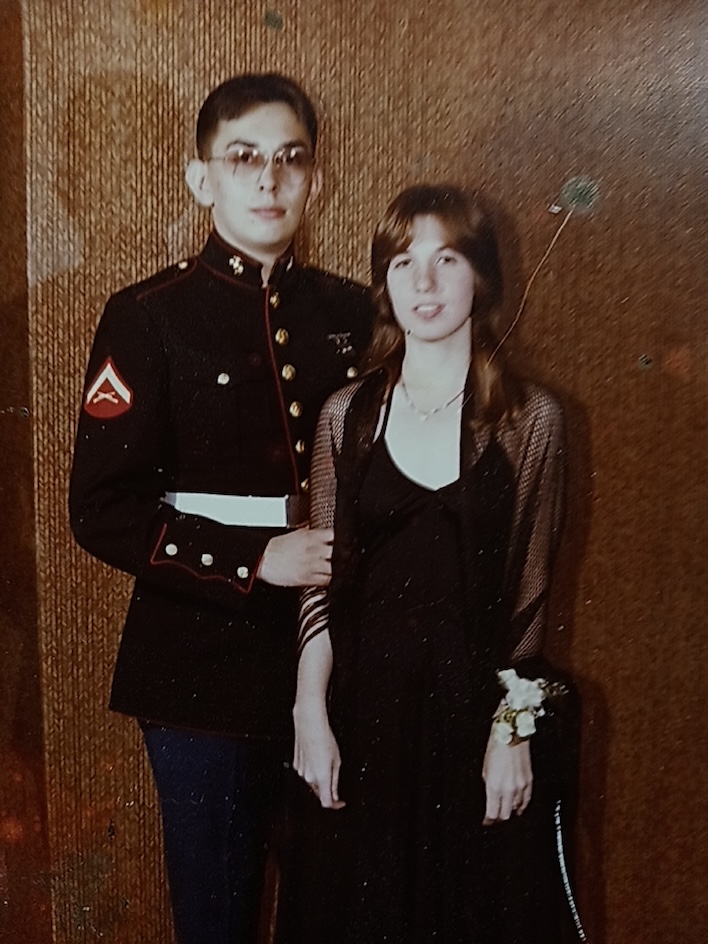
Lance Corporal Joseph J. Smith and his wife Alison attend the Marine Corps Birthday Ball.Image courtesy: J.J. Smith
Nonetheless, despite the delays caused by injuries, recruit training came to an end and Paradise Island would be in the rear-view mirror of the bus as it took new Marines to the airport and their next duty station to train for their “military occupational specialties” (MOS), their jobs. Once that was complete, then it’s on to a permanent duty station. I had the good fortune of being ordered to the impressive sounding Headquarters Marine Corps at Henderson Hall in Arlington, Va…where I was assigned to the motor pool. Admittedly, not very glamorous, but as Staff Sergeant John Soley (who held the post of “truck master”) once said to me, “We may not be the pride, but without us the pride don’t ride.”
Even in the motor pool I was an outsider for I wasn’t a driver, dispatcher, or mechanic, but an “office pogey,” which meant I processed paperwork, including ensuring that requests for vehicles were coordinated, and I wrote reports…lots of report, including “the morning report”; “the weekly activity report,” which accounted for every mile driven, every gallon of gasoline consumed, and every man-hour spent driving; and—most importantly—vehicle accident reports [of which there were plenty])…with those reports being, you know, the mission.
While the morning and weekly activity reports were dull and mind numbing, accident reports were anything but. The Washington, D.C. area is a “military district” and there are an incredible number of military vehicles cruising about the city. Sometimes those vehicles would bump into other vehicles (both military and non-military). The accidents would be investigated and a determination made if the military driver was at fault or not (which determined if the Marine Corps would pay up or not).
Writing accident reports impacted my life in a way I never imagined. First, after being approved by the Officer in Charge (a first lieutenant who rarely raised his voice), the report would be sent to the base judge advocate general’s office (commanded by a major); and then to the battalion commander (a colonel). What I found out was those individuals were actually reading my accident reports because—after many reports—on one nondescript day, I was ordered to report to the battalion headquarters for re-assignment (in the Marine Corps that’s called: “The sea-bag drag”). I had no idea why, but soon found out a body was needed on the base newspaper—The Henderson Hall News—which still publishes today, but as The Joint Base Myer-Henderson Hall News [turns out that in 2009 Marine Base Henderson Hall merged with Army Base Fort Myer].
Nonetheless, while it was still The Henderson Hall News, I was conscripted to help write and produce the weekly publication (keeping the troops informed was the mission). At first I wrote things such as what the menu at the chow hall was for the coming week; or what movies were scheduled for the base theater (they actually showed Flesh Gordon, I don’t know how they got that one through); or photo captions. Eventually, I grew bored with those tasks, and asked for more stimulating work, and to my surprise, the NCO I reported to sent me on photo assignments (usually, promotion or award ceremonies, which are called “three men and a piece of paper”). I did well enough at those that I finagled an actual story assignment.
The story was about a lieutenant from H.Q. who organized a fund raiser for the charity Navy Relief in which he ran laps around the base (which is about the size of a community college) for 24-hours. Monetary pledges were made for each lap the lieutenant ran, and I got the assignment because the officer ran on a Saturday and I was the only one willing to cover it on a day off. I interviewed the officer before he began, and I had the good fortune of being there when the class that was currently training at the Marine Security Guard School (which trained at Henderson Hall before moving to the base at Quantico, Va.) came out to run with him. I took photos, and the story was my first bylined article. That assignment wasn’t a lightening bolt epiphany, but it planted the seed of serving in my own way, and that’s when I decided to pursue journalism as a career (thank you Marine Corps).
I worked on that newspaper until I was “separated” from the U.S.M.C. (separated is military speak for discharged), and enrolled in college. Four years later and a few weeks after graduation, I joined the staff of a Washington, D.C. wire service. However, that is not where I consider the beginning of my career as a newsman. That was at Henderson Hall (again, thank you Marine Corps).
Looking for a reprint of this article?
From high-res PDFs to custom plaques, order your copy today!