Making Safety Effortless
Stop Asking "What Were You Thinking?" After a Safety Incident
Why understanding risky decisions can lead to safer work
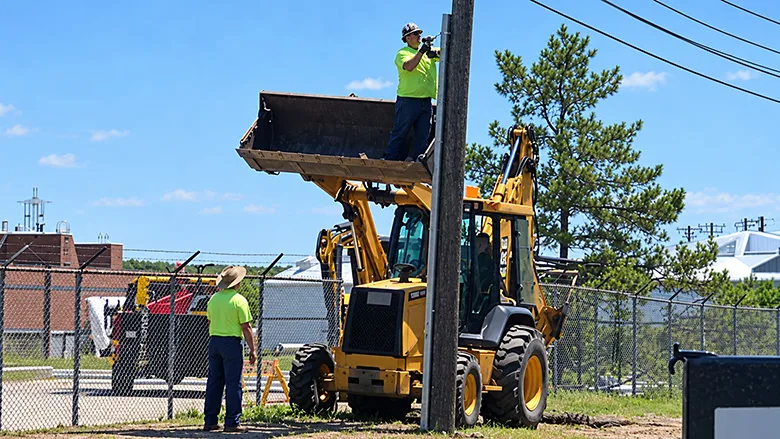
So, my wife Robin and I were driving somewhere, talking about something, and I started to slow down and pull over into a parking lot along the roadside. My wife of many years knows me all too well.
Robin:"You're turning around, aren't you?"
Me: "Yes.” I turned around to take this picture. I think you'll agree this picture is priceless.
Robin: So, what do you see? Unsafe behavior? Disregard of proper procedures? Improper PPE?
Me: I see three people consciously trying to solve a problem. That's after assessing risks, evaluating available resources, and considering time constraints. These men are trying to solve a problem right now.
This is how work gets done. And it's usually not until somebody gets hurt that anyone asks, “What were you thinking?"
Put Yourself in Their Boots
We don't know what happened before I drove by. We don't know what they were told, what equipment was available, or how many times they had done something similar before. So I'm not going to pretend the photograph tells us everything.
Let's instead look at the job from where they were standing for a minute.
- The work had to get done.
- Ladders are heavy. The ones long enough to reach that height are even heavier.
- Leaning a ladder against that pole doesn't exactly strike me as a brilliant Plan B.
- The ground isn't ideal for every type of lift.
- And there sits a backhoe with a bucket that goes exactly where they need to go.
I'm not saying that makes the solution safe. It doesn't. I'm saying I can see how they got there.
And here is the truth: Nobody on this job thought getting hurt was possible doing it this way.
All three people believed they found an effective way to get the work done. In this case, they were right. Nobody got hurt, and the work got done. There is no way to know whether this was the first or fifty-first time they had done something like this. Because it worked, there is also no reason to believe it was the last.
The Problem With "It Worked"
That may be the most important part of the picture. At the end of the day, nobody gets a message saying, "That worked, but you got lucky." The feedback is much simpler, more concrete. Do something successfully enough times, and it stops feeling like a shortcut. It becomes experience. Eventually, it can become, "This is how we do it." Drillers understand this better than anyone. Crews solve problems for a living. Ground conditions change. Equipment breaks. The site is not quite what somebody expected. The right tool is on another rig or back at the yard. The weather is changing. The customer is waiting, and you still have a hole to drill. Good drillers figure things out. We want them to. The last thing we want is a crew that stops thinking when reality no longer matches the plan. But experience can make us very good at finding ways to make something work. Previous success can also convince us that the way we made it work was a good way to do it.
Those are not always the same thing.
Maybe "What Were You Thinking?" Is the Wrong Question
After somebody gets hurt, we have the luxury of knowing the outcome. The person making the decisions did not have that knowledge and never really thought "that bad" was possible. If they had, they wouldn't have done it.
That difference matters.
Once we know the outcome, the bad choices and right decisions can seem painfully obvious. Then comes the question: "What were you thinking?" Look at the photograph again. There are three people involved. Whatever thought process got that person into that bucket, and whatever made that operator lift it, apparently made enough sense to all three of them at the time.
That doesn't make it safe. It makes it worth understanding.
Instead, "Why did this make sense to them?" Is the Right Question
Now we can have a useful conversation.
- Was the right equipment available?
- What was the original plan?
- What happened when the original plan didn’t fit the job?
- Was stopping and getting something different really an option?
- Was there pressure to finish?
- Had this worked before?
- In a perfect world, how should this be done?
Sometimes the answer will be that the company did not give the crew what they needed. Sometimes it will be production pressure. Sometimes it will be habit, convenience, or overconfidence. And sometimes somebody simply came up with a shortcut, tried it, and it worked.
We don't need to excuse the decision, but we do need to understand it well enough to keep the same decision from being attractive. Or better, how do we make the right way the easy way?
Where Does the Plan Meet the Work?
Would a company leader plan the work in this photograph this way? Probably not.
Would we put it in a procedure or a pre-task plan? Of course not.
Yet there they are. Somewhere between how somebody thought the work would be done and how it was actually done, something changed.
That gap is interesting.
When I walk a job, I don't just want to know whether people are following the rules. I want to see where they are improvising. Where are the workarounds? What tool did somebody make because the right one wasn't available? What step does everybody quietly skip because it makes no sense in the field? What piece of equipment is routinely doing a job it was never really intended to do?
And when somebody says, "We've always done it this way," my ears perk up. Not because I automatically think they are wrong. I want to know why that way survived.
Make Safety Effortless
The people closest to the work usually know where the pebbles are in their shoes. Ask them.
- What makes this job harder than it needs to be?
- What do you wish you had when you do this work?
- What part of the plan never survives contact with the job?
- Where do you find yourself improvising?
- What would make the safer way easier?
Those questions get you a very different conversation than walking onto a site looking for violations. The goal is not to take ingenuity away from drillers. That would be a mistake. Their ability to adapt and solve problems is one reason the work gets done. The goal is to remove the friction that makes an unnecessarily risky choice attractive.
That is what I mean by making safety effortless.
Not effortless because nobody has to think about risk. Just the opposite. Make it easier for the person doing the work to make the better decision without having to fight the equipment, the schedule, the procedure or the organization to do it.
Look Again
Look at the photograph one more time. I'm not asking whether you would allow the work to continue. I wouldn't. I'm asking for something more useful. Why did three people, standing right there with the job and the equipment in front of them, decide this was the way to get it done?
Then take that question back to your own operation. Where could a photo like this be taken in your organization?
Looking for a reprint of this article?
From high-res PDFs to custom plaques, order your copy today!