A Church’s Geothermal Experiment Could Pave the Way for Projects Across New York
.webp?t=1775702216)
Image via knowlesgallery from Getty Images
This story is courtesy of Inside Climate News, written by Lauren Dalban.
The Rev. Kurt Gerhard stood near the lectern in Christ Church Bronxville. Beneath him, a network of pipes stretched into a nearby parking lot, where boreholes have been drilled hundreds of feet into the ground.
The lingering March chill hung in the air, so water was piped into these deep vertical shafts, absorbing heat from the ground, and then sent through a network of pipes into heat pumps, warming rooms across the church and the attached buildings.
The church was built over 100 years ago to serve the small but growing community just a few miles outside the Bronx in New York City. The new system began operating less than six months ago—and it’s working. It offers a model for reducing emissions in some city buildings.
Installing geothermal systems in dense New York neighborhoods involves strict safety regulations and careful planning to avoid underground conflicts like subway or water tunnels. For existing properties, engineers must find suitable nearby space to drill into the ground.
Even in less-dense neighborhoods, like in Long Island or Queens, engineers say they are often drilling into unstable artificial fill, placed there to facilitate building construction on unstable ground.
Every summer, hundreds of parishioners would swelter at Christ Church Bronxville, which lacked air conditioning.
“Our church was only available in the morning, and it was 85 degrees in there because of the heat outside,” Gerhard said.
The church is attached to two buildings with offices, apartments and a child care center. Though there were window air conditioning units in the rooms, the building hallways were still hot—too hot for the children.
Despite high upfront costs and some federal tax credit rollbacks, many companies and property owners find geothermal systems financially viable due to long-term savings and incentives. Local utilities offer financial support for owners making the switch, and some federal tax rebates for commercial and multi-family buildings remain—for now.
Since 2019, New York has passed laws that incentivize these kinds of projects. Local Law 97 places escalating limits on building emissions—with considerable penalties for those who exceed them—over the next two decades. Another law prohibits the use of natural gas in a slowly expanding list of new buildings across the city.
An initiative by the state regulatory body for utilities calls on them to build more geothermal systems as part of the state’s push to reduce greenhouse gas emissions, as set out in New York’s Climate Act.
For months, Gerhard said, church leaders deliberated on whether to install a new boiler and air conditioning units—or to go with a more complex but longer-lasting solution.
Ultimately, they chose the latter, reflecting a growing trend in urban areas to adopt geothermal despite challenges.
The Church’s Calling
Geothermal energy systems can vary, but they usually involve a water loop that runs underground and through one or more buildings. The energy network uses the Earth’s constant temperature deep underground to regulate temperatures across the property.
Geothermal systems can also be very efficient; during the summer, some systems can store excess heat in the ground until winter, when it is needed. Heat pumps provide additional warmth or cooling depending on the time of year.
The system runs on electricity. If a building previously relied on natural gas for heating—which is common in New York—the installation drastically reduces the amount of greenhouse gases it releases. Buildings make up more than two-thirds of New York City’s emissions, and a significant amount of the state’s.
Gerhard walks through the halls of Christ Church Bronxville at a brisk pace, stopping briefly to greet colleagues or a local visitor. He views improving the environment as part of the church’s “calling.” The new system, he said, would also last longer, ultimately avoiding expensive replacements, such as a boiler. The capital campaign, which aimed to raise $1 million to help pay for the project, was dubbed “The Next 100,” referring to the church’s century of operation.
The boreholes—the underground pipes—usually last at least 50 years, according to Zachary Fink, the founder of ZBF Geothermal. The company led the project at the church, which took a little more than a year to finish.
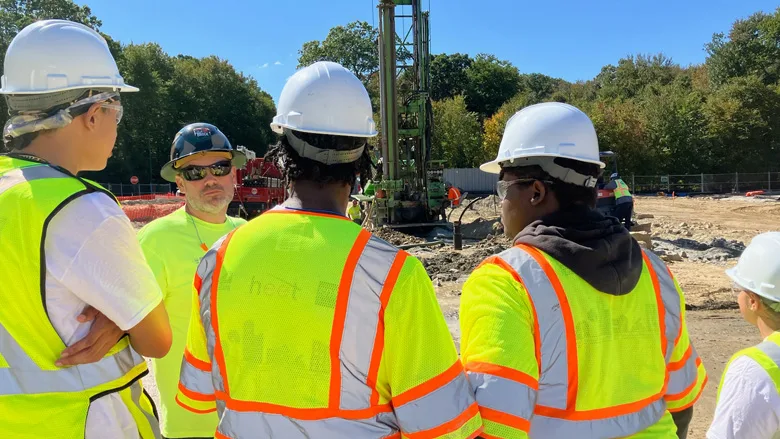
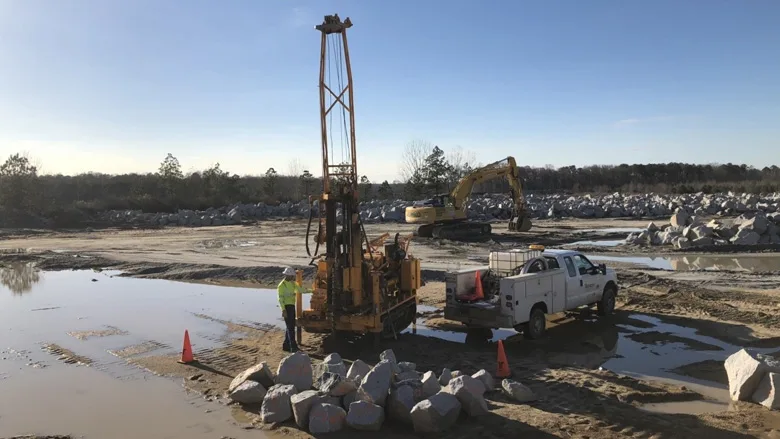
Converting an existing building to a geothermal system requires planning and space to drill boreholes. Fink found space in the church parking lot, drilling 14 boreholes—some at an angle so they extended beneath the church complex.
From the ground, water is pumped up into the building through a network of copper pipes that connect to heat pumps in rooms and hallways across the property. Crews removed radiators, steam pipes and most window air-conditioning units.
The church also had to upgrade its electrical system to accommodate geothermal. By March, the local utility, Con Edison, was still working on the final changes to kick the full system into gear. According to an annual financial report published by the church, the total cost of the new system was around $4.4 million.
After considerable federal tax rebates and financial incentives from Con Edison have been paid out, the church estimates it will have around $418,000 in remaining costs, which it hopes to finance over several years.
Rebates, Incentives and Cost Models
In Coney Island in Brooklyn, Ecosave, an engineering firm that designs and builds geothermal systems, drilled over 100 boreholes. A 463-apartment development was later built above the boreholes, drilled over 500 feet into the ground.
This project would bring the Coney Island property owners into compliance with future building emissions limits, which was seen as an “added advantage,” said Arjun Mehta, the vice president of project management at Ecosave.
And there are also incentives. New York’s Public Service Commission, which regulates local utilities, directed the seven largest investor-owned ones to develop at least one pilot geothermal project. By 2024, there were 12 pilot projects in active development—including three at Con Edison, the main electric utility in downstate New York.
The Bronxville church received over $876,000 from Con Edison to help cover the installation of its new system through incentives for commercial and multi-family buildings, and is expecting around $1.4 million from the federal government, according to its annual financial report.
The One Big Beautiful Bill Act, which passed Congress last year, repealed the residential clean energy credit, so any expenses incurred by single-family homeowners for renewable energy installations after 2025 will not be mitigated by a 30 percent income tax credit.
The church, however, is considered a commercial property, so it can still reap tax benefits from installing a geothermal system. The One Big Beautiful Bill Act repealed the deductions only for properties where construction begins after June 30.
The church chose to pay for construction upfront, but in New York City, a new payment system for geothermal projects is gaining traction—energy-as-a-service. This is a model that Ecosave also uses.
In Coney Island, Mehta’s company paid the upfront cost of the geothermal system. Over the next 15 to 20 years, he said, energy savings will help him recoup the installation cost.
Checking for Fatal Flaws
ZBF Geothermal’s Fink said he has installed geothermal systems in buildings all across the five boroughs. When property owners reach out, he assesses the ground beneath the building (or the construction site) for any fatal flaws, as he calls them. This could be anything—a nearby water tunnel, a subway line or even contaminated soil.
The city’s Department of Environmental Protection, which manages the water supply, has tunnels that run underground to deliver drinking water to the city. If the building is within 200 feet of the tunnel, any drilling or excavation requires a permit, which Fink said can be “costly and burdensome.”
Superfund sites—areas being monitored and remediated by the U.S. Environmental Protection Agency, usually due to the mismanagement of hazardous waste—can also be a death knell for geothermal projects, he said. Drilling at these sites can require extensive EPA paperwork because it risks disturbing contaminants in the ground.
Geological conditions are also a consideration. Rock fills the ground underneath most of the Bronx, according to the U.S. Geological Survey. But parts of Queens and Brooklyn—especially in coastal areas—sit atop artificial fill, a mix of materials that enables building construction on otherwise unstable ground.
In Bronxville, Fink drilled boreholes into hard rock, which means he could stop and start at his leisure. But in Queens and Long Island, Fink is often drilling into artificial fill. Boreholes there are limited in depth because they have to be drilled all in one go—otherwise the unstable ground could shift, filling the newly drilled borehole.
In Coney Island, Mehta had to shore up a planned development area because the project would be built near the coast.
“When we talk about geothermal, we always think about a massive playing field where we can put in boreholes … but that doesn’t work in especially dense cities like New York,” said Mehta. “How we overcome that is perfect coordination.”
Looking for a reprint of this article?
From high-res PDFs to custom plaques, order your copy today!