Financing Thermal Energy Networks: Capital Flow Determines Whether Rigs Move
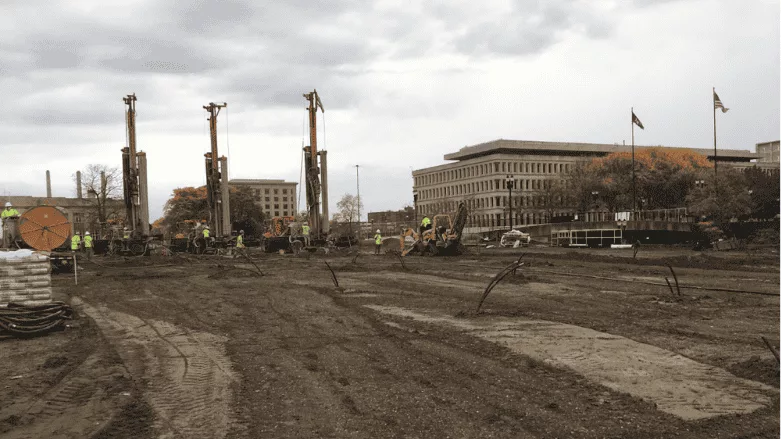
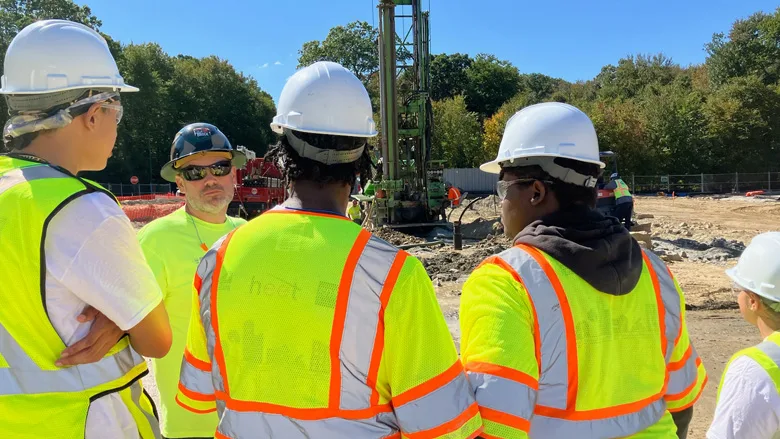
Image courtesy of Midwest Geothermal
Thermal energy networks (TENs) are experiencing a surge of interest across the United States because of their efficiency, decarbonization, and affordability benefits. TENs are infrastructure-scale heating and cooling systems that require large capital investment: horizontal pipes, geothermal heat pumps, and, often, geothermal boreholes. Thirteen states have passed some form of TENs-related legislation, often allowing investor-owned utilities to build and finance TENs pilots. Outside of legislation, many municipalities and campuses are constructing these systems to provide reliable, non-combusting heating and cooling to their buildings.
This accelerating interest means TENs present large-scale opportunities for drillers. But unlocking drilling work begins with unlocking dependable and affordable financing.
The Building Decarbonization Coalition’s Financing Thermal Energy Networks: A Reference Guide for Municipalities and Community Advocates explains how communities, advocates, municipalities, and project partners can overcome upfront capital barriers so projects actually get built. For geothermal drillers, the financing groundwork—and the methods that decision-makers use to access capital–directly determines whether projects scale or stall. The right financing structure means more installations, faster project timelines, larger borefields, and a steadier pipeline of work.
Here, we’ll describe the forms of capital that communities, municipalities, and property owners seek when designing the projects that bring drillers to the job site. When capital flows efficiently, rigs can move.
TENs Are Infrastructure, and Infrastructure Requires Capital
TENs are capital-intensive. Building a TEN requires the system owner(s) to make a significant upfront investment to construct energy centers and pump houses, lay distribution piping, complete building retrofits, and, of course, when using geothermal energy, drill a borefield or well field. In many projects, the borefield is the single largest line item in the budget and the component most vulnerable to cost pressure. If capital is short-term, high-interest, or structured with restrictive draw schedules, then projects often get downsized, phased slowly, delayed, or outright canceled.
Affordable, long-duration financing allows scaled-up systems to be built as intended—maximizing the amount of clean heating and cooling to customers—rather than value-engineered into something smaller and less impactful. For drillers, that distinction can mean the difference between 300 boreholes and 80 boreholes.
We know that drilling costs vary significantly by region. Workforce capacity, borehole size, depth to bedrock, soil conditions, and much more can influence the cost per foot of drilling. The National Laboratory of the Rockies’ 2025 U.S. Geothermal Market Report recently reported wide regional variance for completed boreholes, from a typical ~$12–$16 per foot in Texas and Oklahoma to ~$19–$30 per foot, with extreme cases exceeding $90 per foot, in the Northeast.
Higher drilling costs increase the need for affordable, long-duration financing. Without it, projects face scope reductions or delays before drilling ever starts. In high-cost regions especially, financing can be the gatekeeper to a project.
A Multi-Player Game: Utilities, Municipalities, and Communities Access Financing Differently
Investor-owned utilities play a growing role in funding and owning TENs. Regulated utilities have unique access to financing: these entities can undertake building a TEN similar to their existing investments in the gas system, using rate recovery to finance the cost of a project over 50 or 60 years.
But regulated utilities are relative newcomers to the game. Colleges and institutional campuses have long built TENs as long-term solutions to maximize their energy efficiency and reduce their energy usage. What’s become clear in the past five years, as states allocate portions of their budget to fund geothermal heating and cooling feasibility studies and the Department of Energy funds district-scale thermal energy networks, is that municipalities, community advocates, school districts, housing authorities, and nonprofits are increasingly exploring TENs as clean, localized infrastructure solutions that fit with long-term business plans and decarbonization goals.
Many of these entities are new to energy infrastructure finance and need more education on how these projects are structured, funded, and deployed in order to bring TENs to their communities.
Patient Capital Is the Key
TENs require patient capital: long-term, affordable financing aligned with 30–50+ year infrastructure lifespans. Some of the primary mechanisms communities currently use to finance their thermal networks include municipal bonds, green bonds, state revolving funds, low-interest debt from green banks, and public-private partnerships.
Municipal bonds provide long-term, often tax-exempt capital that local governments can issue to finance infrastructure. Municipal bonds are commonly used to fund public transit, water and sewer systems, and public spaces; for TENs, bonds can be used to support drilling borefields and other components with long lifespans, which match the repayment term of a municipal bond. Green bonds are structurally identical to conventional bonds, but include commitments to use funds for environmental or climate purposes.
State Revolving Funds (SRFs) are state-run low-interest loan programs, often for water and energy projects. SRFs can sometimes support TEN components, depending on their availability in each state. For drillers, this can mean lower-cost capital supporting borefield installation.
While emerging in many states, green banks are public or nonprofit financial institutions that leverage public funds to then attract private investment in clean infrastructure. Green bank loans are typically lower-interest and, as such, are particularly important for derisking first-of-their-kind projects, which can include TENs in many communities. Their lower cost of capital reduces risk, and increases the likelihood that drilling scopes remain intact.
Finally, public-private & public-public partnerships (PPPs) are exactly what they sound like: formal partnerships between cities and private developers—or between public entities such as municipal utilities and other local agencies — that share resources and risk. This allows municipalities or public agencies to initiate borefield construction earlier by combining their own time and money with the financial backing, staff capacity, or expertise of a partner.
Financing Is Also a Community Issue
Financing doesn’t just live in spreadsheets; in many cases, it depends on public approval. The Building Decarbonization Coalition’s Financing Thermal Energy Networks: A Reference Guide for Municipalities and Community Advocates emphasizes community engagement throughout all phases of TEN development. Without community buy-in, projects can stall at permitting hearings, bond votes, or city council approvals as community members grapple with cost implications and impacts. But with community buy-in, appropriate financing models can bring borefields to schools, public housing, and hospitals.
It is likely beneficial to drillers to engage early in these community-driven conversations. As an expert, your team brings technical credibility and firm cost estimates to crucial financing conversations that determine how, and if, budgets get built. Communities will want answers around noise mitigation and environmental protection. Project developers will need to understand subsurface risk. If municipalities and school districts debate bond measures, a drilling team’s cost estimates and realistic schedules can make proposals concrete, instead of simply conceptual.
Bottom Line: Financing Shapes the Project and the Market
The availability of municipal bonds, the terms of SRF loans, and the structure of public-private partnerships can directly influence the drilling project pipeline. As municipalities, communities and advocates become familiar with the types of capital they can access, drillers can position themselves for success by engaging potential clients and system owners early; helping clients build realistic budgets for drilling; advocating for financing mechanisms that support thermal energy networks at scale; and participating in conversations in the rooms where projects are conceptualized and shaped.
The market for thermal energy networks is expanding rapidly, driven by decarbonization mandates, infrastructure investment, and innovative financing models. The drilling contractors who understand this financing landscape, and position themselves as community partners in project development, are likely to capture the lion’s share of this growing market.
Looking for a reprint of this article?
From high-res PDFs to custom plaques, order your copy today!