How Smarter Solution Delivery Systems Are Reshaping Heap Leach Efficiency
Modern Irrigation Tech That's Changing the Game
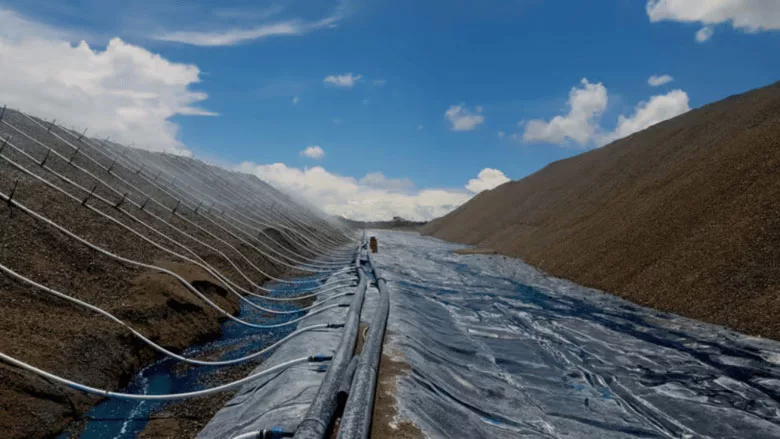
In the field of metal extraction, heap leaching has long played a pivotal role, especially in the recovery of gold, copper, lithium, and other critical minerals from low-grade ore. The process is straightforward in principle: apply a water-based chemical solution to ore that's stacked on a lined pad, the leachate percolates through the ore, and target metals are extracted. But how that solution is delivered makes a measurable difference, and innovation here is long overdue.
Many mining operations still rely on the long-used legacy systems like wobblers and flood. While these methods are familiar and relatively inexpensive to install, they are susceptible to known problems: uneven application, overspray, drift, and pooling. For a process that unfolds over 90 to 120 days, these problems can lead to inconsistent recovery, excess reagent consumption, and expensive yield loss.
Drip irrigation systems, designed specifically for mining, are increasingly being adopted to address these inefficiencies. These systems are engineered from the ground up to handle aggressive chemical inputs, coarse ore, and harsh terrain. Precision leaching systems provide optimal solution delivery, which gives operators tighter control over applications and mineral retrieval, reduces water and chemical waste, and means new ways to work smarter at a time when labor is in short supply.
Better Coverage Starts at the Emitter
At the core of precision leaching is the pressure-compensated emitter. These emitters maintain a consistent flow rate regardless of uneven terrain or pad layout, which is a key benefit in large, multi-level pads. Some systems achieve a coefficient of variation under 5%, vastly improving the diffusion uniformity critical to leaching. That’s a substantial percentage in an industry where margins hinge on fractions of a percent and millions of dollars invested.
Automation Supports Teams Spread Thin
Leach pad operations have traditionally required a good deal of hands-on care from the crew. They must regularly walk the site, checking valves, adjusting pressure, and responding to anomalies. But in today’s tight labor market, that model is increasingly difficult to keep in play. Precision leach systems are designed to integrate with platforms and deploy sensors across the pad to monitor pressure, flow, and line performance. These systems can collect millions of data points per day, allowing teams to detect any imbalances before they turn into expensive problems.
This centralized control reduces labor while redeploying crews for more strategic work. Technicians spend less time examining the pad and can focus more on making data-informed decisions that improve overall operational performance. Every time a valve is adjusted manually, this small action has the potential to ripple across the pad, affecting thousands of emitters over multiple leach pads. With automation, that risk is minimized. Instead, operators can make minor adjustments across the entire system from a single interface, which keeps pressure and application consistent and output stable.
Built for Mining
Agricultural-grade systems can break down quickly in mining environments. Coarse ore, high-pressure demands, and volatile chemical exposure quickly degrade standard ag emitters and tubing. Purpose-built leaching systems consist of chemically resistant tubing, clog-resistant emitter designs, and filtration infrastructure specifically tailored to handle tougher scenarios.
This provides longevity and reliability across the entire leach cycle, with filtration and flushing capabilities that reduce maintenance tasks and extend the life of the components.
Slope Stability and Environmental Compliance
Traditional methods of irrigation, such as sprinklers and flood systems, are known to cause oversaturation that affects slope integrity. A compromised slope turns into real safety concerns and structural risk, especially during heavy rains or in steep terrain. Because precision leach systems deliver the solution directly to the ore pile, runoff is minimized, reducing the dangers of slumping or pad erosion.
It also helps mines stay within the target water and chemical use regulatory requirements. Mining-grade drip systems eliminate overspray and pooling, helping operations better track and report chemical consumption. Some systems use tubing made from up to 50% recycled resin, a more efficient materials profile that doesn't sacrifice performance, in addition to being socially responsible to limited resources.
For regulators, investors, and local communities, verified control over solution delivery is becoming an issue. Precision systems provide the hard data these audiences want to see, like flow rates, pressure readings, and application maps that help mines meet or exceed compliance requirements.
Water Scarcity and Site Adaptability
Water sourcing is a growing concern, especially in arid regions where there are recurring droughts and usage restrictions. Precision leach irrigation systems use water more efficiently, slowing evaporative loss and providing the maximum contact time for chemical-infused water on ore. For sites that are managing recycled water or dealing with limited fresh water access, this becomes a competitive advantage.
Water sourcing is a growing concern, especially in arid regions where there are recurring droughts and usage restrictions. Precision leach irrigation systems use water more efficiently.
Precision systems are also easily adaptive to a range of ore types and pad designs. Whether teams are working with standard run-of-mine ore or finely crushed material, or on sites using static pads or dynamic stacking systems, the irrigation layout, flow rates, and emitter selection can be customized to bring out the best performance.
Smart Scaling for Smart Results
One of the most important aspects of the drip application process is scalability. Precision heap leach irrigation doesn’t require full-system overhauls. Many mines start the process with a single pad or test zone, where they can monitor performance and add sections based on the resulting data. This phased approach keeps upfront costs manageable while providing supporting metrics to justify further expansion.
More installation partners and field engineers are being trained in deploying and maintaining these systems alongside drill-and-blast teams, stacking contractors, and leach pad crews. Increased expertise and collaboration keep operations moving smoothly during transitions.
How to Know When to Upgrade
If your team is thinking about whether it’s time to modernize its solution delivery methods, start out with a few questions:
- Are pressure readings consistent across the pad?
- Are maintenance logs showing frequent emitter clogs or leaks?
- Are labor hours heavily focused on routine valve checks or unplanned maintenance?
- Are there recurring issues with ponding, overspray, or slope stability?
For companies seeing any challenges in these areas, it might be time to evaluate how precision irrigation can support your operations.
Global demand for critical minerals is only growing. At the same time, mine operators face pressure to do more with less — less water, less energy, and fewer crew members. Mines that adopt efficiency-driven methods early are seeing valuable gains, like more predictable recovery, fewer shutdowns, and better resource allocation. For operators who are ready to modernize, adding smarter solution delivery offers a real edge for today and for the long term.
Looking for a reprint of this article?
From high-res PDFs to custom plaques, order your copy today!
.webp?height=96&t=1757831999&width=96)