Bridging Pitkins Curve
California’s State Route 1 is one of the most scenic routes in the world. However, the Big Sur coastline along this highway also is geologically active and unstable. Broken and weak rocks are covered with eroded soils that are highly prone to landslides. As a result of ground water, surface water infiltration, erosion and storms, this area – and particularly Pitkins Curve – has been in constant need of repairs since 1937. Extensive studies revealed that landslides and resulting highway damage would continue to occur indefinitely without a comprehensive solution. Therefore, Caltrans determined that the safest and most cost-effective solution would be to bridge Pitkins Curve, and build a rock shed at Rainrocks, a neighboring area of roadway instability. Golden State Bridge Inc., based in Martinez, Calif., won the $29.4-million contract, and has been on the job since December 2009.
Without a doubt, California’s State Route 1, often called Highway 1, is one of the most scenic routes in the world. Starting in Orange County and twisting north along the Pacific Coast through Ventura, Big Sur and Monterey, then crossing over the Golden Gate Bridge and ending near the Redwood Forest, Highway 1 is known for its rugged beauty.
However, the Big Sur coastline along this highway also is geologically active and unstable, according to the California Department of Transportation’s (Caltrans) Web site. Broken and weak rocks are covered with eroded soils that are highly prone to landslides. As a result of ground water, surface water infiltration, erosion and storms, this area – and particularly Pitkins Curve – has been in constant need of repairs since 1937.
Extensive studies revealed that landslides and resulting highway damage would continue to occur indefinitely without a comprehensive solution. Therefore, Caltrans determined that the safest and most cost-effective solution would be to bridge Pitkins Curve, and build a rock shed at Rainrocks, a neighboring area of roadway instability. Golden State Bridge Inc., based in Martinez, Calif., won the $29.4-million contract, and has been on the job since December 2009.
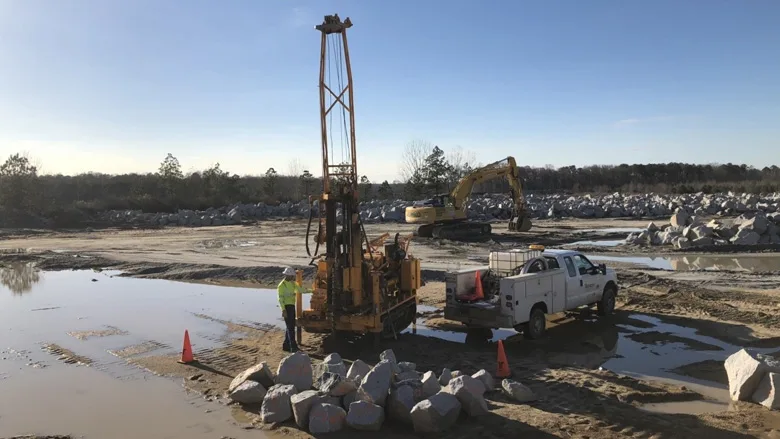
After engineers determined the length of the piles for the trestle bridge, Golden State laid out its locations. With a 120-foot standard swinging lead on the ground, Golden State loads the casing and the Symmetrix system. A Grove HL150C crane then picks up the 120-foot lead to position the pipe pile (casing), and begins drilling. The Symmetrix system advances the casing as it drills the hole for the pile.
According to Doug Podraza, sales specialist with Atlas Copco Construction Mining Technique, Symmetrix is an apt choice for the varying ground conditions at the site. “There are portions of rock, portions of soft material. The material type is constantly changing. There also are angles and steep slopes. Symmetrix makes it easy to advance the casing, and will allow Golden State to use the same pilot bit in order to do both the temporary and permanent casings on the job. The crew will only have to switch the casing shoe and ring bit.”
Golden State has been getting productivity rates of about 1 foot per minute, and they are going 50 feet to 60 feet in actual drilling depth. This means the crew drills a hole in a little less than an hour once it starts production drilling. As a result, about four piles a day are installed, and they are the support for one span of the trestle bridge.
Once the piles are in place, John Matteucci, project superintendent with Golden State, explains that Caltrans requires them to test the piles for strength. “We lay the drill down, and pick up a conventional diesel pile-driving hammer. Then we drive the piles with an impact hammer. We check the length of the stroke – how far the piston comes out of the barrel – in relation to the number of blows it takes to drive the pile 1 foot. The result of the equation calculates the strength or load bearing capacity of the pile.”
Once this is complete, the piles are cut to elevation, and a cap beam is set directly on top and welded to them. Golden State then sets the stringers from the previous point across to the next span. The stringers are welded onto the caps. Finally, 26-foot-by-5-foot crane mats are placed on the stringers. This creates the driving surface for the crane, which advances to repeat the process for the next span.
David Riccitiello, president of Golden State Bridge, points out that the team was fairly certain that it would go with a down-the-hole system on the Pitkins Curve project to ensure that the piles would be in solid ground. The team interviewed a couple of DTH manufacturers, and felt that the Symmetrix system was user-friendly, as well as cost-effective.
“We usually use pile hammers, but we didn’t feel comfortable driving in this material, because it varies between hard and soft. We are running large equipment on the access road and the trestle line we’re building, so we wanted the piles keyed in some fairly hard stuff. I think we’re succeeding in that,” says Riccitiello. “We also could recover a lot of the bottoms that we were going to use, and not spend as much money as other systems to advance the casing.”
Because Golden State is used to pile driving, Riccitiello says that they had a few challenges with drilling at the beginning, but attributes this to the difficult access. “Drilling itself hasn’t been time-consuming, but getting set up to do it in a tiny spot with all the equipment with piles as long as 110 feet is challenging. We can’t set up two cranes side-by-side. As far as the drilling production, we’ve been very pleased with the advancement rate of the piles into the rock.”
Golden State then will construct the foundation, or footing. For this bridge, the footing will be post-tensioned to the pile. A series of rods will extend from inside the rebar cage for the pilings up through the top of the footing. After the footing is poured, a hydraulic jack will tension the rods, essentially cinching the footing and the piles together.
The temporary trestle bridge also will serve as the false work to support the superstructure of the permanent bridge. Two methods will be used to construct the superstructure. From each abutment to approximately 35 feet out past the new piers will be cast-in-place. The remaining 240-foot center span of the bridge will be cantilevered, each section being poured and then post-tensioned. When the two ends are about 12 feet from the center, a closure pour will connect them.
Weather, access and even a landslide have created some challenges, but overall Golden State is pleased with the progress of the job. Riccitiello is quick to credit his team and the support from Atlas Copco. “We’ve been in business for over 20 years, and they are right up there with the best – if not the best. Generally when you buy something you don’t see anybody, but Atlas Copco taught us how to use the equipment and stayed with us on the job. When we had problems, they took action quickly, sometimes overnight with a six-hour drive to Sacramento in order to have equipment fixed and back on the job by morning. We ultimately feel this will be a successful job, and a big part of it will be the DTH hammer for sure. We’re very happy.”
ND
Without a doubt, California’s State Route 1, often called Highway 1, is one of the most scenic routes in the world. Starting in Orange County and twisting north along the Pacific Coast through Ventura, Big Sur and Monterey, then crossing over the Golden Gate Bridge and ending near the Redwood Forest, Highway 1 is known for its rugged beauty.
However, the Big Sur coastline along this highway also is geologically active and unstable, according to the California Department of Transportation’s (Caltrans) Web site. Broken and weak rocks are covered with eroded soils that are highly prone to landslides. As a result of ground water, surface water infiltration, erosion and storms, this area – and particularly Pitkins Curve – has been in constant need of repairs since 1937.
Extensive studies revealed that landslides and resulting highway damage would continue to occur indefinitely without a comprehensive solution. Therefore, Caltrans determined that the safest and most cost-effective solution would be to bridge Pitkins Curve, and build a rock shed at Rainrocks, a neighboring area of roadway instability. Golden State Bridge Inc., based in Martinez, Calif., won the $29.4-million contract, and has been on the job since December 2009.
Placing the Pilings
In business since 1986, Golden State tends to get the challenging jobs that involve a trestle bridge or difficult access, and at Pitkins Curve, they got both. The job site runs along a steep cliff, and final bridge construction must proceed from a temporary trestle bridge. It’s been Atlas Copco’s Symmetrix System that has played a key role in placing the pilings for the temporary trestle bridge.After engineers determined the length of the piles for the trestle bridge, Golden State laid out its locations. With a 120-foot standard swinging lead on the ground, Golden State loads the casing and the Symmetrix system. A Grove HL150C crane then picks up the 120-foot lead to position the pipe pile (casing), and begins drilling. The Symmetrix system advances the casing as it drills the hole for the pile.
According to Doug Podraza, sales specialist with Atlas Copco Construction Mining Technique, Symmetrix is an apt choice for the varying ground conditions at the site. “There are portions of rock, portions of soft material. The material type is constantly changing. There also are angles and steep slopes. Symmetrix makes it easy to advance the casing, and will allow Golden State to use the same pilot bit in order to do both the temporary and permanent casings on the job. The crew will only have to switch the casing shoe and ring bit.”
Golden State has been getting productivity rates of about 1 foot per minute, and they are going 50 feet to 60 feet in actual drilling depth. This means the crew drills a hole in a little less than an hour once it starts production drilling. As a result, about four piles a day are installed, and they are the support for one span of the trestle bridge.
Once the piles are in place, John Matteucci, project superintendent with Golden State, explains that Caltrans requires them to test the piles for strength. “We lay the drill down, and pick up a conventional diesel pile-driving hammer. Then we drive the piles with an impact hammer. We check the length of the stroke – how far the piston comes out of the barrel – in relation to the number of blows it takes to drive the pile 1 foot. The result of the equation calculates the strength or load bearing capacity of the pile.”
Once this is complete, the piles are cut to elevation, and a cap beam is set directly on top and welded to them. Golden State then sets the stringers from the previous point across to the next span. The stringers are welded onto the caps. Finally, 26-foot-by-5-foot crane mats are placed on the stringers. This creates the driving surface for the crane, which advances to repeat the process for the next span.
David Riccitiello, president of Golden State Bridge, points out that the team was fairly certain that it would go with a down-the-hole system on the Pitkins Curve project to ensure that the piles would be in solid ground. The team interviewed a couple of DTH manufacturers, and felt that the Symmetrix system was user-friendly, as well as cost-effective.
“We usually use pile hammers, but we didn’t feel comfortable driving in this material, because it varies between hard and soft. We are running large equipment on the access road and the trestle line we’re building, so we wanted the piles keyed in some fairly hard stuff. I think we’re succeeding in that,” says Riccitiello. “We also could recover a lot of the bottoms that we were going to use, and not spend as much money as other systems to advance the casing.”
Because Golden State is used to pile driving, Riccitiello says that they had a few challenges with drilling at the beginning, but attributes this to the difficult access. “Drilling itself hasn’t been time-consuming, but getting set up to do it in a tiny spot with all the equipment with piles as long as 110 feet is challenging. We can’t set up two cranes side-by-side. As far as the drilling production, we’ve been very pleased with the advancement rate of the piles into the rock.”
The Permanent Bridge
Both sides of the temporary bridge will go out five spans, leaving an open space in the middle. This allows for construction of the two permanent piers. To do this, a coffer dam is constructed to the bottom elevation or bedrock. Next, the drill will come in and sink four piling shafts into the bedrock, and then they will place rebar and pour the concrete to form the piling. There are four 60-inch-diameter pilings reaching a depth of 68 feet, 9 inches for each 9-foot-by-12-foot pier.Golden State then will construct the foundation, or footing. For this bridge, the footing will be post-tensioned to the pile. A series of rods will extend from inside the rebar cage for the pilings up through the top of the footing. After the footing is poured, a hydraulic jack will tension the rods, essentially cinching the footing and the piles together.
The temporary trestle bridge also will serve as the false work to support the superstructure of the permanent bridge. Two methods will be used to construct the superstructure. From each abutment to approximately 35 feet out past the new piers will be cast-in-place. The remaining 240-foot center span of the bridge will be cantilevered, each section being poured and then post-tensioned. When the two ends are about 12 feet from the center, a closure pour will connect them.
Weather, access and even a landslide have created some challenges, but overall Golden State is pleased with the progress of the job. Riccitiello is quick to credit his team and the support from Atlas Copco. “We’ve been in business for over 20 years, and they are right up there with the best – if not the best. Generally when you buy something you don’t see anybody, but Atlas Copco taught us how to use the equipment and stayed with us on the job. When we had problems, they took action quickly, sometimes overnight with a six-hour drive to Sacramento in order to have equipment fixed and back on the job by morning. We ultimately feel this will be a successful job, and a big part of it will be the DTH hammer for sure. We’re very happy.”
ND
Looking for a reprint of this article?
From high-res PDFs to custom plaques, order your copy today!