Blasthole Drilling Operations

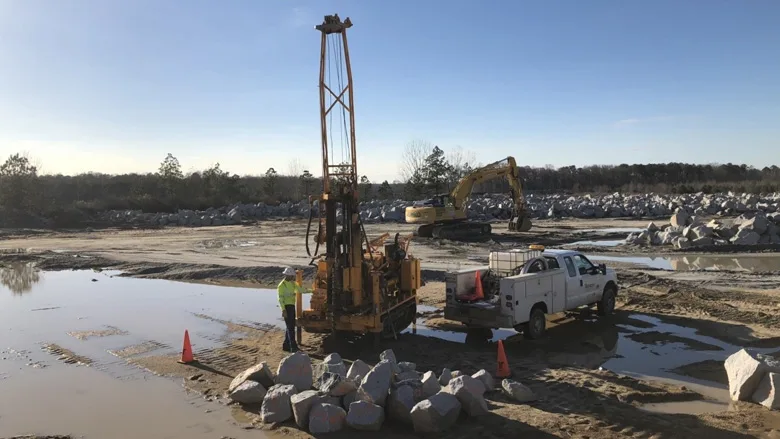
Photo
courtesy of Atlas Copco.
Drilling requirements for blasthole projects need to be carefully weighed in order to select the proper drill rig to meet all the needs of a particular operation. Considerations include:
- total drill-hole depth anticipated,
- geology and surface terrain condition,
- production requirements,
- types of explosive products to be used,
- fragmentation size requirements matched with removal equipment bucket
capabilities, and
- operating and ownership costs.
Selection of Hole Diameter
Hole diameters are matched to blasting bench heights. In general, the higher the bench height or cut to be blasted, the larger the blasthole diameter. Large blasthole diameters can accommodate more explosives, allowing for a hole pattern to be designed with wide spacing between the blastholes. This generally means lower drilling costs with fewer holes to be drilled for a given production.On the other hand, large-diameter holes and wide spacings may generate course fragmentation. For operations that use large bucket draglines or shovels, this may not be a problem. However, some quarries, as well as construction blasting applications that use small-bucket front-end loaders, require hole diameters that remain small, thereby generating finer fragments. Fine fragments, in turn, allow for efficient removal and low equipment maintenance.
There are many rules of thumb for matching hole diameter to bench height. A common method for calculating this relationship is diameter inches should be less than height in feet divided by 5. For example, the maximum drill-hole diameter for a mine that plans to develop a 60-foot bench would be 60 divided by 5, which is 12 inches.
Drilling Accuracy
Mud seams and weathered joints may cause serious borehole deviations. Deviated boreholes, in turn, often result in poorly distributed explosive energy, leading to poor fragmentation, highwall stability problems or both.Common sources of drill-hole misalignments:
- Collaring deviations, or the lateral displacement of a
hole from its planned starting point. This can be caused by the topography of
the drill site, poor drill set-up and/or the inability of the drill to hold the
boom and feed beam in a rigid position (worn pins and
bushings).
- Alignment deviations, or inaccuracies in setting the feed on which a
drill is mounted. This can be caused by instabilities of the drill rig, lack of
precision in positioning equipment, misaligning the feed boom, topography at
the collaring point and/or structural geology.
- Trajectory deviations or deviations from the designed drill path
during drilling of the hole. Factors contributing to this include hole design
(inclination, diameter, length), drill parameters (thrust, percussion,
rotation, flushing velocities), equipment (bits, rods, stabilizers, couplings,
etc.) and/or rock properties (structures, hardness, variations in rock
mass).
- Driller inexperience.
Layout and Drilling
Good drilling and blasting practices start with the accurate layout and drilling of blastholes in planned – and sometimes unplanned – locations. The location of blastholes to be drilled for a single blast rarely form a uniform, rectangular grid. Based on the performance of previous blasts nearby, geology, or production requirements, each blast layout will present new and challenging design elements.Large mining operations, which may shoot several times a day with high-capacity drilling rigs, may use global positioning satellite (GPS) technology and on-board computers to precisely position their rigs in each planned blasthole location. A planning engineer often is responsible for laying out and entering into a computer coordinates for the locations of planned drill holes. This information, in turn, is transferred to the drill rig’s computer, and the drill rig is guided by the GPS to each drill-hole position.
For smaller blasting operations with less frequency in blasting, drill holes may be laid out visually by the blaster and driller together. No computer technology is involved in these cases.
Remote Laser Profiling
The use of lasers and computer-imaging software as planning tools have advanced safe and economical drilling and blasting since the late 1980s. 3-D laser profiling allows the driller and blaster to both visualize the rock face and determine the face profile on the computer, thereby assisting them in the planning of blasthole patterns, optimum burden dimensions, and explosive loading.Equipment is used to transmit a laser beam and receive accurate position information from beam reflections for millions of points on the highwall face between the crest and toe of the bench within the bounds of the planned blast. These data are collected in some form of logger and downloaded to the computer.
In 2-D profiling, the proposed drill angle and hole offset from the crest are entered into the software, and profiles of the rock face and planned borehole are created graphically. 3-D profiling includes a survey of the actual drilled blastholes over the hole length from the hole collar, allowing for both calculation of the effect of hole deviations and computation of the explosive loading required from actual burden dimensions.
Communications
Communication between the drilling and blasting crews is essential for all good blasting operations. In operations where the drilling and blasting are performed by separate crews, the supervisors should work together closely to ensure that boreholes are drilled and loaded to design specifications, and that crews work together to identify problem boreholes.Operations where drilling and blasting are performed under the same supervisor or by the same crews are highly recommended, in that this allows both crews to work closely to maintain efficient borehole drilling and loading.
Drilling information can be conveyed from the drilling crew to the blasting crew by means of stakes placed at each blasthole. Such stakes can record useful information such as hole identification number, total hole depth, water level in the hole, backfill depth, depth of soft/hard layers, location of voids, depth of cracks, etc., that the drillers will observe during drilling operations.
ND
This article is provided through the courtesy of the U.S. Department of the Interior’s Office of Surface Mining.
Looking for a reprint of this article?
From high-res PDFs to custom plaques, order your copy today!