History Lesson
Diamond to Geotech - How Two Fields Diverge
How diamond drilling and geotechnical drilling grew from shared roots into two specialized fields
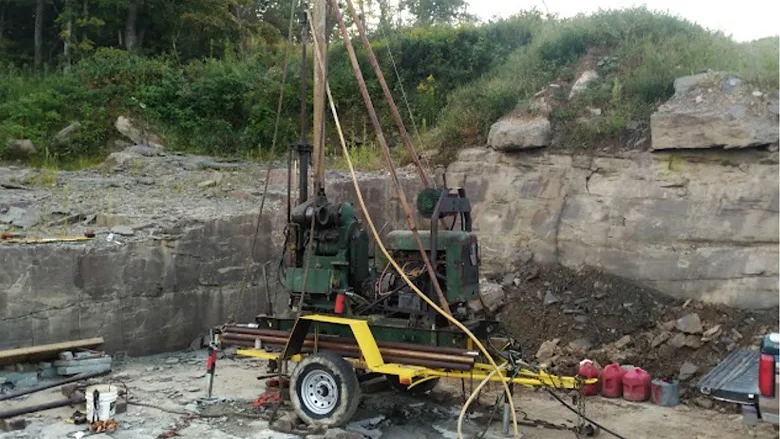
If you asked a deep-hole diamond driller whether they’d take SPT samples today, they’d probably say no unless they were also experienced as a geotech driller. But that wasn’t always the case historically. In our industry today, diamond drilling focuses exclusively on rock coring for mining operations. Geotechnical drilling focuses on using soil sampling and rock coring to gather data for the design or analysis of structures. However, if we look back over half a century, the two fields were intermixed to the point where one driller did the job of both fields.
The Early History
To understand how this occurred, the simple fact is that the geotechnical drilling field is an offshoot of diamond drilling. For over a century, core samples provided valuable data on the structural stability of underground mine workings. Therefore, it wasn’t a stretch to see core borings used to examine bedrock underlying structures. However, prior to the 1920s, no specialized soil sampling tools were commonly available. The typical procedure was to “chop and wash” and examine cuttings to get an idea of what subsurface strata were below. Of course, the samples would be badly mixed, with no reference mark for the density. In some instances, soil density could be correlated by driving a probe into the ground and taking a blow count. The scientific understanding of soil mechanics was still in its infancy.
Because of the growing need for accurate soil data, the split spoon sampler was introduced in the 1920s. Many of the firms best equipped to perform this type of work were the diamond drilling companies as they already had drills capable of rock coring, when necessary, in inventory. Additionally, these drills were often equipped with a cathead for driving casing. It was no big stretch for these firms to start performing work for the up and coming geotechnical engineering field. However, standardization was limited at the time. Sampler diameters ranged from 1” up to 4”, and drop weights from 70 lbs to 350 lbs. Over time, the procedure was more or less standardized. The standard that survives to this day is the Standard Penetration Test, utilizing a 30” free fall drop, 140 lb hammer, and a 2” outside and 1-⅜” inside diameter. The sampler was initially 18” long and drove a foot but later extended to 24” long. This soon became the standard tool for geotechnical testing.
However, utilizing rigs made for diamond drilling wasn’t necessarily the most efficient. These early rigs were primarily made for rock coring and only had 24” or 30” of spindle travel. These rigs were more than capable of gathering data on soil conditions, but before the 1960s, few rigs on the market were designed for geotechnical drilling.
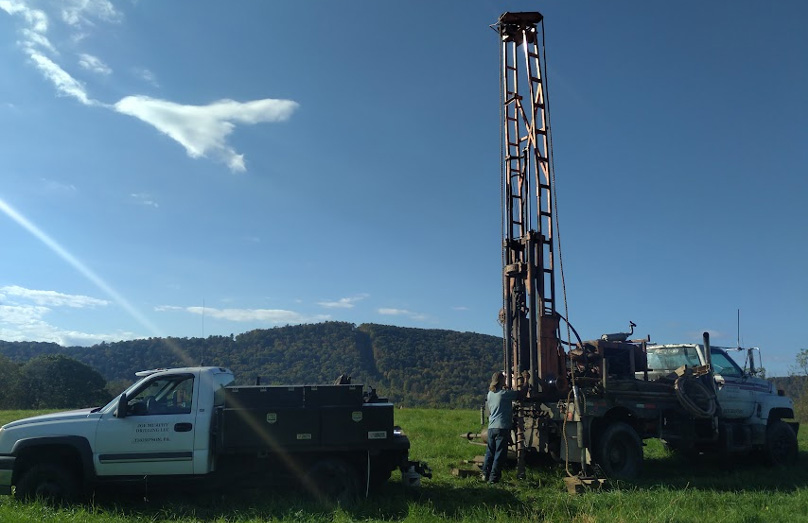
Typical style “Geotech Drill” introduced in 1960s
Photo: Rob Murphy
A New Style of Drill
During the design phase of the northeast extension of the Pennsylvania Turnpike in 1954, core drilling, auger drilling, and electrical resistivity testing were used in tandem to collect subsurface data for the design of modern “superhighways.” In a paper written after the design phase, the authors found that diamond core drills provided the most accurate information of the three methods used. However, auger drilling proved to be fastest in some types of soil. It was suggested that auger drills equipped with a derrick and cathead for driving split spoon samplers and a hydraulic feed to take Shelby Tube type undisturbed samples be introduced to benefit from the advantages offered by augers.
Drill rig manufacturers took note of these recommendations, and in the 1960s, combination auger and core drills were soon available on the market. These differed from earlier auger drills by providing means to take soil samples and having the ability to core rock when required. They also differed from exploration diamond core drills by accommodating 5ft+ lengths of tooling underneath the drill head, but with a lower maximum RPM for coring rock. While a dedicated diamond drill could easily spin a coring bit at 1000 RPM, these first geotech drills usually clocked in around 600 or so - plenty for NX coring to confirm bedrock, but not the fast production desired in diamond drills on deep holes. The reason for this trade-off was that the new geotech drills needed a high torque/low RPM gearing on the low end to spin augers, while diamond drills had been perfected for production rock coring. Essentially, one drill was specialized for one form of drilling while the other was “a jack-of-all-trades” of sorts.
The Information Desired
Also, the information desired has started becoming more diverse in each field. In diamond drilling, the objective is to find a quantity of material that will be profitable to mine. Mineral assays and other various tests were the standard information desired in this regard. Any information pertinent to engineering is secondary to this primary objective. In geotechnical drilling, the information desired is what's relevant to engineering purposes. Core samples extracted in the same manner as in diamond drills would be inspected and RQD measured. Soil samples would have blow counts taken and be classified and examined to determine the bearing capacity of the soil and how it may behave under different conditions. If any substantial earthmoving was required for a project, the information from these geotech borings could be useful for utilizing materials already available on site.
Of course, over the last half a century the geotechnical and diamond drilling fields have become even more specialized in their own fields. Now diamond drills can be disassembled and reassembled with helicopters in the most remotelocations, and geotech drills can be disassembled similarly for restricted-access work. In some instances, the geotech rigs find themselves back in the diamond drill exploration field, with faster drill heads becoming available now and diamond drills being built to accommodate 5 or 10 ft lengths of tooling under the drill head. As much as the two fields have grown to differ, the fundamental basis behind each remains the same - obtaining accurate data from subsurface samples.
Sources
- Acker, W. L. (1974). Basic procedures for soil sampling and core drilling. Acker Drill Co.
- Acker, W. (2026). Personal communication.
- Cumming, J. D. (1951). Diamond drill handbook (1st ed.). J. K. Smit & Sons.
- Murphy, J. (2019). Personal communication.
- Murphy, M. (2021). Personal communication.
- Heinz, W. F. (2007). Diamond Drilling Handbook (4th ed.).
- Purdue University. (1958). Experience with core drilling machines power auger and electrical resistivity on the Pennsylvania Turnpike (Joint Transportation Research Program Publication No. 1906). Purdue e-Pubs.
- Ross, A. E. (n.d.). Diamond drilling for coal. Sprague & Henwood, Inc.
- Sprague & Henwood Inc. (1962). Diamond-drill helper's manual. Sprague & Henwood Inc.
- Sprague & Henwood Inc. (1968). Driller's manual. Sprague & Henwood Inc.
Looking for a reprint of this article?
From high-res PDFs to custom plaques, order your copy today!