The Driller
search
cart
facebook twitter linkedin youtube
  • Sign In
  • Create Account
  • Sign Out
  • My Account
The Driller
  • NEWS
    • Water
    • Geothermal
    • Construction
    • Environmental
    • Mining
    • All Industry News
  • CLASSIFIEDS
  • EQUIPMENT
    • Rigs & Heavy Equipment
    • Consumables
    • Pumps
    • Featured Products
  • SAFETY
  • VIDEOS
    • Newscast
    • Drill Talks
    • Ask Brock
    • Emerging Drillers
  • EDUCATION
    • Drilling Business Insights
    • Reference Desk
    • Sponsored Insights
  • SOURCEBOOK
  • PODCASTS
    • The Newscast
  • SUBMIT
    • Driller E.G.O. Award
    • Drillers @Work
  • ABOUT
    • Contact
    • Advertise
  • SIGN UP
WaterSchmitt's 'Let Me Tell Ya'

Well Pits a Part of the Past for Most Drilling Contractors
By John Schmitt
John Schmitt, CWD/PI
March 1, 2015
For many of you younger readers, this subject will be historical. Perhaps some of you have had or still have experience with well pits. They are not allowed by most health codes anymore and, while they served a purpose, their banishment has been a good thing in my opinion.
Well Pits
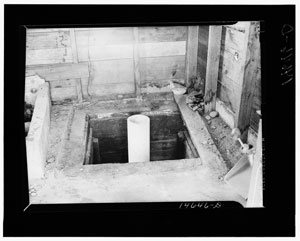
Well pits are against most health codes these days, so younger drilling contractors may not be familiar with them. Source: Library of Congress, Prints & Photographs Division, FSA/OWI Collection

The use of well pits came from a need to combat freezing temperatures here in the north country. You readers who live where it never, or seldom, freezes or gets below 32 degrees Fahrenheit probably are not that familiar with them. It is perhaps fitting that we recently experienced extremely cold weather here in southern Michigan. As I write this near the end of January, we have been through a real severe cold snap. In the last couple weeks we had daytime temperatures right at, or even a little below 0 degrees. Now that is actual temperature. Chill factors were roughly 25 degrees below zero, night time temperatures were even lower and water can’t really tell if it is day or night — all it knows is that below 32 degrees it will freeze solid, expand and break things.

As a result of these conditions, which have been around in the north country forever, people figured out a way to, in effect, beat the freeze. They dug a hole in the ground, perhaps shored up the sides, put on a roof of some sort and they had a freeze proof place. In my part of Michigan frost will go down about 3½ feet in a normal winter. It is good policy around here to bury water pipes at least 4 feet deep and I always liked to go 5 or even 6 feet deep. A driveway or even a walkway used by people will send frost below the nomal 3½ feet. In these locations — especially a driveway — a minimum of 6 feet is an effective bury depth. Strangely, north of us they experience less frost than we do in some places as they can get snow as early as late September and snow is a good insulator. I have been told by my friends in the Dakotas and Minnesota that 7 or 8 feet is a good depth to bury pipes around there.

With the knowledge of what it took to be below the frost line, people here in southern Michigan and all other cold areas began constructing well pits. This would be a space in the ground dug around the well casing. A good well pit would be 6 feet wide by 6 feet long by 6 feet deep. The walls would be constructed of good concrete block or poured concrete, the floor would be poured concrete, the roof would be concrete or perhaps metal rafters covered by some sort of weather-proof roofing. This pit would have a drain of at least 4 inches in diameter naturally coming to the surface, a couple of pipes for air circulation being 2 inches or greater diameter with U bends at the top protruding through the roof with one pipe ending near the floor of the pit and the other just below the inside of the roof. The pit would also have some sort of moisture-proof ladder below an access hatch so a workman could get down inside. An electric light or lights would be desirable, if not necessary. A pit to this design would pretty much ensure freeze-proof operation and, at risk of upsetting my public health friends, actually work pretty well.

The problem was, and still is for that matter, that only about one pit in 200 was built like this. Most were really not quite deep enough or large enough, so the pumping equipment was crammed into too small of a space. Almost none had an adequate drain. Usually these were plugged up or never did work. In an attempt to get around a drain some people constructed these pits with a sump and then installed a sump pump. This was probably OK most of the time, but if the sump pump failed or the power went out we had, in effect, a small swimming pool. Most of the roofs were inadequate, leaky and rotten. Most every one of these had a poor ladder for getting down inside. A favorite of many owners was to place a wooden step ladder under the access hatch. Over time moisture would rot these ladders and many, many times in my career I went through a rotten rung on a ladder but, fortunately, was never hurt really badly when this happened.

One of the major drawbacks of a well pit, though, was the moisture that I just wrote about — condensation on walls, roof and anything inside was a real problem. When the industry used surface pumps like piston, rod or jet pumps, this did not seem to be a huge problem. When the motors on these pumps ran they created some heat and their cooling fans dried them out. When the submersible pump became popular there was no heat at the surface and no fan either. Three-wire pumps, which used a control box, were especially vulnerable to condensation but pressure switches, starters and disconnect switches were also badly affected by moisture. There was really no way other than, perhaps, a dehumidifier to keep the inside of the well pit dry and I never saw one of these installed, ever.

Some of the other drawbacks of these pits were freezing when the access hatch was left open and, as I said, difficult access by the service man. The worst drawback was they tended to flood, sending contaminated flood water down the well casing even if it was equipped with a so-called sanitary well seal. Because these pits were relatively warm and cozy, they became the winter home of assorted squirrels, chipmunks and, yes, snakes. Homeowners also figured out that this was a great place to store potatoes, carrots, onions and other vegetables they had grown in their garden. With this storage, many times a service call turned out to be a trip to the vegetable department … and a smelly one too. While banned by most public health codes, I believe most of these pits are now considered confined spaces and illegal under OSHA rules. That, friends, is a good thing. If I never have to go into another well pit — and yes we still have some — it will be too soon.

I included my monthly weather report earlier, so I will end on the comment that next month I will talk about some so-called innovative ways to make well pits. In the meantime, work safe and stay out of these darn things if at all possible.


For more John Schmitt columns, visit www.thedriller.com/schmitt.

KEYWORDS: water well drilling well drilling

Share This Story

Looking for a reprint of this article?
From high-res PDFs to custom plaques, order your copy today!

John schmitt 200px
John Schmitt is a former Certified Well Driller/Pump Installer with decades of water well experience.

Recommended Content

JOIN TODAY
to unlock your recommendations.

Already have an account? Sign In

  • geotechnical drilling rig

    6 Onsite Phrases Environmental Drillers Hate

    Here are six phrases that highlight common frustrations...
    Opinions
    By: Jeff Garby
  • Wayne Nash

    Pipe Stuck? Common Causes and Solutions for Drillers

    If you have drilled for any length of time, sooner or...
    World According to Wayne
    By: Wayne Nash
  • deep water well

    Selecting and Sizing Submersible Pump Cable

    This article helps pump installers and servicers decide...
    Water
    By: Bob Pelikan
You must login or register in order to post a comment.

Report Abusive Comment

Manage My Account
  • Newsletters
  • Online Registration
  • Subscription Customer Service
  • Manage My Preferences

More Videos

Sponsored Content

Sponsored Content is a special paid section where industry companies provide high quality, objective, non-commercial content around topics of interest to the The Driller audience. All Sponsored Content is supplied by the advertising company and any opinions expressed in this article are those of the author and not necessarily reflect the views of The Driller or its parent company, BNP Media. Interested in participating in our Sponsored Content section? Contact your local rep!

close
  • truck-mounted 3100GT drilling rig
    Sponsored byGeoprobe

    Equipment That Helps Solve Your Workforce Problem

  • Star Iron Works  sales team
    Sponsored byStar Iron Works, Inc.

    Using the Experience of Long-Term Employees to pass on Dedication, Tradition, and Legacy

Popular Stories

An image of a manhole

Elon's Boring Co. Fined Nearly $500K for Illicit Drilling Fluid Dumping

An image of a house with efficient energy

Unlocking Geothermal Power Everywhere

The Driller Newscast episode 153 - Boots on the Ground to Loops in the Ground: A Veteran's Geothermal Career

Boots on the Ground to Loops in the Ground: A Veteran's Geothermal Career

The Driller Classifieds

COMPRESSORS

EAST WEST MACHINERY & DRILLING IS BUYING AND SELLING AIR COMPRESSORS, AIR BOOSTERS, AIR ENDS & PARTS
Company: East West Machinery

DRILL RIGS

LOOKING FOR LATE MODEL TOPHEADS & DRILLTECH D25'S
Company: Spikes’s Rig Sales

DRILL RIG PARTS

MEETING DRILLERS NEEDS AROUND THE WORLD
Company: East West Machinery

ELEVATORS

SEMCO INC. PIPE ELEVATORS
Company: Semco Inc.

GROUTERS

GROUTING EQUIPMENT - GROUT PUMPS & GROUT HOSE REELS
Company: Geo-Loop Inc.

PUMP HOISTS

SEMCO INC. - BASIC PUMP HOISTS
Company: Semco Inc.

WELL PACKERS

LANSAS PRODUCTS - INFLATABLE WELL PACKERS
Company: Vanderlans Lansas Products

WELL SCREENS

WELL SCREENS & SLOTTED PIPE
Company: Alloy Screen Works

Products

Water Quality Engineering: Physical / Chemical Treatment Processes

Water Quality Engineering: Physical / Chemical Treatment Processes

By carefully explaining both the underlying theory and the underlying mathematics, this text enables readers to fully grasp the fundamentals of physical and chemical treatment processes for water and wastewater.

See More Products

The Driller EGO award - Tell Us Who's Making An Impact in the Field

Related Articles

  • John Schmitt

    The Most Important Part of a Spudder Drill String: The Drill Bit

    See More
  • John Schmitt

    For Drilling Contractors, Equipment Upkeep Can Be a Point of Pride

    See More
  • John Schmitt

    Residential Well Houses – A Step Forward from Well Pits – Maybe

    See More

Related Products

See More Products
  • M:\General Shared\__AEC Store Katie Z\AEC Store\Images\ND\new site\water-and-wastewater-treatm.gif

    Water and Wastewater Treatment: A Guide for the Nonengineering Professional, Second Edition

  • M:\General Shared\__AEC Store Katie Z\AEC Store\Images\ND\new site\water-well-pumps.gif

    Audel Water Well Pumps and Systems Mini-Ref

  • M:\General Shared\__AEC Store Katie Z\AEC Store\Images\ND\new site\modern-well-design.gif

    Modern Well Design: Second Edition

See More Products

Related Directories

  • Western Hydro

    Serving the Western region of the United States since 1977, Western Hydro is a wholesale supplier of drilling supplies, well service equipment, water pumps and accessories, and water treatment and wastewater handling equipment. Western Hydro aims to serve contractors with the highest quality, most competitively priced products, coupled with support and service second to none.
  • Headwater Wholesale

    Headwater Wholesale is a distributor to the groundwater industry focused on providing contractors with unparalleled quality, service, and support. With locations throughout the central United States, contractors trust Headwater Wholesale to have the supplies they need in-stock and ready for the job site. At Headwater Wholesale our goal is to be your first choice for all your water well, irrigation, water well drilling, water treatment and wastewater needs.
  • Groundwater Supply Co. Inc.

    A family-owned business, opened in 1992, located in Central Mass. We are a wholesale supplier and source for Water Well, Environmental, Geothermal, Geotechnical and Construction drilling. We represent many manufacturers and have most everything you could possibly need for your drilling project.
×

Dig deeper into the drilling and water supply industry!

Build your knowledge with The Driller, covering the people, equipment and technologies across drilling markets.

SIGN UP NOW
  • RESOURCES
    • Advertise
    • Contact Us
    • Directories
    • Store
    • Want More
    • Classifieds
  • SIGN UP TODAY
    • Create Account
    • Newsletters
    • Customer Service
    • Manage Preferences
  • SERVICES
    • Marketing Services
    • Reprints
    • Market Research
    • List Rental
    • Survey/Respondent Access
  • STAY CONNECTED
    • LinkedIn
    • Facebook
    • YouTube
    • X (Twitter)
  • PRIVACY
    • PRIVACY POLICY
    • TERMS & CONDITIONS
    • DO NOT SELL MY PERSONAL INFORMATION
    • PRIVACY REQUEST
    • ACCESSIBILITY

Copyright ©2025. All Rights Reserved BNP Media.

Design, CMS, Hosting & Web Development :: ePublishing