U.S. and Mexico Finalize Historic Deal to End the Tijuana River Sewage Crisis
As part of the deal, Mexico agreed to begin construction immediately on two long-delayed priority projects.
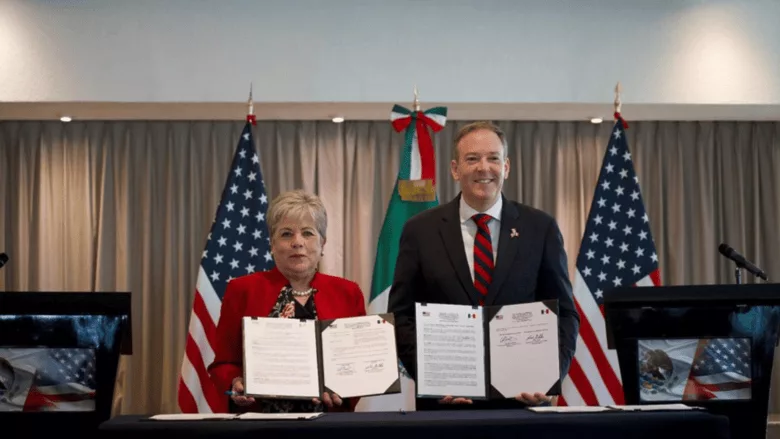
Image Courtesy of EPA.gov
In what is being described as a “massive environmental and national security win,” the United States and Mexico have reached a landmark agreement to permanently address the Tijuana River sewage crisis—a decades-old public health disaster that has long plagued both sides of the border.
Speaking from Mexico City at the Council of the Commission for Environmental Cooperation (CEC), U.S. Environmental Protection Agency Administrator Lee Zeldin signed a Memorandum of Understanding (MOU) with Mexican Secretary of the Environment and Natural Resources Alicia Bárcena Ibarra, marking what could be the most aggressive and coordinated binational action ever taken to stop the flow of raw sewage into Southern California from Mexico.
“For far too long, raw sewage has been flowing into our country, closing beaches, fouling the air, and endangering communities,” Zeldin said. “The Trump Administration is proud to deliver this massive environmental and national security win for Americans in the San Diego area.”
The agreement accelerates the completion of critical Mexican infrastructure projects outlined in the U.S.-Mexico Minute 328, obligates $93 million in previously uncommitted Mexican funds, and mandates a new joint commitment—by December 31, 2025—to expand the scope of sewage control projects beyond the original framework.
The Tijuana River Valley has long suffered from untreated wastewater flowing north from Tijuana, often leading to beach closures, illness, and economic harm in California’s coastal cities. The issue became a central point of concern during Zeldin’s visit to San Diego in April, when he met with residents, local officials, Navy SEALs, and toured the border region by helicopter.
“In April, I visited San Diego to meet with local community members, elected officials, and residents who have been dealing with the consequences of this crisis for decades,” Zeldin said. “I made a commitment to the residents that I would spearhead an effort to construct an all-encompassing plan to finally bring the sewage crisis to an end.”
Fast-Tracking Solutions
As part of the deal, Mexico agreed to begin construction immediately on two long-delayed priority projects:
The diversion of 10 million gallons per day (MGD) of treated effluent from entering the Tijuana River
The rehabilitation of the Parallel Gravity Line, a vital pipeline for wastewater transport
Both projects are scheduled for completion by December 31, 2025, and are intended to sharply reduce river contamination levels within the next 18 months. The United States, in turn, has agreed to release EPA Border Water Infrastructure Program (BWIP) funds to upgrade key components of its system, including the rehabilitation of Pump Station 1 and Tijuana River collection pipes.
Zeldin also announced that the South Bay International Wastewater Treatment Plant (SBIWTP), managed by the U.S. International Boundary and Water Commission (IBWC), will complete its capacity expansion from 25 to 35 MGD by August 28, 2025—a project originally expected to take years, now on track to be completed in just 100 days.
The agreement is not just about short-term relief. It also accounts for projected population growth in Tijuana, long-term operation and maintenance, and further commitments under a new Minute agreement to be drafted by the end of the year. This new agreement will include “at minimum, one dozen new actions” the U.S. has identified as necessary to permanently end the crisis.
“This is not just a solution for 2025,” said Zeldin. “We devised this agreement to factor in population growth, operation and maintenance costs, and other variables that would make this solution durable and long term.”
Zeldin credited Mexican President Claudia Sheinbaum, Secretary Bárcena, and the Mexican Ministry of Foreign Affairs for their “partnership, cooperation, and commitment.” He also highlighted the behind-the-scenes work of U.S. Secretary of State Marco Rubio, the National Security Council, and White House leadership in helping negotiate the final terms.
Both nations have committed to reviewing all project timelines within 100 days to ensure infrastructure development is occurring “on the shortest possible timelines.”
“This is a huge win for millions of Americans and Mexicans who have been calling on us to end this decades-old crisis,” Zeldin said.
The signed MOU promises a full resolution by December 31, 2027, though both governments say several key deliverables will be completed as early as this year.
As of now, for communities on both sides of the border long burdened by pollution, closed beaches, and the stench of untreated sewage, that finish line finally appears within sight.
Looking for a reprint of this article?
From high-res PDFs to custom plaques, order your copy today!