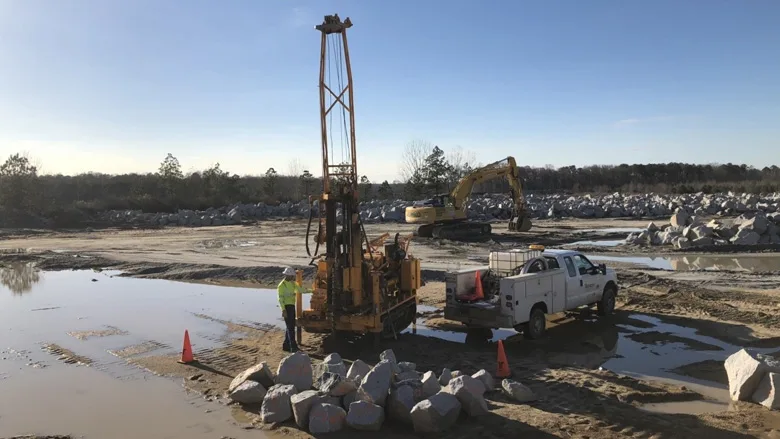
Air-drilling Trends: A Q&A with Schramm's Hillier

I recently had the opportunity to speak with Greg Hillier, product manager at Schramm Inc., and he was kind enough to share his thoughts on some of the latest goings-on relative to air drilling.
Give us a little background to get us started.
“Schramm started out as an air compressor manufacturer back in 1900. We built compressors for a variety of applications, and in the 1950s, we started mounting compressors onto drilling rigs to be used in blast-hole coal-mining applications. These drilling rigs were very easily adaptable to water well drilling, and were an improvement over the cable-tool technology in vogue at the time, offering increased production and efficiency. As time went on, we started to apply rigs in mineral exploration, environmental drilling and, most recently, in the oil and gas drilling markets. It’s been a natural progression for air drilling as it has expanded into a variety of different markets.”
Geologic conditions usually determine whether fluid or air is the best option for drilling operations.
“A recent trend is to have combination mud-and-air-rotary rigs that have big on-board compressors and mud pumps on the rig. You might be in an area where the well can’t be completed in the glacial surface formations. Sometimes, surface conditions don’t allow for air drilling. You need fluid to get through those tough boulders and gravel and all that. Then ultimately, you get to a hard bedrock formation, and to try to drill through that with fluid is very slow, so you want those high-pressure compressors on board to be able to effectively drill the hard rock. So you use the mud pump on the surface to drill through the unconsolidated formation to set a casing. Once the casing is set and you’re into a consolidated formation, you just switch over to air for the flushing medium, and you might run a tricone or down-hole hammer. Mechanically, it’s very simple – often just a matter of moving a hose from one discharge to another.
Can the reverse happen?
“In oil and gas applications, that’s not uncommon at all. You start with air because there aren’t any problems with surface conditions. You want to get down to a certain depth as fast as you can, and then when you get to where the oil or gas formations are known to exist, you use the fluid because it’s a more stable medium and will prevent uncontrolled blowouts of high-pressure gas.”
On the horizon, where will technological advances manifest themselves in regard to air drilling?
“Probably in the controls that manage the compressor systems. Traditional compressor control has been accomplished using air piloting – air signals telling the compressor to make – or stop making – air. Today, electronic controls can be used, which eliminate the air pilot lines and minimize the chance of control line freeze-up. That’s a big issue with any compressed-air system in cold-weather climates. The biggest maintenance and service nightmare is trying to keep all those control lines from freezing. When trying to run an air compressor in a cold climate, a lot of time often is spent thawing out control lines. With the electronic system, there are no more regulators to freeze up, no more air controls and pilot lines to freeze up, and no more small air filters that are prone to freezing.
Traditionally, oil and gas drilling has been a fluid-drilling business. To hear it from a Texas oilman, the only way to drill an oil well or a gas well is with fluid. Out east, particularly in the Appalachian basin, there is a huge amount of gas well drilling being done, and the majority of that is being done 100 percent by air. The Marcellus Shale formation is bringing lots and lots of western-Texas-oil mentality to that region, but they’re starting to grasp the idea of doing the surface drilling with air and then doing the bottom-hole drilling with fluid. Had they not had the experience of the locals brought to their attention, they probably would have done the drilling with fluid from start to finish. So it’s catching on.”
So much of air drilling is dependant on the compressors. Where are we at today?
“Compressors are rated by their output, which is volume and pressure. Over the last 20 years, we’ve seen compressors go from an average of about 500 cubic feet per minute up to as much as 1,350 cubic feet per minute. And the pressure capabilities of those compressors go up to 500 psi. A common air compressor on a typical water well rig is 1,050 cfm at 350 psi. By the standards of the ’70s and ’80s, that’s a monster compressor. These advances must go hand-in-hand with the down-hole equipment. It doesn’t do you much good to have a compressor that has some incredible volume and pressure capability if the tools it’s going to operate can’t handle it.
With the air-control systems, you can tailor the output of the compressor – both its volume and its pressure – to the tools in the ground. When we mount a compressor on a rig, it has a certain capacity, and depending on the hammer or bit that’s in the ground, and the diameter of the hole that’s being drilled, you may or may not need all the compressor’s volume. In the past, excess volume and pressure capability would go to waste, and waste is inefficiency and inefficiency is fuel. If your up-hole velocity is too high, it accelerates the wear on all the down-hole tools. The electronic controls available today will allow the compressor to be infinitely dialed in to the down-the-hole tools being used. They’ll only produce as much air and as much pressure as that tool that’s in the hole asks it to. The benefits of that: The best possible fuel performance, the best-possible penetration rates and the best possible service life of all the equipment involved. Having these control systems that maintain the correct volume helps everything last longer.”
ND
Looking for a reprint of this article?
From high-res PDFs to custom plaques, order your copy today!